Media: 2025
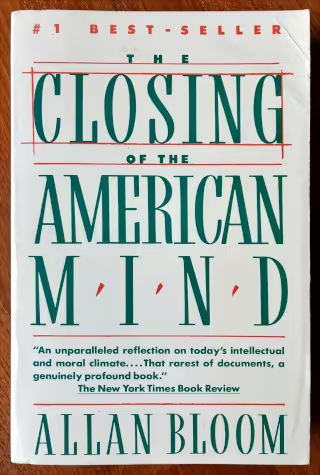 The Closing of the American Mind by Allan Bloom, 1987
392 pages. Simon & Schuster; Trade.
ISBN: 0-671-65715-1
I had heard of this book, but wasn't terribly familiar with its contents. It lived up to my expectations (a defense of classical liberal education) and also exceeded them in its extraordinary depth and density of thought. Practically every sentence is a fully-formed idea worthy of consideration. I found myself stopping frequently to parse out what a long, compound sentence might be saying, and without exception found the effort worthwhile. In my experience, authors typically write this tersely when they wish to obscure something. Bloom is just the opposite: digging into his crystallized prose instead reveals exactly the profound ideas he wishes to relate, often with broad application. For example, speaking of the ideas of John Locke and Adam Smith (p. 210):
|
"When the liberal, or what came to be called the utilitarian, teaching became dominant, as is the case with most victorious causes, good arguments became less necessary; and the original good arguments, which were difficult, were replaced by plausible simplifications — or by nothing." |
Bloom refuses to gloss over his ideas with such heuristical thinking, and invites the reader to delve into his ideas and really think about them. At nearly 400 pages, this can get tiring, and I found his propensity to not only refer to introduced subjects as former/latter, but to refer back to his own arguments by label rather than idea, a little tedious. In computer science terms, he tends to call by reference rather than value. But the ideas are so fully formed in his own mind, I suspect he doesn't notice how much harder it is for those not already familiar with them. At any rate, it doesn't appear he is trying to pull one over on the reader, but simply and genuinely wishes to avoid repeating himself.
I spent better than a week reading the book, and took a long pause for Thanksgiving, so by the end (there being so much to digest) the overall thrust of the narrative had become a bit unclear to me. Part Two (Nihilism, American Style) is a long diversion into the philosophy of Socrates and Plato; Nietzsche and Rousseau; 19th- and 20th-century German thought in general; and the key difference between the primacy of idea or of action. How this relates to changes in the American university is picked up in the third part, but by the time I'd gotten there I was a little fuzzy on some of the connections. I'm sure Bloom could have done a semester course on the topic without ever fully plumbing its depths.
The Closing of the American Mind is not an easy read, but a thought-provoking one, contending with fundamental ideas and applying them to concrete circumstances. It makes me want to read (and really grapple with) more Plato, Hobbes, Locke, Mill, Kant, Nietzsche, Rousseau, and others. Bloom takes firm stances on a number of issues on which thoughtful minds disagree, but is rigorous in presenting his reasons. Recommended if you find this intriguing.
 She by H. Rider Haggard, 1886/87
181/670 pages. Walter J. Black; Hardcover, 1928.
No ISBN
[the full volume comprises Cleopatra, She, King Solomon's Mines, and Allan Quatermain]
In Victorian England, Ludwig Horace Holly, a nascent Fellow at Cambridge is approached by his only real friend, a rich widower dying of tuberculosis, who begs Holly to raise his five-year-old son, Leo, in exchange for a generous allowance. He also gives over an iron box, and leaves strict instructions that it should only be opened on his son's 25th birthday, as it contains details of his ancient ancestry and a quest he may choose to fulfill. Of course, this all comes to pass, the box is opened twenty years later, and is found to contain a Greek potsherd covered with messages from the past two thousand years or so, along with translations. The fantastic story is that Leo's ancient forebear, Kallikrates, a priest of Isis, broke his celibacy vow to marry Amenartas, an Egyptian princess, then fled with her from the Pharaoh's wrath. They were shipwrecked and ended up in an unknown land in southeastern Africa, and were taken by wild men to their queen (Ayesha, She-who-must-be-obeyed), an undying sorceress of surpassing beauty. This queen fell in love with Kallikrates and offered him the same perpetual youth if only he would kill Amenartas. He refused, so Ayesha slew him in anger, but could not kill Amenartas, who was protected by her royal birth, and instead sent her away. Amenartas arrived in Athens and gave birth to a son, and ever since an unbroken line of male heirs has passed down the tale until one of them should take revenge and slay the ever-youthful queen.
Haggard gets a lot of things right: the verisimilitude of (for example) presenting the full text of the potsherd in various languages, which convinces the characters of its authenticity, the mystery of an undiscovered civilization just barely plausible given the setting, and the presentation of the story as a surviving memoir of the journey. Unfortunately his narrator, Holly, also goes on some extended speculations into the nature of the universe, life, and death. The writing is not the best, but it is made up for in the mythic feel of the tale. Its influence is obvious in later stories like the Indiana Jones chronicles. But I also sense it in the works of J. R. R. Tolkien, where Galadriel has a magic seeing-basin, and refuses to accept the One Ring and become like She — "all shall love me and despair!" I think Michael Crichton blends verisimilitude and fantasy in a very similar manner, and in my opinion even more effectively.
She is definitely a Victorian novel: the overpowering sex appeal of She-who-must-be-obeyed is seen only in its effects on the men who behold her, and is never made explicit. And the British imperial attitude of noblesse oblige in civilizing the darker races is apparent throughout, with skin tone mapping more or less isomorphically with savagery. She is herself an undiluted Arab, but white as any Englishwoman. Yet taking the book as an artifact of its time, I suppose it would be more surprising if these peculiarities were absent.
Story-wise, there's an interesting undercurrent: She is tormented at having slain the one she considers her only true love, and is anxiously awaiting his reincarnation. Millennia of self-recrimination and brutality toward her subjects has warped her into a monster, though her beauty remains. She has deified Eros — the undying loyalty to her lover that will endure any hardship — and surrendered whatever humanity she might have had in pursuit of her single-minded obsession.
Not a perfect book by any stretch, but nonetheless recommended.
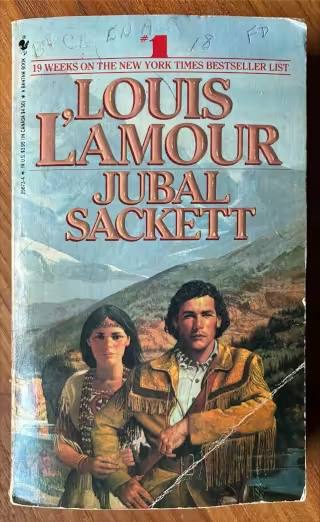 Jubal Sackett by Louis L'Amour, 1985
338 pages. Bantam Books; Paperback, first printing.
ISBN: 0-553-25673-4
Yet another Sackett family novel, this time following the patriarch Barnabas' more introspective and bookish son, Jubal, on his adventures seeking what is west beyond his Carolina mountain home. He forms a loose partnership with a Kickapoo wanderer, meets a Natchez medicine man, and agrees to carry a message to a princess who has left to seek out new lands for the Natchez in the west. Her spurned suitor vows to beat him to her and take her for his own, and along the way he meets friends and enemies, both native and European. There are the benign-to-friendly Quapaw and Ponca, Tensa mercenaries, ruthless Comanche, and both noble and self-serving Spaniards. There are almost too many plot lines running at times, with multiple dangers and threats to consider, some of which finally peter out. As with Sitka, I suspect L'Amour may have had plans for a fuller novel that he just had to wrap up at some point. And rather than cut out the stray storylines and fill in the gaps, he emphasized others and let their resolution carry the weight of the narrative. But that's a complete guess. He might also just be going for realism: not everything one runs into in life is meaningful or leads to anything. Also, this leaves plenty of hooks for future stories. As to quality, I'd put Jubal Sackett somewhere in the low middle for L'Amour stories, but it's an entertaining enough read. If you like the genre, I give it a mild recommendation.
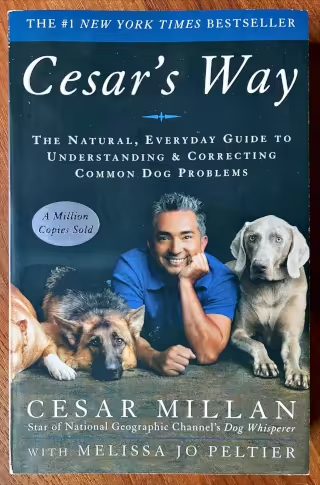 Cesar's Way by Cesar Millan, 2006
298 pages. Three Rivers Press; Trade, first printing.
ISBN: 978-0-307-33797-9
This is the first book by TV's "Dog Whisperer", Cesar Millan, and principally concerns developing appropriate attitudes and interactions between humans and dogs, what Cesar labels "energy". I found a lot of things that agreed with my own experience of dealing with rescue dogs, only a few that I questioned, and learned a lot of valuable insights that I hope will help me in interacting with dogs in the future.
The big take-away from the book is that humans must radiate calm-assertive energy so their dogs can relax into calm-submissive energy, and let the humans be the pack leaders. Beyond this, Millan sees exercise, rules, and affection — in that order — as the indispensable way to fulfill the dog's needs. He notes that Americans in particular emphasize just affection, leaving dogs without clear boundaries or adequate activity, and leading to all manner of issues. He reminds us that dogs are not little humans, and have a different psychology that has different requirements. All of it is presented in an accessible, well-considered format.
The only thing I can add is to underscore his insistence that the human take seriously the role as pack leader. I had a foster dog (Rudy) that, while small and cute, was naturally very dominant. It was not sufficient for me to go through the motions of laying down rules and sticking to them. I had to believe in my core that I was in charge. When he challenged me, I couldn't merely correct him, I had to exude the attitude that he'd done something unthinkable, like a newly-minted corporal walking into the war room to school the Joint Chiefs on how to manage the military. And then I had to correct him and follow through consistently. Granted, not all dogs need this level of discipline, but it works on all of them, and does no harm. I was glad to hear I'd done at least some things right, even as I learned about things I'd messed up. For anyone with a dog or thinking about getting a dog, highly recommended.
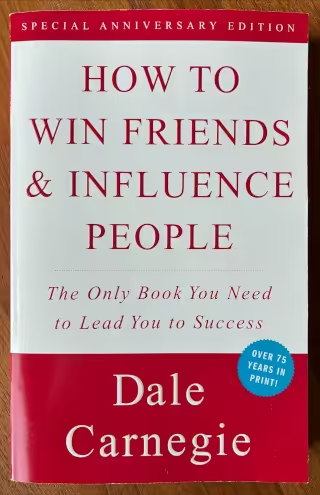 How to Win Friends and Influence People by Dale Carnegie, 1936
260 pages. Gallery Books; Trade, 35th printing.
ISBN: 978-0-671-02703-2
The 1936 classic, updated in 1981 by Donna Dale and Dorothy Carnegie, still seems as relevant as ever. Due to my own ignorance, I'm not sure how close it hews to the classical art of Rhetoric, but it seems to me to fill the same gap, one which continues to be under-emphasized in education. It is an easy read, methodically presented to hammer home maxims for interpersonal relations and persuasion. Some of the examples are dated, or of questionable provenance, but still illustrate the concepts, which I believe to be reliable regardless of the veracity of the anecdotes. I found it a worthwhile read just to bask in the attitude it presents — one quite different than one might naturally exhibit. Above all, it seems to advise humility and cooperation whenever possible, success over vindication. Good advice for any age. Highly recommended.
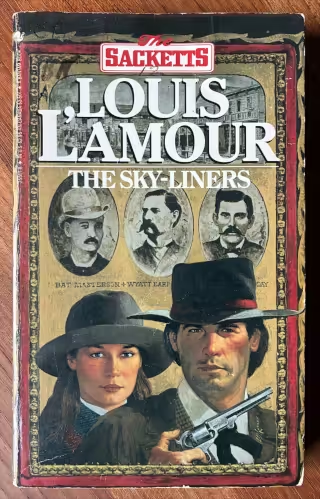 The Sky-Liners by Louis L'Amour, 1967
188 pages. Bantam Books; Paperback, 24th printing.
ISBN: 0-553-25511-8
A fairly convoluted, meandering tale of the old west, I'd guess around the 1880s, from Tennessee to New Mexico. A couple of Sackett brothers head back to Tennessee to settle up an old debt of their father's, but run afoul of James Black Fetchen and his gang. They stare them down and think nothing more of it, since they're headed back west, never to see Tennessee again. But they learn from Irish horse traders that Fetchen is trying to kidnap a young girl, whose father wants her returned to him in New Mexico. Between the generous offer to see her there, and their reluctance to leave her to the predations of the malevolent Fetchen, they agree. For reasons that aren't revealed for some time, and not entirely clearly, the Fetchens and their gang follow the Sacketts west, turning outlaw, rustling cattle, robbing and killing as they go. The Sacketts must survive, try to get the girl to her father, and deal with a host of complications along the way... and maybe get the girl... and a random señorita. The penultimate battle with the Fetchen gang seems needlessly complicated and hard to follow. There are cameo appearances by Bat Masterson, Wyatt Earp, Doc Holliday (misspelled Halliday) and some lesser-known western figures, but they amount to little more than name-dropping. There are also tie-ins with other Sacketts novels. I found this book less satisfying than L'Amour's more straightforward westerns. Not recommended unless you're really into the series.
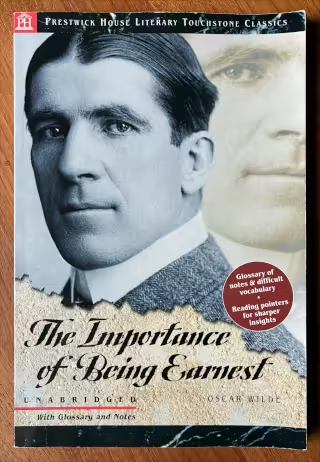 The Importance of Being Earnest by Oscar Wilde, 1895
75 pages. Prestwick House; Trade, 2005.
ISBN: 978-1-58049-580-6
An extremely short book (indeed, a play) that I'd heard of with some regularity, but never actually read. Apart from ordinary laziness, this may also have been due to some hesitancy about its author. In college, people who raved about Oscar Wilde tended to delight in his reputation as a libertine, homosexual, and general thorn in the side of respectable society. As an undergraduate in Portland during the Reagan and Bush years, I was in no need of additional sources of this kind of criticism. I associated Wilde with the kind of easy cultural criticism you'd get from NPR, and was well aware of how its proponents could gush about tepid and unimaginative products such as the Prairie Home Companion. It felt like I'd heard all this before, and would find it tedious.
Boy, was I wrong. This is a delightful little play, pithy and full of surprising word play. It immediately reminded me of works perhaps influenced by it, such as P.G. Wodehouse's novels and Samuel Beckett's Waiting for Godot. It's a silly, convoluted romp, and indeed pokes a great deal of fun at Victorian gentry. But it does not rely on the reader's prior inclusion in the deriders' club the way so much modern satire does. I'm thinking of The Daily Show, Family Guy, just about all the late night comics, and yes, anything on NPR. In Earnest, you laugh at the silly people because they're silly, not because you already hate them for being aristocrats. No prior disdain is required. Indeed, no accusation more pointed than being unacquainted with the struggles of the lower classes is made. The gentry aren't portrayed as oppressive devils, but as objects of bemused mirth for being so woefully out of touch, so completely unaware that their lives of leisure are built upon an artificial infrastructure which need not endure. They are unaware and unconcerned that their experiences are largely divorced from reality.
As to the particular volume, it appears to be a reprint by a scholastic press, for use by small or home schools. Oddly, the discussion questions precede the text, and reference quotes without important context. The glossary of archaic and difficult words includes more than I'd expect for an adult audience, and sometimes the definitions don't carry a word's full connotation. But you can, of course, simply skip these and enjoy the text as written. Highly recommended.
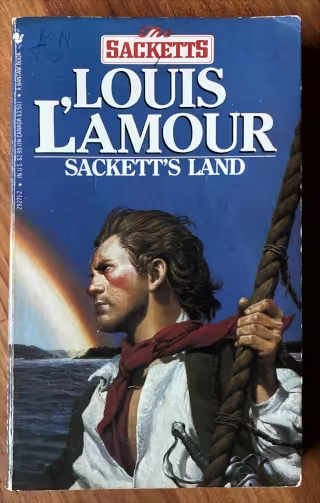 Sackett's Land by Louis L'Amour, 1974
185 pages. Bantam Books; Paperback, 20th printing.
ISBN: 0-553-25271-2
Part of the beloved Sacketts series, this volume concerns the patriarch Barnabas Sackett, from the fens of Cambridgeshire, England, beginning in 1599. Having stumbled on a small fortune (to him), a few ancient coins, Barnabas seeks out an antiquarian dealer and sells a couple of them. The dealer knows of a buyer for the remainder, and offers to broker a deal. Unfortunately, our hero runs afoul of a hot-headed gentleman who takes offense at him offering his thirsty lady a ladle of water. A scuffle ensues in which the gentleman is disgraced. He vows revenge. If this weren't enough, the gentleman discovers his uncle, Earl Robert, is contemplating leaving his estate to the unlikely Sackett, due to Sackett's father having saved his life in the wars. While evading the nephew's minions, Barnabas comes up with plans to find and sell more antiquities, buy up trade goods, and sail to America to trade for furs. He has it just about lined up, when the Earl's nephew has him kidnapped and pressed into service on a ship bound for... America. He must keep from being killed en-route (as the captain promised), escape his captivity, make his fortune, return to England, save the ailing Earl ... and get the girl. Yes, it's very L'Amour. There are way too many just-so coincidences that make the story flow nicely, and a good deal of expounding on the land of freedom that Barnabas foresees America will one day represent. There are no difficult moral decisions to make, only decisions between boldness and trepidation. Still, it's a fun story, reiterating themes that run throughout L'Amour's canon (the moral prevail in the end, boldness is rewarded, industriousness leads to success), but nothing much deeper than that. Lightly recommended.
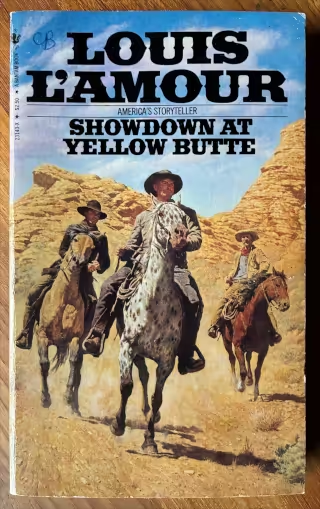 Showdown at Yellow Butte by Louis L'Amour, 1953
181 pages. Bantam Books; Paperback, 3rd printing.
ISBN: 0-553-23143-X
Originally published under the pseudonym Jim Mayo. A decent tale of deceit and payback in the desert of what is today part of the Navajo Nation in northwestern New Mexico. Tom Kedrick, a Civil War veteran and subsequent soldier of fortune, is hired to help run off some squatters from swampland (!) prior to its sale to his employers by the Federal government. On arriving he finds no New Mexico swamp, hard-working families with as much claim to the land as his employer, and a rabble of various shades of outlaw as his crew. He quickly determines he wants no part in the deal, but knowing what the company will do without him in charge, seeks to broker a settlement to avoid bloodshed. Betrayed by the company and on the run, Tom has to thwart his former employers, save as many pioneers as he can, and live long enough to testify (and maybe get the girl). An obscure figure riding a grey grulla horse seems to hover at the edge of it all, defying identification. All in all, a good story with typical L'Amour good, bad, and in-between characters. The grulla element is intriguing, but doesn't ultimately deliver on the suspense of its build-up. I'd place this book somewhere on the lower end of the L'Amour canon, but at 181 pages, it's a quick and entertaining read. Mildly recommended.
 Atomic Habits by James Clear, 2018
306 pages. Avery Books; Hardcover, 40th printing.
ISBN: 978-0-735211-29-2
My wife got this book from the library-on-a-stick, since she'd heard about the author on a podcast. It's a crisp, succinct summary of a lot of data regarding, and techniques for manipulating, habits. It reminds me a bit of (and the author cites) Scott Adams' (the Dilbert guy's) advocacy of systems over goals. It starts with the notion that small, consistent improvement is far more powerful (and psychologically sustainable) than pursuing lofty goals. Like compound interest, it accrues over time and builds upon itself. The author posits a concentric model where identity is the core, surrounded by process, and finally outcomes. He champions working at the process level to both produce outcomes and inform identity. That is, performing processes produces the outcomes you want, but also convinces you that you match the identity you are pursuing. He maintains that becoming that kind of person should be your focus, rather than particular goals.
The rest of the book is spent filling in details about a model of habit formation and perpetuation. The basic model is the sequence: cue, craving, response, reward. You can manipulate this habit model by encouraging or discouraging at each point, depending on whether you want to promote or resist the habit:
| Cue | obvious | vs. | invisible |
|---|---|---|---|
| Craving | attractive | vs. | unattractive |
| Response | easy | vs. | difficult |
| Reward | satisfying | vs. | unsatisfying |
Techniques for cues include modifying your environment, stacking new habits on old, and fleeing temptation by avoiding bad habit cues.
For cravings, you can bundle a desired habit with an old rewarding one, invert a bad habit's expectation of a reward, or join a group that values the habits you want to adopt. We imitate those who are close, many, or powerful; and can leverage this tendency to motivate ourselves.
For response, desired habits should be as easy as possible, but don't limit yourself to things that are easy to do. Prefer practicing the habit over planning for it. Repeating a habit is more important than each occurrence being significant. That is, prefer doing one push-up to not working out at all. Even if the actions themselves are small and seemingly inconsequential, they can prune the decision tree of your day to affect the environment of your future decisions.
For rewards, have an immediate and satisfying reward. Track your progress and don't break the chain of repetition. If such a break occurs, jump right back on it — one break doesn't derail a habit, but prolonged lapses will.
He closes with some ideas on choosing habits that fit your predispositions: not everyone can be an NBA star or musical genius. Again citing Scott Adams, he notes that everybody can be a standout by stacking their pretty-good talents into something unique. Adams can draw better than average, and is funnier than average, and has a particular life experience that allows him to make a unique comic strip, but none of his talents is world-class by itself. And life can change. Clear encourages the reader to adapt to changing circumstances like water around an obstacle.
All in all, I think Atomic Habits is a great overview of these concepts and as far as I can tell accurate in its prescriptions for consistent improvement in whatever you pursue. Recommended.
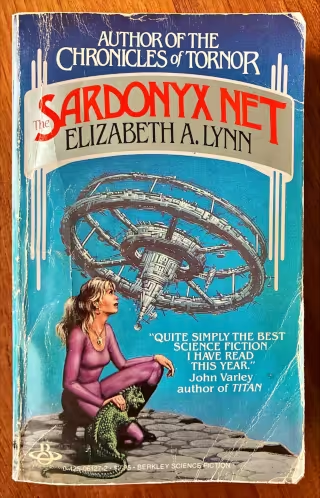 The Sardonyx Net by Elizabeth A. Lynn, 1981
423 pages. Berkley Books; Paperback, 2nd printing.
ISBN: 0-425-06127-2
Got this title from the King City library-on-a-stick. I'll admit, when contemplating this read, I became concerned after reading a few summaries and reviews. I even put it back in the library for a few weeks. Major features of the book are: slavery, drug use, and sexual sadism. And, being written in 1981 (on the heels of 70s anything-goes culture) by a lesbian fantasy author, I was afraid it might be thinly-veiled pornography. It is not. Instead it aims at unflinching realism, and while it doesn't always find its mark, it usually fails only on technicalities.
What finally prompted me to fish it back out and read it was listening to a Daniele Bolelli History on Fire podcast with his good friend and frequent political antipode Darryl Cooper talking about slavery generally, and American race slavery in particular. They explored the financial incentives that encouraged perpetuating slavery even while American society was increasingly extolling the equality of all people, how this actually led to further degradation of blacks as sub-human, justifying some of the worst abuses to occur in what had already been centuries of subjugation, and how this abuse intensified right up to emancipation and the eventual defeat of the Confederacy.
The Sardonyx Net actually deals with some parallel concepts. No character in the book is completely good or evil, and even the worst of them is given sympathetic treatment before the end. It explores how people born into a system of exploitation will rationalize and justify it, and how people opposed to it will justify their own brutality in trying to end it. Like distant echoes of Thomas Jefferson and John Brown, though no character in the book is close to either.
Unlike American chattel slavery, Sardonyx Sector slavery is punitive: convicted prisoners are sentenced to a term of servitude and are sold. They cannot be physically harmed or killed without justification, and receive their freedom and property back at the end of their term. This does not preclude, however, painful abuse and degradation, much to the enjoyment of a major character, who has sublimated his inappropriate sexual love for his sister into an even more deviant (but more socially acceptable) enjoyment of experiencing and inflicting pain. But even this character is not portrayed as wholly villainous, and toward the end of the book we get a more complete picture of his psyche.
The book is also unusual in that the overdue and anticipated radical change does not arrive within the span of the narrative. Things change, even significantly, but the forces in play to keep the institutions of punitive slavery and stratified culture in place still hold sway. It is, in fact, unclear whether the changes will be for the better, or will only serve to further entrench the exploitative system, making it more difficult to ultimately dislodge. Certain characters do grow and become better people, yet they are still tied to their deeply flawed society. So the ending is anticlimactic on a broad view, even if some individual fortunes improve.
I'd only recommend this book if this summary sounds interesting to you. It's definitely not a read for everyone. I would, however, recommend Bolelli's podcasts generally.
 The Dark Night of the Soul / The Living Flame of Love by St. John
of the Cross, ~1580
The Dark Night of the Soul / The Living Flame of Love by St. John
of the Cross, ~1580237 pages. Fount Classics; Trade, third printing, 1995.
ISBN: 0-00-627934-1
This is a difficult read, both for the archaic language (even in translation) and concepts which are difficult to grasp. Written in 16th-century Spanish, even the modern English translation is difficult to parse at times. The author takes most every opportunity to digress into effusive descriptions of God and the contemplative's experience of Him. This serves to underscore his point, but also to dilute his exposition with interstitial reiterations of God's worth and grandeur. The author speaks with the immense confidence of one who has both experienced and observed the things he writes about.
The basic idea of the first volume is that God will use all kinds of suffering, even psychic and spiritual pain at separation from Him, to effect salutary change in the soul. Suffering a dark night is portrayed as indicative of God's favor, raising the sufferer to a higher state than they were previously capable of holding to. Two levels of night are presented: the night of sense, in which the sufferer feels separation and can sense no connection with God, and the night of spirit, which is felt at a more fundamental level, unattainable to the one who has not already endured the night of sense.
The book presumes varying levels of office in God's kingdom, ordained by God Himself and worked out both through these and other means. More intense and shorter-lived episodes seem to presage greater glory, though God is free to do as He will regardless. The latter volume deals with the same subject matter, but more from the perspective of one who has already come through a dark night and into the nearer proximity to God that is its purpose.
If this sounds interesting, I know of no other work like it. If it doesn't, you can safely avoid it, as it will probably seem irrelevant.
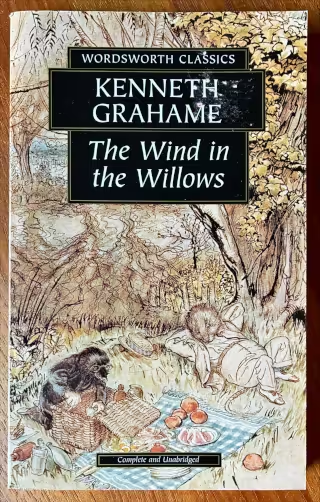 The Wind in the Willows by Kenneth Grahame, 1908
192 pages. Wordsworth Classics; Trade, 1993.
ISBN: 1-85326-017-7
I read this in preparation for the September, 2025 C. S. Lewis Society of Beaverton meeting. It comes up occasionally in essays and correspondence by Lewis, Tolkien, and other Inklings-adjacent thinkers, and was apparently an influence on a number of them. To my mind, it's an accessible children's book (and was likely all the more so to contemporaries in the early 20th century), principally about friendship. It teaches by example and from the perspective of a peer how to be a friend to someone who is sad, homesick, lonesome, lost, afraid, or even in the wrong. Mr. Toad especially has trouble controlling his impulses, and his friends, with only as much force as is necessary, restrain and rebuke him, then gently restore him to their fellowship after he comes to his senses again. I was particularly struck by the realistic illustration of temptation when Toad is contemplating stealing a motorcar, convincing himself by degrees that each step along the way isn't so bad, until he finally abandons all restraint. Recommended for children, but also for adults.
 Wuthering Heights by Emily Brontë, 1847
353 pages. Barnes & Noble Classics; Hardcover, 2004.
ISBN: 978-1-59308-361-8
I had never been assigned, and never read this until I saw it in the library-on-a-stick. Knowing it to be an important and oft-cited work, I decided to pick it up. I have to say I agree with a contemporary critic (cited in an appendix) that it is a very unpleasant book. The characters are trapped in a world where they know of no better options, and mostly just have to endure their mistreatment in hopes of outlasting it. Their lives are short and often squandered on drink, gambling, and other dissipation. Even the ostentatiously pious gardener is little more than a self-righteous scold, improving neither himself nor anyone else. The real compassion extended by the father to the urchin Heathcliff is repaid with nothing but ruthless exploitation. If this at all reflects the sheltered upbringing and short lives of the Brontë sisters, I have great pity for them. I found nothing of the novel's reputation as a great romance. Heathcliff and Catherine's relationship, such as it is, bears a closer resemblance to pathological obsession than healthy love, at least to my mind. It is an unhealthy preoccupation that serves neither them nor anyone around them.
Spoiler alert on this paragraph: I was actually relieved when Heathcliff finally dies, leaving the surviving residents of Wuthering Heights and Thrushcross Grange with at least a chance at building for themselves a meaningful and potentially pleasant life.
Recommended for its importance and influence on other works. Not recommended as enjoyable reading.
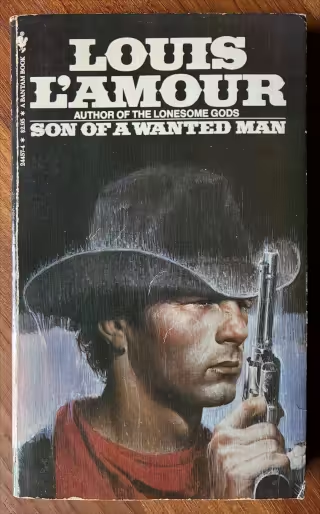 Son of a Wanted Man by Louis L'Amour, 1984
161 pages. Bantam Books; Paperback, 4th printing.
ISBN: 0-553-24457-4
This is another short, typical Louis L'Amour novel. An adopted orphan, raised to take the reins of a secretive gang of robbers in the old southwest, must decide for himself whether to accept this inheritance or reject it in favor of an upright life. Whichever path he chooses, he must face the ruthless gang members his adoptive father has kept at bay, who know he alone stands between them and their criminal ambitions. L'Amour gives a nuanced treatment of banditry in the old west. He maintains that over time it evolved from largely faceless robbing of absentee investors to preying more on local landholders and businessmen. This is part of the main character's reticence to take on leadership of such a group. He has conveniently to this point not participated in any illegal activity, and can claim law-abiding status, despite his close association with the gang. L'Amour presents how a "gentleman bandit" like the adoptive father might convince himself that he's at least not as bad as the worst of the outlaws: not killing except in self-defense, only robbing a given place once, targeting outsiders' money, new-found gold, etc. Not his best work, but not a bad little tale. Mildly recommended if you like L'Amour.
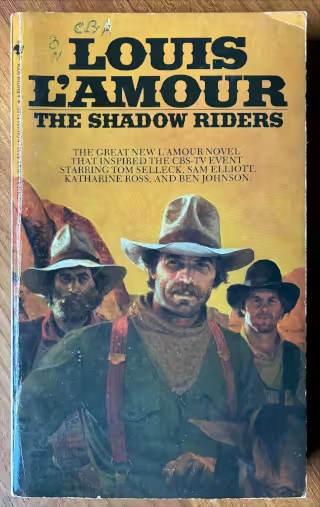 The Shadow Riders by Louis L'Amour, 1982
176 pages. Bantam Books; Paperback, 4th printing.
ISBN: 0-553-23132-4
Another short L'Amour novel, set just after the Civil War, in which two brothers who fought on opposite sides return to their Texas gulf coast community. A renegade Southern colonel has raided the area, taking horses and guns, but also women to sell into slavery in Mexico and the Caribbean in order to finance his dream of reigniting the rebellion. It contains the usual salient details of the setting, and how they inform the characters' decisions. Memorable characters, based loosely on historical archetypes, add to the flavor. It was made into a television movie (apparently taking a lot of liberties with the plot) in the 1980s starring Tom Selleck and Sam Elliot. Recommended if you're into L'Amour.
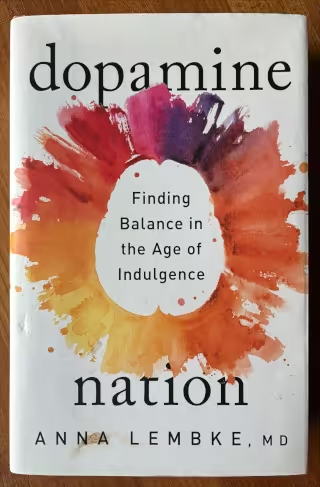 Dopamine Nation by Anna Lembke, MD, 2021
290 pages. Dutton; Hardcover, 3rd printing.
ISBN: 978-1-5247-4672-8
This turned out to be a very easy 290 pages.
While certain addictions (alcohol, sex, gambling) have been around for millennia, Lembke maintains that the modern era has resulted in a profusion of new ones — and new ways to practice old ones. These include prescribed medications (particularly opioids, benzodiazepines, and stimulants), online offerings (gambling, pornography, social media, shopping), recreational marijuana, tasty high-calorie food, and so forth. In short, anything that prompts the brain to release excess dopamine can ignite an addictive cycle. And these things can be deceptively innocuous: checking your social media, competing for online likes, finishing that game or getting that badge. She recounts her own compulsion with Kindle vampire romances. The key point seems to be that regardless of the inherent value of the thing itself, if you find yourself compulsively seeking it, you should consider addressing your relationship with it. The book comprises three parts:
The first introduces the concept of the brain having an internal balance between pleasure and pain, which it seeks to keep in equilibrium. Addictive substances or behaviors push down on the pleasure side, thereby eliciting the brain to counterbalance this with conceptual (and fancifully illustrated) "gremlins" on the pain side. Once the pleasure-inducing activity ceases, the balance tips to pain, incentivizing further addictive use.
The second part introduces methods for calming this see-saw, starting with "dopamine fasting" to intentionally let the pain side rule for a while so the brain re-balances itself. This gives a person perspective on what life can feel like without both the addiction and its counterbalancing reaction. The person might then choose to abstain entirely, but this is not always possible for addictions that are excesses of normal, healthy, and even necessary activities such as eating or social or sexual interaction. The person may instead decide to limit the behavior by time, location, or category. There may be an appropriate time and place for a behavior, or an appropriate context. Avoiding contexts that trigger cravings can be immensely helpful in short-circuiting the addictive cycle. Lembke also briefly discusses medications that can help people whose internal balances may have trouble restoring themselves due to deeply entrenched addictions.
The third part deals with intentionally pushing on the pain side of the balance, in order to induce a bodily response in the other direction. Cold plunges, exercise, and facing fears are presented as potential methods for doing this which can have overall positive effects. She cautions, however, that pushing on the pain side to get the reactive pleasure rush can itself become an addiction. Cutting is a well-known example of this, but compulsive work, extreme sports, and overtraining can also become pain addictions. Moderation seems to be the catchword: too much or too potent pleasure or pain can set off an addictive cycle. She also discusses how being honest with others about one's struggles can boost the willpower to maintain change, and how shame can be a pro- instead of an anti-social motivator if, when we are honest with people, they accept rather than reject us.
All in all it's an interesting overview of addictive physiology and psychology, with practical suggestions for dealing with all levels of compulsive behavior. Not just a book for hard-core addicts, it is for anyone who occasionally gets so wound up in something it starts negatively affecting their life. Recommended.
 Past Tense by Lee Child, 2018
487 pages. Dell Publishing; Paperback, Dell Mass Market 2019.
ISBN: 978-0-399-59353-6
Past Tense, yet another Jack Reacher novel by Lee Child is, I think, textually better than The Secret, his collaboration with his younger brother, but it's not as good as Bad Luck and Trouble or Blue Moon. It has the same kind of loose ends as Blue Moon, and really of any action thriller not meticulously scrubbed for consistency errors. Michael Crichton seems to be the best I've seen at avoiding them. But the level of effort required versus the payoff for most readers is probably too costly. I suppose there comes a point at which the exhausted author decides to just tell the reader, "trust me, things worked out from there". But the real difficulty I have with Past Tense was the discomfort I felt with the plot. To avoid spoiling it, I won't mention exactly what, but one of the two plot arcs involves bad people doing a Bad Thing, and the particular Bad Thing is not substantially revealed until a good 300 pages in. This leaves the reader to speculate and worry about the victims, much as the victims are doing themselves. This works well in the sense that it heightens tension and helps the reader identify with the characters. But the footprint of possible bad things includes things so very bad that it's unnerving, at least to me. It gives me that Kiss the Girls / Silence of the Lambs feeling: like I'm looking at something too horrible to contemplate, so bad it will actually harm me to see. If you are at all susceptible to this, I'd avoid this book. In the end, it's not the worst I could imagine, and isn't presented particularly voyeuristically, but it's still pretty bad, and the characters' motivations are indeed depraved. Not recommended.
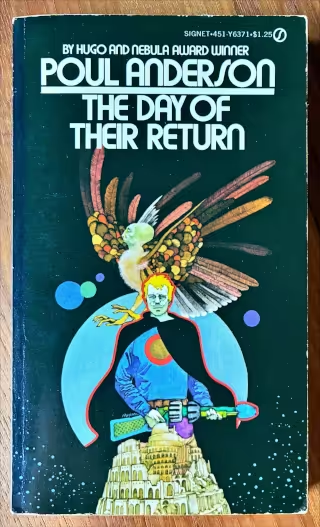 The Day of Their Return by Poul Anderson, 1975
185 pages. Signet; Paperback, first printing.
No ISBN
Interesting book. Starts slow and a bit confusing, but eventually things start to make sense. Anderson has an annoying (to me) habit of using obscure words whenever possible, often without enough context to intuit their meaning (unlike, say, E. R. Eddison1). This difficulty is slightly compounded by his (more standard) practice of supplying invented neologisms for alien objects, whether biological or cultural. Used by themselves, these give the reader a sense of otherworldliness appropriate to high science fiction, but due to Anderson's frequent use of archaic words as well, the reader sometimes has to guess. I kept Wiktionary open on my phone to look up terms just in case they were important, which often they were not. I imagine readers in 1975 keeping near their reference dictionaries, or else just having to roll with it.
Similarities to Dune are frequent: The planet is dry and harsh, nascent revolution has been violently stamped out, multiple peoples and guilds populate the land, apocalyptic religious ideology simmers among the lower classes, and nomadic tribes roam the wastes. But instead of Paul Atreides slowly becoming what he is fighting against, Ivar Frederiksen must choose amongst several options in order to fulfill his destiny. Will he lead a revolution of his own people against the Terran Empire, embrace a new religion heralding the return of the Ancients, drop out and become a nomadic hippie, secure peace for his planet by colluding with the Empire, or ally with alien governments to throw off its fetters?
While relying on touchstones of Gypsy/Romani, Oriental, Norse, and Arab culture, there's actually a good deal of world building and depth behind certain details. A short read, and not difficult, especially if you don't care to look up what an "elflock" is or what "monoceroid" means — both turn out to be immaterial to the story and easily expressed using common words ("tangled lock [of hair]", "one-horned"). Not a great read, but worthwhile. Mild recommendation.
1The Worm Ouroboros is practically a lesson in Jacobean vocabulary, due to Eddison's consistent pairing of archaic and modern terms. This also gives it a bit of Hebrew-poetic flavor, which is not a bad thing.
 Christian Reflections by C. S. Lewis, compiled 1967
176 pages. William B. Eerdmans; Trade, 1985.
ISBN: 0-8028-1430-1
Review to follow.
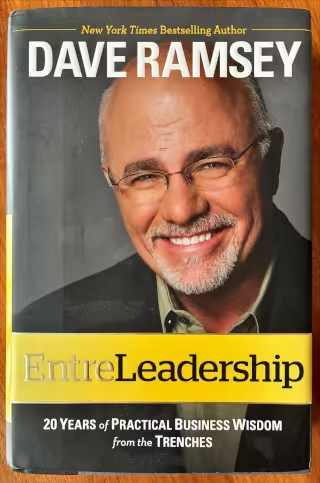 EntreLeadership by Dave Ramsey, 2011
305 pages. Howard Books; Hardcover, first printing.
ISBN: 978-1-4516-1785-6
Despite the quirky and somewhat confusing title, it's a great book about entrepreneurship and leadership (get it?). It contains solid advice on starting, building, and maintaining an entrepreneurial business; developing a positive, unified and cooperative culture; and incubating leaders within that culture. But the book is for entrepreneurs: owners and leaders to whom those owners have delegated sufficient authority. It is just impossible to implement many of the concepts in a corporate, much less a government setting. Compensation packages, hiring and firing, benefits, delegation of authority, and so forth — all of these are cast in stone in government and many large corporate environments. As a result, there's not much opportunity for growing leaders you can trust with authority, since you have no authority to delegate. The book outlines a great roadmap for building a culture of competence, integrity, and customer service; but requires the latitude to implement it, which is sadly lacking in many managers' situations. I'd recommend the book to someone starting a business, dealing with vendors and contractors, or mentoring people in business. But I suspect a corporate or government manager at any level would only become either jealous of their counterparts' latitude or else thankful they don't have to take on that level of responsibility. Irrespective of their reaction, the book just doesn't apply to their position.
 The Canterbury Tales by Geoffrey Chaucer, 1387; tr. Neville
Coghill, 1977.
The Canterbury Tales by Geoffrey Chaucer, 1387; tr. Neville
Coghill, 1977.504 pages. Penguin Books; Hardcover.
ISBN: 978-0-141-39321-6
The Beaverton chapter of the C. S. Lewis Society of Oregon's "book" for August was selections encompassing about a third of Geoffrey Chaucer's The Canterbury Tales, but I went ahead and read the whole thing. Well, I actually read Nevill Coghill's translation of the verse portions, which unfortunately excludes the Tale of Melibeus and the Parson's Tale, giving only quick summaries of their (prose) content. I'll have to find a reasonable translation of them, or else puzzle through the Middle English myself at some point. Multiple discussion participants found them both particularly edifying.
I was introduced to The Canterbury Tales in high school, where I was compelled to memorize the first 18 lines in Middle English, though with minimal indication of how to pronounce the words. I was able to recite it (in the accent I chose at 17) without any trouble while walking the park with my wife, which is a testament to the mnemonic power of verse after 39 years. Anyway, I had never delved any further into the work for two reasons: the difficulty in reading (much less comprehending) Middle English, and consistent indications from those "in the know" that it was a "dirty book", full of obscenity. I understood the Miller's Tale to be particularly offensive. What I discovered on reading what I assume to be a close translation was something markedly different.
The passages assigned did not include the sections of worst reputation, but I did find occasional lighthearted treatment of vulgarity. However, these instances did not seem to me to cross the line into lasciviousness or filth. To wit, the Host teases the celibate Monk that he is of such fine form that he could make a woman very happy, and what a pity it is that she now must choose among less fit laymen. While the passage openly speculates (in general terms) about the man's potential sexual prowess, it's clear that it's all in good fun — and less explicit than the kind of talk you'd hear in a locker room or after hours in a bar. The Host states openly that he's only joking, and the Monk himself takes no offense.
After finishing the assigned reading, I started fresh at the beginning, and came quickly upon the dread Miller's Tale, which actually struck me as more juvenile than pornographic. To be clear, it is the tale of a wayward wife and two suitors ready to participate in her adultery. Things like this are the subject of a number of the tales, in fact, but unless writing about sin is itself sinful, it's hard to condemn them on these grounds. As for explicit or lascivious content, the Miller's tale contains little of the former, and to my mind none of the latter. It consists of several elaborate practical jokes stacked upon one another to effect a lighthearted romp. As for depravity, it has nothing on a good deal Greek and Roman mythology.
The most explicit passage I can recall occurs in what amounts to a 14th-century rap battle between the Summoner and the Friar. They trade barbs at one another in verse, and the Summoner provides a lurid description of what he imagines to be the fate of Friars in Hell.
The most offensive portion is the Prioress' Tale, a ruthless attack on the character of Jews. As offensive is the fact that the Tale is received by all without complaint. Jews are variously painted in the Tales: sometimes as wise patriarchs, sometimes as fine craftsmen, and here as murderous devils. Curiously, I don't recall any reference to Jews as greedy swindlers, which I understand was a common stereotype by the time of Shakespeare.
Most versions (including Coghill's) include a later retraction issued by Chaucer himself, wherein he revokes his "translations and enditings of worldly vanities", including the Tales "that tend toward sin", along with a number of other works, and begs both the reader, and especially God, to forgive him. Certainly, not all of the tales are salutary and edifying, and might be seen by some to excuse or downplay the seriousness of adultery, drunkenness, larceny, and other sins. Perhaps Chaucer learned that what he had intended to be merely a realistic survey of the various kinds of people in society, both good and bad, was being used corruptly, and thereby developing a reputation as a corrupting influence. In this light his evident revulsion and repentance are understandable.
Now that I've given you some idea of how offensive the book might be, I'll move on to its merits. I found most of it absolutely delightful, and (unlike some other readers) that the rhyming verse only added to this enjoyment. I had occasional trouble switching meters (different characters often use differing metrical standards, or make up their own "doggerel" style), but once I "clicked in" to a given scheme it all flowed quite naturally. I find poetry also tends to concentrate its content, possibly from the need to choose precise wording in order to match both rhyme and meter. That said, there are several instances where a tale-teller goes on extended digressions and you kind of wish he'd get to the point. One instance of this is comically excessive and obviously intentional — a long passage where the Knight informs you of all the many details he's not going to get into, for lack of time.
There is no consistent tone to the tales. They vary from pious homilies to bawdy comic romps, cautionary tales, colorful fables, even the aforementioned 14th-century "diss tracks". Each narrator has his own voice and temperament, and it's all tied together by their shared pilgrimage to Canterbury to pay homage to the martyr St. Thomas à Becket (who is never mentioned by name). I can certainly see why it was so popular and influential to English narrative style.
If you like rhyming verse, well-considered commentaries on life, humorous fables and anecdotes, good- or ill-natured banter, and you don't mind hearing about people doing bad things in a lighthearted and humorous manner (and I suspect most modern readers will not), Coghill's translation of The Canterbury Tales is a delightful read that can be taken in small doses over time. Highly recommended.
UPDATE: This morning brought me a new insight into the controversial nature of The Canterbury Tales. When we go to the gym, my wife and I leave some music on in the hopes that JJ won't bark as much at things he hears outside the house. For no better reason than variety, I've been methodically stepping through artists on my iTunes library each time we go. Today was James and Lucky Peterson, a pair of Chicago blues men whose album If You Can't Fix It is in my collection. It includes a track notable for its humorous but potentially troubling content called "Never Take Sand to the Beach". From the narrator's perspective, taking your wife on vacation is like taking sand to the beach. My best guess at the lyrics follows:
|
Going on vacation |
Now, I've always liked this song, and taken it as a humorous description of someone pathetically trying to justify his bad behavior. That's what makes it funny. But I can also understand how someone might take offense that it's normalizing infidelity, and how a conscientious author might retract it as a result. Perhaps this is what has happened with portions of The Canterbury Tales and Chaucer.
Appropriately enough, it reminds me of a C. S. Lewis quote about coarse jokes. In The Screwtape Letters, the senior demon, Screwtape, is instructing his underling Wormwood on promising methods for tempting humans:
|
The Joke Proper, which turns on sudden perception of incongruity, is a much more promising field. I am not thinking primarily of indecent or bawdy humour, which, though much relied upon by second-rate tempters, is often disappointing in its results. The truth is that humans are pretty clearly divided on this matter into two classes. There are some to whom "no passion is as serious as lust" and for whom an indecent story ceases to produce lasciviousness precisely in so far as it becomes funny; there are others in whom laughter and lust are excited at the same moment and by the same things. The first sort joke about sex because it gives rise to many incongruities; the second cultivate incongruities because they afford a pretext for talking about sex. If your man is of the first type, bawdy humour will not help you — I shall never forget the hours which I wasted (hours to me of unbearable tedium) with one of my early patients in bars and smoking-rooms before I learned this rule. Find out which group the patient belongs to — and see that he does not find out. |
I suspect this might have been said more succinctly elsewhere, though I can't find it, as something like "there are those who tell dirty jokes because they are funny, and those who tell them because they are dirty". Regardless, I believe it to be true. And though I consider myself predisposed to be the former type, I understand utilizing humor as a shield to obscure or excuse vice. I've certainly used other things to that purpose.
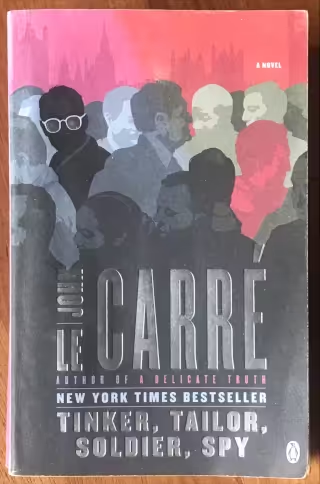 Tinker, Tailor, Soldier, Spy by John LeCarré, 1974
381 pages. Penguin Books; Trade, 18th printing, 2011.
ISBN: 978-0-14-311978-4
I was surprised at how difficult a read it was, more so than The Night Manager. Not only does LeCarré have his usual broad and refined vocabulary, but the book is ordered in such a way that there are frequent reminiscences and flashbacks. In retrospect, I think he keeps these explicit, but not knowing that going into the book, I sometimes mistook scenes in alternate settings as being historical. I found myself questioning my own reading comprehension at times, since I would read a chapter, understand the events that took place, yet have no idea what they had to do with the broader story. As it turns out, I probably wasn't intended to, and the storylines didn't completely coalesce until about 250 pages into the book. I'd like to blame the American education system for emphasizing the extraction of meaning from short samples of text. But it could also be that I was somewhat lazy in keeping track of characters and settings. LeCarré sometimes switches scenes or points-of-view without more than a word or two of indication, so it's easy for me to miss these transitions. These difficulties aside (and they may be peculiar to my own reading), the book convincingly immerses the reader in the cold-war espionage mindset. Even when one doesn't understand the specific jargon or methods (or perhaps because they are sometimes obscure), one senses the authenticity of the setting. It seems like a book that would be better on the second reading, when you know what to take in as background and what is vital to the plot.
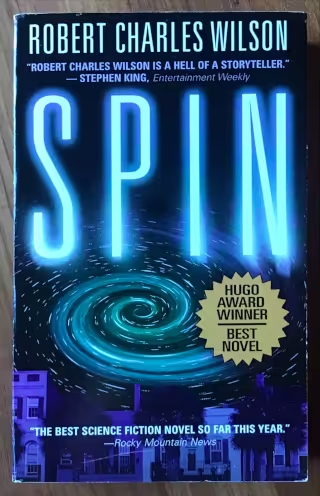 Spin by Robert Charles Wilson, 2005
458 pages. Tor; Paperback, 18th printing.
ISBN: 978-0-7653-4825-8
A sci-fi novel about the Earth being suddenly trapped in a slow-time bubble while the rest of the universe evolves about 100 million times as fast. The characters try to figure out what has happened, why, and what to do about it. It quickly becomes apparent that the effect is intentional and specifically designed to not obliterate life on Earth, since it both isolates and carefully protects the ecology of the planet from the effects of the time dilation. Exploring people's reactions to such an event, investigations and attempts to escape or disrupt the effect, and the lives of three childhood friends who will have significant roles, it won the Nebula award for best novel for 2005. It's odd to call something just 20 years old "dated", but it does predate social media, the smartphone, real electric cars, the success of SpaceX, and what passes for AI; not to mention three rather consequential presidencies and a global panic over COVID. I suspect any of these would have altered the chosen narrative of the book, and together they make it seem a bit like a revisionist history, rather than "the day after tomorrow" as the back cover promises. We give Jules Verne a lot of slack for writing in the late 19th century, and have to give Wilson a little as well, since things have moved so rapidly lately. It's a good read, and the characterizations are just as valid as ever, but it was probably a better read when it came out. Also recommended, but not highly.
I almost forgot: Spin does demonstrate the proper use of metaphor in description, without forcing the user to backtrack and reconstruct the scene as The Kingless Land did. Kudos to Wilson for applying these techniques smoothly and effectively.
 The Andromeda Evolution by Daniel H. Wilson, 2019
362 pages. Harper-Collins; Hardcover, first printing.
ISBN: 978-0-06-247327-1
Picked up The Andromeda Evolution at the library-on-a-stick. It is an extension of Michael Crichton's Andromeda Strain universe where the adoptive son of the doctor who saved the day 50 years prior uses his robotics expertise to save the day again. That Crichton was a medical doctor and Wilson is a roboticist makes it clear Wilson sees Crichton as his literary father and wants to continue his legacy. And he does a decent job of it. It's not quite as good as a true Crichton book, but it's not bad either. There are over-the-top scenes and high-minded speculations (some of which turn out to be true), but those are hallmarks of the techno-thriller that Crichton practically invented. Not to give too much away, but Andromeda has evolved into something akin to the blue gunk in The Expanse television series (I haven't read the books): dangerous but also potentially purposeful. The story contains a lot of common Crichton elements:
|
It is also a blessedly straightforward read after the circuitous Kingless Land.
All in all, it's a worthy addition to the Crichton universe, just not quite up to par with most of it. Still recommended, though.
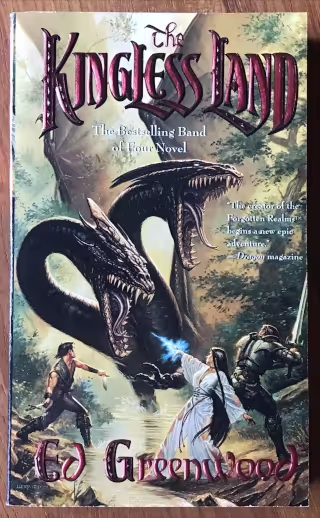 The Kingless Land by Ed Greenwood, 2000
376 pages. Tor; Paperback, first mass market, 2001.
ISBN: 0-812-58041-1
Picked up a book I probably bought while in a sci-fi/fantasy book club at Barnes and Noble about 25 years ago, which we never got around to reading: The Kingless Land by Ed Greenwood, the creator of Forgotten Realms (a popular Dungeons and Dragons milieu). This book seems to mark the start of an entirely new setting, and doesn't show any obvious hallmarks of conforming to the D&D rules. It's typical high fantasy in a kingdom that's fallen into brokenness and evil, but hope remains if someone (perhaps our heroes!) can find and wield the magic maguffin that will restore the kingdom. But just because we know, in broad strokes, what's about to happen, doesn't mean it can't be entertaining to find out how. The story itself is interesting enough, and the world and how it works as plausible as most fantasy realms. In my opinion, the book's problems lie principally in the prose, and to a lesser extent the characterizations.
The prose reminds me of junior-high-school advice on how to write well: always use an active, loaded word; put the reader in the scene using sense words; frequently describe things metaphorically. For example, on page 354:
|
"Ingryl's dying scream didn't last long. Two stones ground him to liquid between them in an instant, in their thundering haste to roll the width of the castle and see the gardens for themselves. They made it, too" |
Forget the confusion that Embra (our heroine) and Ingryl each have a magic Stone that together can awaken the sleeping king or release an evil serpent — from later context it becomes clear that the two referenced here are common stones from the falling tower. As such, they have no will or senses, yet they are in "haste" to "see the gardens", and succeed in their quest. The reader is frequently asked to unwind these metaphors to determine what's actually happening, and it gets exhausting. I'm not against poetic license, or clever turns of phrase — they have their place, especially in verse. But this is nearly 400 pages of pulp fantasy — the kind of book you read on the plane, not a dense epic poem where you stop every line or two to unpack and savor the gestalt of the verse. I remember someone expressing shock that such a great work as The Lord of the Rings almost exclusively invokes the simple word "said" when relating dialog. And it's true. To my mind, this lends immediacy to the story and helps embed the reader in it, rather than forcing him to constantly interpret the narrative. But it may also be a matter of taste: some people may genuinely relish a constant appeal to metaphor.
A lesser complaint is the characterizations: in this respect, our heroes are like D&D characters: individuals with diverse backgrounds and talents, yet played by good friends who joke with each other and get "out of character" sometimes. I'm not saying it's bad that the characters form unlikely bonds: that's part of the genre, really. It's that it feels imposed by the author rather than being the characters' own development. They all give each other a hard time like old veterans or schoolmates, though only two of the four have any such history.
Not recommended, but not a bad book if you're into the genre.
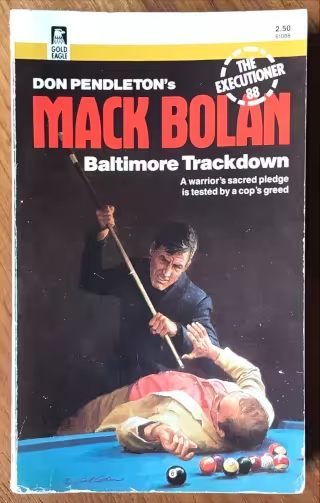 Baltimore Trackdown by anonymous authors mimicking Don Pendleton,
1986
Baltimore Trackdown by anonymous authors mimicking Don Pendleton,
1986189 pages. Worldwide Library; Paperback, first printing.
ISBN: 0-373-61088-2
Wow. A "Mack Bolan" book showed up in the library-on-a-stick. I've heard of these uber-pulpy novels, and seen them in the used bins, but never actually read one. Well, now I have, number 88: Mack Bolan: Baltimore Trackdown by an unnamed team of authors, with characters created by Don Pendleton. Apparently, Mack has been tracking down and killing Mafia members for years after losing his beloved to them at some point in the past. He really hates these guys (just the guys — gals get a pass because they're presumed to lack agency). At one point a cop reminds him there are men in that flaming automobile. "Not men", replies Mack, "Mafia scum". So you get the idea. It's a terrible book in that the plot and action are uninteresting, the conclusion foregone, and the contents little more than a set up for the next installment. What surprised me was how much it reminded me of movies and television. The kinds of things we take in stride in a movie, represented here in print, are laughably bad. It's almost as if we give movies a pass for bad writing because of all the work they had to do to make the visuals.
Principally what I'm talking about are plot holes and loose ends ignored, or given perfunctory treatment. Bolan acts with impunity, yet we know he's never going to have an Omar moment (which is one of the things that made The Wire such a standout television series). Yes, he has some random setbacks, but always in service of the straightforward plot. Once out of immediate danger, nothing ever comes back to bite him from behind the scenes. He and the reader can expect this, just like James Bond, Luke Skywalker, or the A-Team do. I'm not saying that two of those aren't decent entertainment — they're just not good writing. Yet we tolerate and even expect this kind of lax storytelling in film and television. While sometimes a producer can transcend this (as in The Wire, and most of James Cameron's pre-Titanic work), it's not rewarded in any way commensurate with the amount of effort it takes. So we generally only see deeply consistent content from obsessive producers, creating continuity from their own OCD, not out of any external incentive.
Not recommended, but interesting to contemplate.
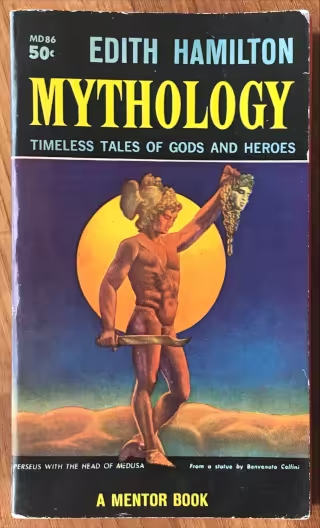 Mythology by Edith Hamilton, 1940
315 pages. Mentor Books; Paperback, 14th printing, 1961.
No ISBN.
Finished Edith Hamilton's Mythology, a 1940/42 summary of Greek, Roman, and a little bit of Norse mythology. While some of the stories were familiar, there were quite a few I either had forgotten or never heard in the first place. The author typically gives a single narrative derived from one or more sources, only occasionally relating alternative accounts. It's a good summary (as good as the Amazon series I watched on Greek and Roman myths), and quite accessible. Recommended if you're interested in the stories themselves, and not their telling.
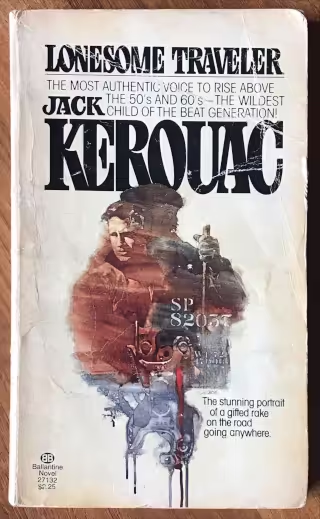 Lonesome Traveler by Jack Kerouac, 1960
183 pages. Ballantine Books; Paperback, second printing, 1977.
ISBN: 0-345-27132-7
Another Kerouac book showed up in the stick library, and Big Sur had been worthwhile enough that I grabbed it. Lonesome Traveler is a mixed bag of short stories about some of the author's various travels in the 1950s. Kerouac plays the roles of Southern California partygoer, Mexico tourist, California railroad brakeman, Pacific coast freighter scullion, New York City partier, fire lookout in the Mt. Baker wilderness, European vacationer, and hobo apologist. I'll just touch on a few of these.
Kerouac initially lauds Mexico as a sort of easy-going paradise, superior in every sense from the restrictive US. But as his travels take him farther in, he transitions (without comment) to less pleasant and more weighty observations: tragic drug use, the graphic killing of a bull by minor-league toreadors, and the equally graphic crucifix of a local cathedral.
As a brakeman on the railroad in California, he describes both his work and the slums of San Francisco. This narrative is more disjointed and erratic, e.g.,
|
"Standing on the back platform are the rear brakeman and an old deadheading conductor ole Charley W. Jones, why he had seven wives and six kids and one time out at Lick no I guess it was Coyote he couldnt see on account of the steam and out he come and found his lantern in the igloo regular anglecock of my herald and they gave him fifteen benefits so now there he is in the Sunday har har owlala morning and he and young rear man watch incredulously his student brakeman [Kerouac] running like a crazy trackman after their departing train." |
He gives sadly familiar descriptions of "bums" in San Francisco, which would be adequate to describe many Portland residents today. Also of note, he frequently mentions migrant workers seen from the train: e.g. "Mexicans working fields that America with its vast iron wages no longer thinks feasible, yet still eats". This in 1952.
Recollections of the Skagit valley are much more linear, lucid, and informative, yet no less compelling. Being familiar with some of the towns, dams, and mountains made this section particularly interesting to me. 63 days of sobriety in the Mt. Baker wilderness may have contributed to the change in style.
His descriptions of revelry in California, New York, and especially Africa and Europe sometimes only hint at objective meaning and serve only to leave impressions and a general sense of the places and his experiences in them. A desultory run-on sentence about traveling to Morocco goes on for almost two full pages of text (pp. 137-39). I found it easiest to just power through and not try to understand, instead letting the words pile up like dots in an impressionist painting until your mind forms some idea of what he intends to convey.
He ends the book with a lament for the "hobo", and how there is no longer a place in society for him. Yet to my mind he conflates the prospector and adventurer with the troubled addict. Not that the two are mutually exclusive, but it's a difficult task, and may be impossible, to make room for the one without enabling the latter, at least in a settled land.
I'd say if you're at all interested in Kerouac, Big Sur is a lot more cohesive and enjoyable. Lonesome Traveler reads like a quick collection of short stories to sate the appetites of readers, such as you sometimes see as a follow up to a "hit" novel, or after a popular author has died. At its best ("Alone on a Mountaintop"), it's both interesting and compelling, but elsewhere suffers mightily from aimlessness and impressionistic prose (unless you're into that!).
 Schrödinger's Cat: Groundbreaking Experiments in Physics by
Adam Hart-Davis, 2015
Schrödinger's Cat: Groundbreaking Experiments in Physics by
Adam Hart-Davis, 2015176 pages. Metro Books; Hardcover, first printing.
ISBN: 978-1-4351-6132-0
I believe my mother-in-law gave this to me because I'm sort of science-minded. I don't know where she got it. It's a popular sampling of science experiments from antiquity to about 2009. The book itself was published in 2015. I learned a few things, and it mostly held my interest, but it's not a fabulous book by any stretch. It also seemed to have a slight ideological bent, though it's hard to pin down its exact direction. Hart-Davis repeats the common belief that not much happened between the Greeks and the Renaissance, which I don't think is terribly fair. He mostly avoids the assumed antipathy between science and religion, noting that several major discoveries were made by devoutly religious people, profiling a number of Christians and one Muslim. I was, however, surprised that Pierre Curie was portrayed as a mere instrument-designer and helper to Marie, e.g.:
|
"By this time [1898], Pierre had become fascinated by her research, and decided to join her, although she was definitely the driving force behind their joint investigations." |
Missing context and the word "joint" are doing a lot of work there. Pierre had made advances in crystallography and magnetism, invented or perfected several scientific instruments, and discovered piezoelectricity and with his brother prior to ever meeting Marie. She did get him interested in radioactivity, recently discovered by Henri Becquerel (who later shared their Nobel Prize in 1903), and together they set off to study its genesis in certain heavy ores (she working primarily on isolating the elements, he principally studying the effects of the radiation), until his untimely death in 1906. Certainly, Marie faced a good deal of discrimination for being a woman in physics, with the Royal Institution of London refusing to let her present, and the Nobel committee initially excluding her. But far from being complicit in such offenses, Pierre pointedly deferred questions to her at the Royal Institute and insisted that she be added to the prize. But without context, these sound like admissions of inferiority rather than an insistence on equality.
Still, it seems to be mostly a fair presentation (so far as I know) of several dozen groundbreaking experiments, given in a popular context, and assuming little prior scientific understanding. It did clarify for me a couple of things I didn't know much about, and captured to some extent the lure of discovery, but on the whole wasn't particularly compelling.
P.S. surprised to see Maxwell left out.
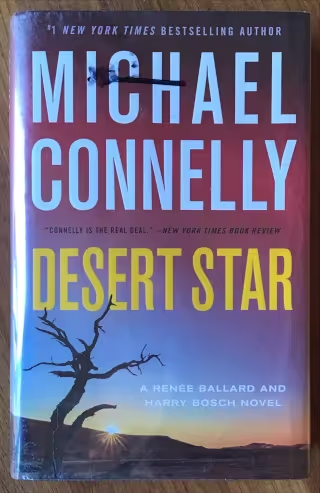 Desert Star by Michael Connelly, 2022
391 pages. Little, Brown and Company; Hardcover, first printing.
ISBN: 978-0-316-48565-4
Found another Michael Connelly book in the library-on-a-stick. This one is a Harry Bosch tale called Desert Star. It actually contains characters used in the latest season of Bosch: Legacy, though the details are different in the show. I'd recommend either for a crime novel / program enthusiast. The show continues to be of high quality and engaging, its biggest flaw being (to my mind) the atrocious intro music. Why could they not pick some old-school jazz (swing, hard bop, anything) that Harry might actually listen to? Royalties too much? Have some hard-up jazz trio do a cover. Anyway, the show is well-produced, the actors do a good job, and the stories aren't riddled with plot holes. The book is, as typical, even tighter on the details, and I for one enjoy that the show isn't just a rehash of the book. It means I can consume one without spoiling the other. And they don't make nonsensical choices the way, say, The Night Manager did. Connelly books go down like candy, and this one is no exception. I'm a slow reader, and I got through 391 pages in about 6 hours of total reading time over three days. The dialog is easy to follow, the descriptions paint a relevant picture without going into unnecessary detail, and details tend to be introduced as they are needed, rather than being a set of specifics you have to recall. Only a couple of times did I think he could have said something more clearly, and neither time did my momentary confusion affect the storyline. I can see why he's such a popular author: he really polishes the prose to a utilitarian minimum, and that's what you want in a book you're reading for the story, not the clever phrasing. Great book to read on a plane, when you're tired, or just want something lighter.
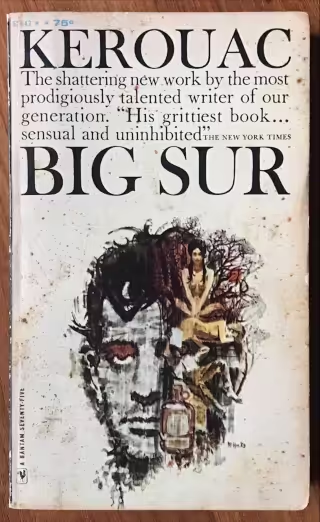 Big Sur by Jack Kerouac, 1962
200 pages. Bantam Books; Paperback.
No ISBN
The library-on-a-stick had Big Sur by Jack Kerouac, whom I'd only known by reputation up until now. I was pleasantly surprised that, unlike the proponents of his I've encountered, Kerouac is quite unassuming and not the slightest bit preachy about his outlook on life. If anything, Big Sur is an unguarded autobiographical glimpse into a pivotal summer in his chaotic and forthright life. He's clearly an alcoholic, distressed about his place in the universe, and uncomfortable with fame and a reputation he can't control. Unexpectedly, he spends no effort railing against the system or detailing its atrocities. He simply ignores the rules he doesn't care to follow and takes the consequences on himself — a very libertarian lifestyle. And he makes no effort to hide the deleterious effects of his and his companions' choices. Throughout the book he alludes to his end-of-summer breakdown and what he suspects may have contributed to it. But he has no overarching message or advice to the reader: he is simply documenting his subjective experience. He cleverly embeds the poem he wrote that summer, "Sea", at the end of the book, where the reader can best appreciate it. Throughout the narrative, he explains the allusions and metaphors that are "called back" in the poem. He doesn't care much for conventions, and this is reflected in his spelling and punctuation. But it doesn't have the feel of a gimmick or even an overt statement. It is just another reflection of his unabashed self-revelation. He's not trying to conform, but he's not trying to smash the system, either. He just wants to make his own way unfettered by rules and expectations, including those of his fans. It's an outlook I find a good deal of sympathy for, even if I make entirely different choices for myself, and would advise against many of his excesses. Perhaps if the beat and hippie movements had retained this perspective, and not been co-opted by revolutionaries, they would not have been so polarizing. But the same could be said of abolition, unionization, and various civil rights and religious movements. We can't blame the progenitors of new ideas for how others with ulterior motives took advantage of them. I shouldn't have been surprised to find a compelling idea at the base of the beat movement, but I was. And such an unvarnished narrative of the joys of its expression and the agonies of its consequences gives the reader a strong indication of its veracity. Recommended.
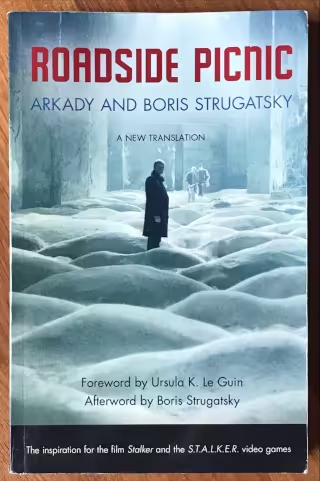 Roadside Picnic by Arkady and Boris Strugatsky, 1972; tr.
Bormashenko, 2012.
Roadside Picnic by Arkady and Boris Strugatsky, 1972; tr.
Bormashenko, 2012.209 pages. Chicago Review Press; Trade, foo printing.
ISBN: 978-1-61374-342-6
Got around to reading a new translation of Roadside Picnic by Arkady and Boris Strugatsky. I'd previously read an online translation, and can remember no differences between them — not that it's likely I would. A Russian story from 1971, it tells the tale of Redrick Schuhart, a resident of Harmont, a mining town in an unspecified country, probably Canada, which was one of several "zones" on Earth visited by aliens. Little is known about the visitation (which was apparently cataclysmic for the residents) and the zones themselves are now littered with fantastic and dangerous artifacts. One character likens it to a roadside picnic, where cigarette butts, dropped items and general trash are left behind for the local fauna, who can't possibly understand them, to discover. Redrick is a "stalker": a freelance scavenger of artifacts from the local Zone. This is incredibly dangerous, as nearly-invisible effects or innocuous-looking items or substances can prove anywhere from harmless to fatal. Experienced stalkers, such as Redrick, have learned to recognize some of them, often by watching friends and acquaintances die or be hideously disfigured. There's too much detail to explain the situation fully, and even the text itself doesn't attempt to. This seems like an intentional choice: a new artifact, effect, or even character is introduced by name before we learn anything about them, and the reader must play catch-up with the characters, who already have some idea of who or what this is. This makes it a harder read than it needs to be, in my opinion, and less satisfying. The authors may be trying to convey the general uncertainty of the situation, even after years of studying the Zones, but it doesn't work for me. I know the characters have a much better idea than I do what's going on, even if they don't know a lot. But the grandness of the story itself and the world-building is phenomenal: truly first-rate science fiction in the tradition of Stanislaw Lem and Philip K. Dick. The aliens aren't Star Trek humanoids with bumps on their faces: they are incomprehensible beings whose trash humanity has no theories to explain. They are so indifferent that it's unclear whether they even noticed us, and apparently didn't care to communicate. People try to explain the Visitation various ways, but no one is really sure, and their theories aren't really testable. In this sense the story rings true. People start using the technologies they discover for quotidian purposes, not understanding what they might be intended for. They just start living with the new situation, the unknown technology, Zone-induced disabilities, mutations, and even statistical effects.
In the end, it's a story you'd have to read to decide whether you liked it or not, and no attempt to sum it up here is going to fit. So if you like Dick or Lem or weird high-minded sci-fi tales, you'll probably relish the tale, though I myself have reservations about the narrative style. If you enjoy prose that points in the general direction of something rather than explaining it, you might really like it. I found this distracting and an impediment to both understanding and enjoying the book. Still, I didn't regret my second reading of it — and I'd certainly recommend a first try.
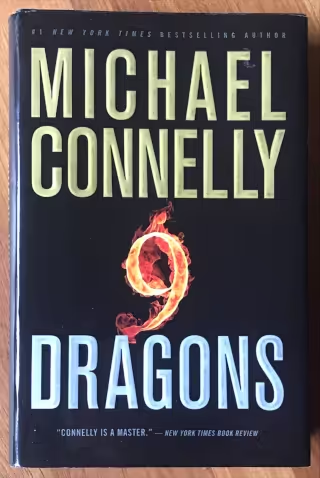 Nine Dragons by Michael Connelly, 2009
374 pages. Little, Brown and Company; Hardcover, first printing.
ISBN: 978-0-316-16631-7
Another Harry Bosch novel, I'd say it's not quite as good as The Last Coyote, but it's still pretty good. It is a bit over the top as far as suspense, and the reconciliation of Harry and his ex-wife's new beau seems a bit forced, but it all falls within the realm of possibility, if not likelihood. I was right that $216 is purposely twice the very auspicious number of 108, though the book gives a very specific reason that is itself likely designed to fit the number, rather than being the genesis of it. The twist is just visible as it comes up on the horizon, but not by any means obvious early on — a satisfying degree of obscurity. Not the bolt from the blue that makes total sense in hindsight (the best kind), but not painfully clear from the outset or maddeningly impossible to discern from the myriad possible outcomes. This installment changes Harry's world forever, and marks another divergence by the television series, but fans of the series and the broader genre will likely enjoy it. Recommended.
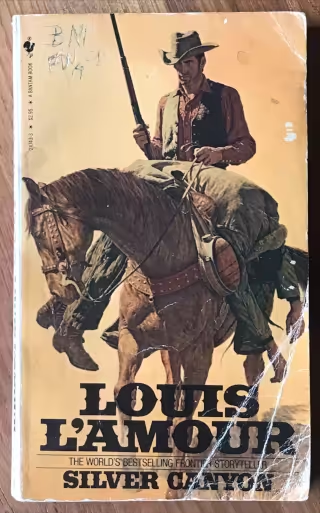 Silver Canyon by Louis L'Amour, 1957
167 pages. Bantam Books; Paperback, 21st printing.
ISBN: 0-553-24743-3
Silver Canyon is set in the desert southwest, where a newcomer to town injects himself into a feud between two major ranches over who will control a smaller, but well-positioned ranch, held by a single man. Our hero, Matt Brennan, sides with the underdog against the powerful interests set on destroying him. Notable for the somewhat morally ambiguous head of one of the big ranches (more on this theme later), it's a tale of the triumph of dogged determination against the truly rapacious and the mundanely aggressive. The "CP" and "Boxed M" ranches both need the water and range of the smaller "Two Bar", and are fighting over who will take it over. The CP's Pinder is at home in the ruthless environment of the western range, where taking what you want generally yields the best results. The Boxed M's Maclaren has grown accustomed to this mode of competition, but is more resigned to than comfortable with it. Ball, owner of the Two Bar, is holding out the best he can, but is running out of supplies and ammunition to forestall the inevitable. Brennan throws in with Ball and holds off incursions by the other two ranches while courting Maclaren's daughter and uncovering the secret motive of one of Maclaren's hands. As is typical for L'Amour stories, good overcomes evil, and evil is repaid in kind. Maclaren moderates his ruthless ways when he realizes he can treat fairly with Brennan, and experiences a sort of redemption. But everything happens in service of the story, and events magically resolve to the benefit of the righteous, which is not terribly realistic.
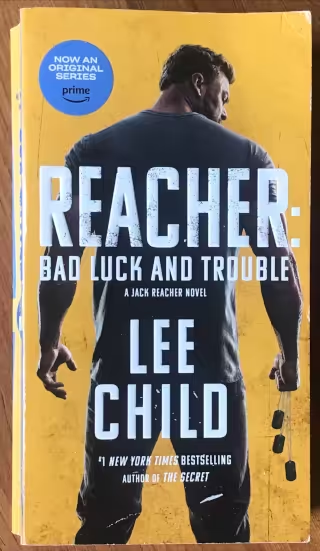 Bad Luck and Trouble by Lee Child, 2007
477 pages. Random House; Paperback, Dell Mass Market 2023.
ISBN: 978-0-593-72549-8
Another Lee Child "Jack Reacher" novel, upon which I believe the second season of the Amazon series was based. Once again, I was struck by the ease of reading it. I devoured its 477 paperback pages between beach excursions, meals, and visiting friends while on vacation in Newport, OR in less than 3 days. This is fast for me. Child doesn't try to paint scenes with emotive words or craft memorably worded sentences. He conveys information as directly and succinctly as possible — exactly what his audience is after. These are not books to relish for their clever prose or surprising analogies. They're action thrillers about crime and revenge; heroes operating at the limits of human abilities, yet still fallible and self-doubting. And he does it well. I much preferred Bad Luck and Trouble to The Secret. It seems better than my recollection of Blue Moon as well. If you're thinking of picking up a Reacher novel, this might be a good one to start with.
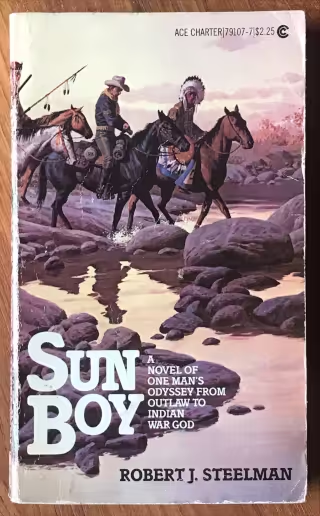 Sun Boy by Robert J. Steelman, 1975
204 pages. Ace Books; Paperback, first printing.
ISBN: 0-441-79107-7
Sun Boy by Robert Steelman stands in contrast to the L'Amour novels primarily in its protagonist's ambiguous morality. Where the heroes of the other books may be reviled, they are always righteous. Here, Philip Rainbolt is a former Confederate officer who abandoned his command, leaving his men to be slaughtered by the Union. He lost everything in Sherman's conquest of Georgia and headed west, eventually enlisting as a private in the Army he once fought. His commanding major's wife is a relentless flirt, and while he resists her advances, her jealous husband sets the sergeant major on him, eventually provoking him to strike his superior, earning him six months at hard labor in Leavenworth. He is incarcerated in the post's jail with a number of captured Kiowa and a ne'er-do-well comanchero named Coogan who gets sprung by his well-paid lawyer. The Kiowa chief is killed resisting his transfer for trial, and soon a band of his people break the remainder out of jail, killing the guard. For no reason he can determine, Rainbolt is also freed, and decides to run. He first encounters a lone Tonkawa ("Tonk") Indian, purported cannibals, and in a desperate fight eventually bests and kills him. He takes the Tonk's horse, ancient Dragoon Colt, and decorated lance. Eventually, he is captured by the Kiowa, who treat him poorly until they realize whose lance he's carrying. He has killed their greatest rival, the Tonkawa chief, and taken his medicine. They start to wonder if he might be the prophesied "Sun Boy", who would rescue the Kiowa from their enemies. An uneasy truce develops, but the comanchero returns to trade, telling Rainbolt he has to adopt the Sun Boy persona and tell the Kiowa they must trade only with Coogan, and they'll both get rich — or else he'll rat him out to the Army and he'll hang for murdering the guard. The story is at once more realistic (as its characters are flawed) and less satisfying (since they don't really have an arc of redemption or corruption). Rainbolt acts in some ways admirably, in other ways not, and these actions result in both good and bad outcomes for himself and those he cares about. While a L'Amour novel would inevitably reward the good and punish the bad, Steelman's tale is not so straightforward. We can view Rainbolt's selflessness as redemption for past wrongs, except that he doesn't really regret his past wrongs, but simply accepts them. The book is curiously unfeeling in its outlook — almost postmodern. While there are people of good will and moral courage in the book, it is clear they already have their reward, and the indifferent world will take no account of it. Which is fine; we get plenty of that from the real world we live in. I think the unsatisfying thing is that even in the minds of the characters, there is no satisfaction in their morality or shame in their immorality. It's indifference all the way down. Contrast this with the movie Unforgiven, where there are also no truly good or bad characters, but William Munny and the kid both bear the colossal weight of their sins within themselves, regardless of their external fortunes.
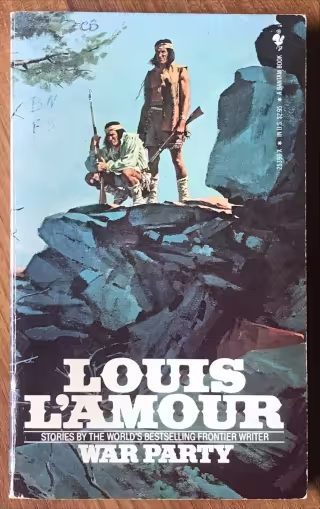 War Party by Louis L'Amour, 1975
152 pages. Bantam Books; Paperback, 16th printing.
ISBN: 0-553-23258-4
A series of short stories of the old west, all in or about the 1870s. Some are humorous, some pithy. They carry a number of different impressions of life in the west. There is nothing of the recent notion of native Americans as a monolithic group of honorable warriors: there are good and bad; by tribe, by band, and by individual. Just as the white people and Spanish come in all kinds. Easy reading in small chunks, each a complete story with its own setting and characters.
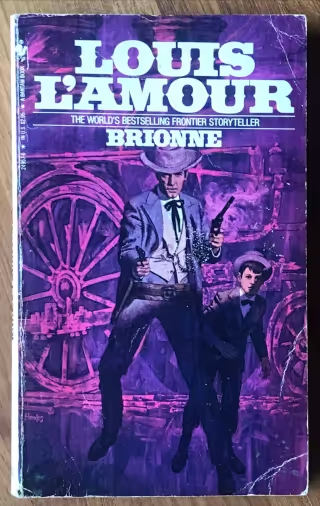 Brionne by Louis L'Amour, 1968
151 pages. Bantam Books; Paperback, 22nd printing.
ISBN: 0-553-20880-2
Another L'Amour western thriller. This time, a military officer's wife is killed by a family of ne'er-do-wells in "revenge" for his prosecution of their kin for crimes committed during and after the Civil War. Brionne takes his young son out west to start a new life, and quickly finds that his old life is trying to catch up with him. He must defeat the clan still after him, protect his son, and help an innocent woman retain her inheritance. The same basic story of grit and determination triumphing over evil intent, but once again well done. I see the appeal of these novels.
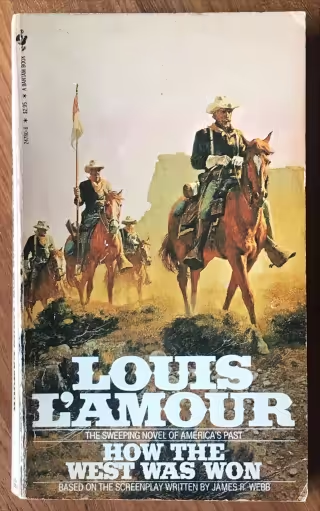 How the West Was Won by Louis L'Amour, 1962
248 pages. Bantam Books; Paperback, 27th printing.
ISBN: 0-553-20003-8
How the West Was Won is apparently a novelization of the motion picture of the same name (the way they get some science fiction author to novelize Star Trek: The Wrath of Khan). As such, the author is severely restricted in how to present the tale, and it's a convoluted and multi-arc story probably better suited to film than print. Still, L'Amour pulls it off with his usual easy-going style. It's nearly as easy to read as his more straightforward tales, with the caveat that it was sometimes difficult for me to remember which character was which when reintroduced (though to be fair, this is something I'm particularly bad at). The multiple narratives are interwoven between a number of different settings, delineated by sections: "The Rivers", "The Plains", "The War", "The Iron Horse", and "The Outlaws". It loosely follows a single family as they disperse and find their fortunes in various ways in the Old West, from about 1840 to 1890, I'd guess. Having never seen the film, I can only speculate, but I imagine there is little added detail in the book — it reads like a narration of movie scenes. Still, it's a decent set of stories bound together by bloodlines and torn asunder by the family's dispersal across the West from Ohio to San Francisco, Wyoming to Arizona. Not my first choice for a L'Amour western, but an interesting read nonetheless. Mild recommendation.
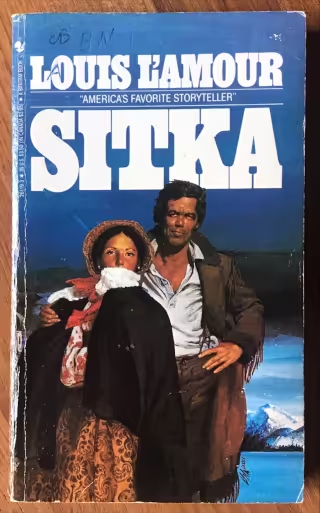 Sitka by Louis L'Amour, 1957
245 pages. Bantam Books; Paperback, 31st printing.
ISBN: 0-553-24289-X
An outsized adventure, even by L'Amour standards, it is the tale of Jean LaBarge, penniless orphan from the swamps of the Susquehanna in Pennsylvania, childhood friend of senator Robert Walker, fearless adventurer, shrewd businessman, formidable fighter and duelist, with dashing good looks only enhanced by a rugged scar. We follow Jean from the swamp to the West, through triumphs and reverses, where he learns everything from wheat farming to seamanship to fur trading. Still restless after amassing a small fortune, he becomes enamored of Russian America, its rugged beauty and its promise of even greater riches. He concocts a plan to insinuate himself into the Alaskan coast, where he can offer the mistreated Indian tribes better deals than the Russians for their pelts and blankets. The Russian port of Sitka is in dire need of provision, and he has the only wheat to be sold out of San Francisco. Seemingly insurmountable obstacles fall one by one as he makes his way to Alaska, Siberia, St. Petersburg, Washington DC, then back to San Francisco and Sitka. He consorts with royalty and thieves, serfs and Indians, gangsters and senators, endures hardship, beatings, bullet wounds, and prison. But his eventual triumph is never in question: only how his will and his wits will prevail in the end. A rollicking if unlikely tale, it's a light but decent read. In his typical style, L'Amour illuminates the more technical aspects of fighting, seamanship, royal and democratic politics, even the portage of seagoing vessels and the Russian equivalent of stagecoach lines. He sent me to the dictionary several times to learn what a particular nautical term meant, and sometimes they were obscure or dated enough that I just had to wait to see if they were explained later. I suspect these are shibboleths for those in the know, marking the author as one who understands the jargon and the geography, thereby burnishing his authenticity. The book does seem quite well-researched, especially considering available sources in 1957. A brief sojourn through southern Oregon (the only area in the book I'm familiar with) mentions towns and landmarks appropriately, and though fantastic, the transit is at least plausible. As usual, his fight scenes show a familiarity with unarmed combat. Unexpectedly, the pace speeds up quite a bit toward the end, as though L'Amour had planned a much longer novel. But the book's biggest drawback is that it sets its sights too high, while the outcome is never in question. Whatever the setback, we know our hero will always find a way out, against any odds, and triumph at whatever he sets his mind to. This makes the danger less dangerous, the suspense less suspenseful, and almost every outcome predictable. That said, LaBarge is a reliably heroic character, is easy to like, and gets in some very good lines. So if you're up for setting aside disbelief and reading an adventure where the bold, brave, and good prevail, Sitka is a whole lot of that.
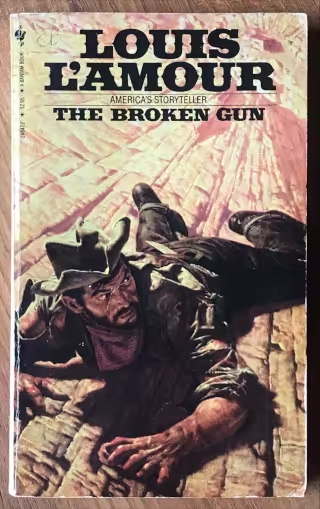 The Broken Gun by Louis L'Amour, 1966
151 pages. Bantam Books; Paperback, 30th printing.
ISBN: 0-553-23155-3
Set in "modern" times (the mid-60s, when it was written), but setting right an injustice from the 1870s. A writer researching a story (write what you know!) stumbles into a mystery that, if exposed, will endanger the ill-gotten gains of a powerful family in Arizona. Having narrowly escaped an "accidental" death on the trail, he has to survive and get word to the authorities. The remote setting he's lured to forces him to a struggle against both nature and man, as if 90 years of progress had never occurred. There are jeeps and telephones, but they may as well be horses and telegraphs as far as it concerns our protagonist. An interesting way to put a modern twist on what is essentially a 19th-century tale.
 Comstock Lode by Louis L'Amour, 1981
406 pages. Bantam Books; Paperback, 16th printing.
ISBN: 0-553-27561-5
At 406 pages, Comstock Lode is longer than a typical L'Amour by about twice, and has a comparatively complicated narrative. A few times I found myself thinking, "now, who is that guy? Never mind, it will either become clear later or be irrelevant". Unfortunately, the plot does rely quite a bit on various characters (including the hero, Trevallion), not having certain information and not communicating with those who do, even when it's a fairly obvious move. I can imagine psychological reasons why, and perhaps L'Amour intended to include more exposition on this, but pulled it when the book started getting too long. No matter. As published, the book is a little like those scary movies where you want to scream at the characters to do the obviously smart thing rather than continue putting themselves in mortal danger. But only a little like that. If you just roll with the premise that these people don't recognize or inquire about one another, the story is actually decent. The bad guy is atrociously bad, and the good guy scrupulous, but there are shades of black- and white-hat characters as well. In the short interview at the end of the book, L'Amour makes it clear that in his view there were almost no grey-hats in the West, and only a few who "switched sides" along the way. He believes that the lack of restraint and the need for self-reliance on the frontier revealed people for who they really were underneath. A reasonable position, I think.
It's a decent story with much detail about the Nevada territory, placer and hard-rock mining, boom towns, prospectors, and businessmen. I wouldn't put it near the top of L'Amour's accomplishments, but somewhere in the middle, mostly due to the characters' irritating lack of curiosity and follow-through. A good and relatively light read, despite its length.
 The First Fast Draw by Louis L'Amour, 1959
156 pages. Bantam Books; Paperback, 18th printing.
ISBN: 0-53-14538-X
The First Fast Draw is set in the borderlands of Texas, Louisiana, and Arkansas after the Civil War, where carpetbaggers are all that pass for law and well-connected miscreants run roughshod over our hero, recently returned from the west to claim his family's homestead. He decides that his best course of action is to learn to draw his pistol quickly and accurately, as he never knows when he may need to, and his opponents aren't honorable enough to give him a fair fight. Lots of local insight into the swamplands, thickets, and population of this part of Texas, and a satisfying story of justice and revenge.
 Buckskin Run by Louis L'Amour, 1981
175 pages. Bantam Books; Paperback, 15th printing.
ISBN: 0-553-24764-6
Buckskin Run is a collection of short stories, too many and varied to sketch here, interspersed with very short (typically one page) historical vignettes. I can see why some of these were never developed into full books, but they generally work well as they are. Fun to read when you're sick and just want a few minutes distraction at a time.
 Flint by Louis L'Amour, 1960
185 pages. Bantam Books; Paperback, 23rd printing.
ISBN: 0-553-20886-1
An unnamed foundling is taken in by a notorious gunfighter, known only as Flint. Flint sends him to boarding school on the proceeds of his job as a gun for hire. When his schooling is done, he accompanies Flint and learns the self-reliant skills of the range. When Flint is ambushed in a poker game and mortally wounded, the kid (now about 17) fights off his attackers and takes Flint out into the desert, where he dies. With nowhere to go, the kid takes a name and heads east, using his fine education and ruthless determination to build a substantial fortune. Many years later, with a diagnosis of terminal cancer, he decides to head back west and die in peace. But his plans are upset by a rival's coincidental meddlings in the area, and he takes his benefactor's name to set things right. Surprise: the good guys win, but it's well-written, with plenty of insight into the southwest, cattleman culture, the history of land filings, range wars, and so on. Well worth the short read if you find this sort of thing interesting.
 Killers of the Flower Moon by David Grann, 2017
377 pages. Vintage Books; Trade, 40th printing.
ISBN: 978-0-307-74248-3
Just finished Killers of the Flower Moon by David Grann. I really wanted to like this book, having listened to the Daniele Bolelli's excellent History on Fire podcast on it and the Osage murders, and not having seen the motion picture. And it's not a bad book — it just suffers from some weaknesses that vexed me (though I'm perhaps more sensitive than most). It's a maddeningly complex story, so kudos to the author for making even the subset of it he relates comprehensible. With such complexity, it's only natural that the reader might have some confusion over the characters and their importance to the story. Grann is additionally hamstrung by the requirement to keep to history: he can't simply ignore confounding facts or intermediary actors the way a fiction author (or screenwriter) might. So I present these caveats with confidence that I could do no better.
The first thing I noticed was the inclusion of colorful details, seemingly meant to draw the reader into the narrative, that seem invented. In relating the discovery of Anna Burkhart's body, he says:
|
"... the boy spotted a squirrel and pulled the trigger. There was a burst of heat and light, and the boy watched as the squirrel was hit and began to tumble lifelessly over the edge of a ravine." |
One can presume the grand jury testimony from which the account was derived included details about squirrel hunting, and the boy going down the ravine after a kill before finding the body, but "a burst of heat and light" reads like invented detail. Not only is it a bit overwrought, it leaves me with the suspicion that, however copiously end-noted the book (and it is!), certain specifics may have been added purely for dramatic effect. I had no such concerns with Steinbeck's openly fictional Cup of Gold, probably because it doesn't make any pretense at historicity. But this book is marketed as "literary journalism" and advises booksellers to file it under "history", so it bothered me a bit.
Also annoying was the author's (sometime) affinity for quoting descriptions of, not the thing in question, but similar things, again for added color. In describing Mollie Burkhart's journey to a Catholic boarding school, he writes that she rode "past shadowy blackjacks and sunless caves — perfect places, as a Indian Affairs agent once fretted, 'for ambush'". And on arriving at the school, that "Mathews" (from the notes, apparently the same Indian Affairs agent) "once described the entrance to another Osage boarding school as a 'big, black mouth, bigger and darker than a wildcat's'". Once again, maybe it's the purple prose that rankles, but Mollie was not in any danger of ambush, whatever the agent might later think of similar trees and caves. And shoehorning in a description of an entirely different school was just too much for me.
My most petty complaint is occasional awkward phrasing, though I am quick to add that the meaning is never in doubt. For example, "the private detective didn't arrive in Ponca City until dark, only to discover that Brown wasn't there", I find a bit clumsy. It would be much more straightforward to simply say that the detective arrived in Ponca City after dark, leaving the trailing clause to refer to his arrival, rather than his modified non-arrival. But there are only a few other instances I can recall, and only once did I have to look for context in following passages to resolve an ambiguity. It's more a lack of polish than anything else. I may be getting spoiled by L'Amour's and Connelly's laminar prose.
These minor caveats out of the way, it's a fascinating story that it doesn't appear to have been told in this detail until now. It's clear from the book that there is a great deal more to it, but that much of the truth of what actually happened may be irretrievably lost. I'd recommend the book to learn about the Osage murders, just not for recreational reading.
For an easier overview, Bolelli's podcast (based largely on this book) is also excellent.
 Cup of Gold by John Steinbeck, 1929
187 pages. Penguin Books; Trade.
ISBN: 978-0-14-303945-7
I'm only slightly familiar with Steinbeck's more popular works (The Grapes of Wrath, East of Eden, etc.), having never read them, either. By all accounts Cup of Gold is a very different sort of tale. A fictional biography of one of the most famous historical pirates, Captain Henry Morgan, it is light on the historical and big on the fiction. Steinbeck says as much in the subtitle: "A Life of Sir Henry Morgan, Buccaneer, with Occasional Reference to History". It's short, well-written, and interesting. I probably could have dispensed with the Penguin edition's 43-page introduction to a 187-page book. The former reads like a literature class lecture, while the book itself really holds one's interest. The pacing moves in fits and starts: there's a long and detailed introduction of Henry's adolescent decision to go to the Indies, and a considerable section on his transit, but once the buccaneering starts, most of the action is glossed over. The final conquest of Panama City (the eponymous Cup of Gold) is related in some detail, however. The real meat of the story, though, is the character of Henry and how his exploits are driven by childish ambitions, which are obliterated once he reaches the pinnacle of his success, leaving him with nothing but lesser, "grown up", respectable ambitions to pursue.
Stylistically, I like how Steinbeck doesn't tell you Morgan copied his uncle (the vice-Governor of Jamaica) in mode of dress, or that he's lying about a conquest. He simply describes Henry's new outfit the same way he described his uncle's, and tells the tale and later Henry's retelling of it. It's as effective as laying things out explicitly, but gives the reader credit for remembering, and somehow makes the appropriation more vivid and the casual lying more offensive. We get to notice the similarity and the dissonance, as if we were there, and our own discovery makes it more palpable. Steinbeck makes no excuses for Captain Morgan's attitudes, vices, and excesses, lending a ring of veracity to what is apparently a near-complete fiction. You imagine that a ruffian-turned-knight might have such offensive ideas, but the nobles he eventually consorts with are just as vile, despite (or perhaps because of) never having to get their hands dirty. One hopes they were at least a little better than this in real life.
 The Secret by Lee and Andrew Child, 2023
292 pages. Random House; Hardcover, first printing.
ISBN: 978-1-9848-1858-4
Another Lee Child (this time with younger brother Andrew) novel featuring Jack Reacher. Written in 2023, this one throws back to 1992 and Reacher's active-duty MP days. He's been busted down to captain for some undisclosed infraction in a prior installment (likely to avoid giving away a plot point in that book), and winds up assigned to a motley team tasked with finding a killer who's taking out members of a chemical weapons team from the late 60s. That the investigators comprise only misfits in their particular fields causes them to suspect they may also be convenient scapegoats should things go even worse.
So far, so good: Reacher gets to be the ultimate badass investigating an unrelated weapons smuggling scheme while the assassins (readers know there are two and something of who they are) rack up kills. We get introduced to the other players and something of their backgrounds. Then it starts getting implausible. The two female assassins have thus far been successful by audacity, surprise, and superior planning. Once the defenders are on to them and know the very short list of people they're likely to target, things should get a lot harder. But they're such badass girlbosses that one of them can defeat three armed agents hand-to-hand in their own venue, trick one of them into sending literally everyone else away, then disable him while handcuffed. The two reunite, discern in a few minutes everything the guarding agents should already know about the location (but don't because they're stupid), and escape. This is chalked up simply to the men underestimating them because they're women, which men always and ever will do. Which is insane. It's plausible when the police sergeant in The Matrix underestimates Trinity because he has no idea he's in a computer simulation that she's hacked and can thereby perform supernatural acts of violence having nothing to do with her stature. It's another thing entirely for an allegedly trained field agent to treat a known assassin like a shoplifter at Wal Mart, especially after he's just seen her beat two of his fellow agents into unconsciousness. How he knows they're not dead is left as an exercise to the reader. Why they're not dead is also an open question, but we are led to believe that for all their murderous intent, the pair are quasi-nobly motivated by the death of their father, and only kill those who worked with him (?), but not those defending them. Oh, and maybe a meth addict whose guns they need, but he might have survived as well — we don't know, and they don't seem to care. It's all very unsatisfying storytelling. The twist is visible miles away, but requires an inordinate amount of explanation in the tedious denouement to tie up the loose ends no one cares about any more because there have been so many they've lost count. Not recommended.
 The Body Keeps the Score by Bessel Van der Kolk, 2014
445 pages. Penguin Books; Trade, 55th printing.
ISBN: 978-0-14-312774-1
I recently read The Body Keeps the Score by Bessel van der Kolk, a popular presentation of a theory of traumatic experiences, their effects, and potential treatments. I've heard that it's a phenomenal introduction to an important new paradigm. I've also heard that it's completely backward and at odds with nearly all clinical experience. I'm not qualified to weigh in on this debate, but I'm of the opinion that the truth likely lies somewhere in between. The author explores (among other things) a relatively unexamined connection between the brain and the vast network of other neurons in the torso. While the exact nature and significance of this connection remains unclear, it seems to me to remain a viable topic of study. The book can both be wrong about what's actually going on, yet right to question why there is such a significant amount of traffic on the vagus nerve system, and to speculate on what it all means. It's true that the author has no qualms injecting his own medical, clinical, and even political opinions, but that doesn't automatically discount his hypothesis or methodology. It's an interesting read and alternative view of how vertebrates (and particularly humans, with our significant frontal lobes) react and adapt to trauma. My prior experience with qigong is a decent analogy: while I don't believe there's literal qi running through channels inside my body, I can still see this as a useful metaphor for what happens when you slow down, take deep breaths, consciously relax, and assume stances that promote circulation. Yoga, which gets more attention in the book, seems to me similar in purpose, if entirely different in its mythology. So I can take any of these (qigong, yoga, van der Kolk) as insightful without necessarily adopting their underlying explanations. I make no recommendation: if it sounds interesting, you might want to read it. If not, probably not.
 Op Center by someone other than Tom Clancy or Steve Pieczenic,
1995
Op Center by someone other than Tom Clancy or Steve Pieczenic,
1995387 pages. Berkley Books; Paperback, first printing.
ISBN: 0-425-14736-3
Op Center is not explicitly written by Tom Clancy or co-creator Steve Pieczenic. I'm not sure if they just came up with the concept and characters, or if their involvement also extended to writing or review. Anyway, it's certainly a Clancy-esque tale of high intrigue and small unit tactics on the Korean peninsula, but doesn't land quite as hard as a legit Clancy novel. Told from multiple viewpoints, the plot doesn't rely on anyone being particularly dense or uncommunicative, which is a relief after some of the lazy storylines I've seen in movies and elsewhere lately. Everyone is pretty sharp and is pursuing their own goals, most of which are noble or at least ambitious. Still, it's the kind of book that would make a good action movie, but not something you'd come back to again and again. This book is OK if you like the genre, but not something special.
 The Last Coyote by Michael Connelly, 1995
408 pages. St. Martin's; Paperback, 5th printing.
ISBN: 0-312-95845-5
Having not realized this was a Harry Bosch novel, it sat on my shelf unread even as I watched the entire Bosch series on Amazon. Very well written and taut with suspense, it's a great break from the sloppy writing of The Rig television series. Harry's more of an a-hole in the books, but even he isn't resigned to going through the motions the way the cops in the TV series On Call are. In his own belligerent way, he's deeply concerned about the victims for whom he's seeking justice, and even the unintended consequences of his reckless actions. While the book relates an extreme circumstance, the characters act in understandable, if not always appropriate ways. There's no sense that they're doing the one dumb thing that will move the plot ahead. Bosch makes an immense blunder out of spite and malice, but you understand why, from his perspective, it's justifiable. And he owns up to the consequences internally, while still striving to keep his actions from destroying his life and reputation. Not exactly a role-model, but super relatable. In short, he's a real human with flaws and qualities, who reconciles this with himself and select others, because he grew up, and still lives, in a world where trust gets you hurt. Recommended.
 Theft of Fire by Devon Eriksen, 2024
x pages. Self-published; Trade, printed on demand.
ISBN:
Starts a bit slow, but it's good, hard science fiction with plenty of explanation of why the physics work that way. Reminds me of old Heinlein, before he got all weird. The Moon Is a Harsh Mistress, not Number of the Beast. Plus, the characters (essentially just three) are whole individuals who reflect on themselves and their values. Despite going after an alien artifact with unknown properties, the weirdness factor is extremely low — physics works like you'd expect (and if it's counter-intuitive, that's explained succinctly), people react the way you'd expect (or can imagine), and it's all very grounded. It gets even better in the last 100 pages, and I strongly recommend it — it's quite the debut for a self-published author. I didn't realize until I got to the end that it was published just for me in Troutdale, OR the day after I ordered it and the day before I received it. It says so right on the back page. Looks for all the world like a trade paper from a major publisher. Anyway, the plot remains strong, and the characters come up with creative (but in the end explicable) ways of getting out of most of their tough situations. There's clearly going to be a sequel, and I know from the author's Twitter postings that it's well underway. I'm looking forward to it.
 Master of Middle-earth by Paul H. Kocher, 1972
233 pages. Del Rey Books; Paperback, first Ballantine edition, 1977.
ISBN: 0-345-27242-0
Master of Middle-earth by Paul Kocher is a summary and critique of Tolkien's writings. I was unimpressed and a little disappointed with the first couple of chapters, but the insights seemed to get a lot better thereafter. I was entirely unaware until reading this that in medieval Catholicism, despair was considered a mortal sin — a loss of Hope, one of the cardinal virtues. Seems there are a couple of minor Tolkien works I should read as well.
 Still Life with Woodpecker by Tom Robbins, 1980
277 pages. No Exit Press; Trade, 2001.
ISBN: 978-1-84243-022-4
Still Life with Woodpecker is better than Palahniuk's Pygmy. The story is just as silly, mind you, but more abstruse: you're never quite sure where it's going. Once again, the highlights are the turns of phrase and illustrations, sprinkled at random and without fanfare (or warning) throughout. I'd be happily reading along, and hit a particularly hilarious description of something mundane and ancillary to the plot, and have to set the book down for a bit, or read the passage to my wife. I can see why authors like Robbins, and this book in particular. He has that Kurt Vonnegut I'm-the-author-I-can-do-whatever-I-want attitude, talking directly to the reader as author without a care for convention. Plenty of random things happen, but none of his characters goes nonlinear the way Palahniuk's (or Stone and Parker's) occasionally do. It's a higher-order satire, I guess.
 Pygmy by Chuck Palahniuk, 2009
241 pages. Doubleday; Hardcover, first printing.
ISBN: 978-0-38-52634-0
Pygmy is written entirely in the broken English of a communist spy from an imaginary country sent to destroy America from within. The word choices are occasionally hilarious, but the story can be quite disturbing at times. It does work as a simultaneous critique and celebration of America, but you have to take it like a South Park episode for realism: things happen (and more importantly, people do things) that are vanishingly unlikely, for comic effect. Once I oriented my expectations appropriately to the genre, however, I was able to settle into it.