Media: What I'm Reading, Watching, and Listening To
When I worked for the Corps, after we got sent home for COVID, I started a Teams channel for sharing recommendations on streaming content. This quickly led to me including impressions of books I was reading as well. This page is something of a continuation of that.
When my wife and I lived in Portland, we had one of those neighborhood libraries-on-a-stick. You know the kind: where people take and leave books for free. Like most, it consisted primarily of romance novels and religious tracts, so it wasn't very interesting. But after moving to King City I found the local library-on-a-stick also contained worthwhile reads. So with an easy and steady supply of decent books, I started reading more, and more broadly, than when I had to choose and buy books on my own.
Also, in 2025 I discovered that not only was there a local C. S. Lewis Society chapter, but three of them: Newberg, Beaverton, and Salem. Salem was a ways to go, and Newberg was on a break until fall, so I started with Beaverton, later joining the Newberg group as well. This further expanded my horizons, especially since the Beaverton group includes lots of Lewis-adjacent literature like Chaucer, Chesterton, Grahame, MacDonald, Tennyson, Tolkien and Williams; and their December meeting is always devoted to recommendations.
Note: the following are just my own impressions of things I've engaged with recently. I'm not an author, producer, musician, or professional reviewer, so I don't necessarily know what I'm talking about. If I didn't like your favorite book, show, or album, or if I liked some trash you can't stand, don't despair: I'm just some rando on the Internet.
20-Oct-2026
 Tyrannosaur Canyon by Douglas Preston,
2005.
Tyrannosaur Canyon by Douglas Preston,
2005.365 pages. Forge; Hardcover. First Edition,
ISBN: 0-765-31104-6
Tom Broadbent and Sally Colorado (now Broadbent) return after their adventures in The Codex. Tom, despite inheriting 100 million dollars in the previous book, is still a large animal vet in New Mexico, but has restored a very nice classic pickup truck. His new wife is now a children's equestrian instructor, having set aside archaeology. She is much more pleasant this time around.
I can't get into the plot too much without revealing the layers of mystery that are revealed throughout the book, so I'll keep to things that are known early. A prospector / treasure hunter has found something in the desert near Tyrannosaur Canyon, and is ready to lay claim to it. But someone is following him, and shoots him from an overlooking cliff. Tom, riding the range late in the day, hears the shots and investigates. With his dying breath, the man gives Tom a notebook and makes him promise to give it to the man's daughter, Robbie, and not the police. Tom agrees and, though he later reports the murder, he holds back the notebook, intending to find the daughter and fulfill his promise. After Tom has left to summon the police, the killer arrives at the scene and loots and hides the body.
The notebook contains nothing but many pages of numbers, painstakingly written out longhand, so Tom takes it to a desert monastery and a former CIA cryptanalyst studying to be a monk. They figure out what the treasure is and try to locate it before the killer, his employer, and any other interested parties do, all while keeping the police at bay until the man and his daughter can be identified.
It's a better book than The Codex, but not so good as Extinction. There's plenty of action and intrigue, lots of plausible, if not necessarily accurate science, and the pacing is swift. The opening sequence of Apollo 17 on the moon is not tied in to the plot for quite a while, leaving the reader to wonder just how it fits in, which I found intriguing.
The good guys are quite good, and the bad guys are truly despicable — but never quite get the opportunity to carry out their most sordid plans. I get it: you don't want to gross out your reader with traumatic details, but you still want an unsympathetic bad guy. I tend to prefer more nuanced villains, but I must admit that such irredeemable ones are common to the genre.
It's a quick and very easy read. Preston has given up showing off his vocabulary, and uses precise, but relatively common words, explaining most of the unusual ones (I looked up gymkhana — which reminded me of a bad martial arts movie — but the context was sufficient enough that I didn't strictly need to). The chapters are short and punchy, with events and dialog that move the story forward at a rapid pace. Like many thrillers, it would make a good airplane read. Mildly recommended for those who like the genre.
11-Oct-2026
 A Connecticut Yankee in King Arthur's Court by Mark Twain,
1889.
A Connecticut Yankee in King Arthur's Court by Mark Twain,
1889.319 pages. Heritage Press; Hardcover, 1942.
No ISBN
This was the October selection for the Beaverton C. S. Lewis Society, as Lewis mentions it in Surprised by Joy and a couple of letters. He was not a fan, though he appreciated The Adventures of Huckleberry Finn, and I find I agree with him on both points.
Straight off, I noticed something odd. Twain has a seemingly unexamined assurance of the 19th-century vision of Progress. He appears to believe that history is a one-way ratchet that turns ever toward the good, and that later necessarily implies superior. This assumption is presented without argument, as if self-evident. His preface begins:
The ungentle laws and customs touched upon in this tale are historical, and the episodes which are used to illustrate them are also historical. It is not pretended that these laws and customs existed in England in the sixth century; no, it is only pretended that inasmuch as they existed in the English and other civilizations of far later times, it is safe to consider that it is no libel upon the sixth century to suppose them to have been in practice in that day also. One is quite justified in inferring that whatever one of these laws or customs was lacking in that remote time, its place was competently filled by a worse one.
And the same attitude persists throughout the work. The main character, Hank Morgan, a rough-and-ready industrial engineer of 1879 Hartford, is transported back to 6th-century Britain, and immediately sets about fixing its myriad problems. These include the monarchy, the Established Church, slavery, superstition, and uncleanliness. So far, so good. But his attitude toward the aristocracy, the clergy, and the great bulk of commoners borders on, and usually trespasses into, disdain. While expressing his disgust with the superior attitudes of the nobility and clerisy, he ironically displays the same self-satisfied arrogance.
While purporting to tell a silly tale of technology in medieval times, the book is mostly a polemic against pre-19th-century attitudes toward everything from government to science to religion. Twain sounds almost Marxist at times, but I must bear in mind that he is writing in 1889, before the Bolshevik revolution, before Stalin, Mao, or Pol Pot. Utopia sounded pretty good, and had never been tried. Many genuinely believed that a communist state would be a great improvement, particularly given the excesses of factories and company towns that were only later banished by organized labor and government regulation. Still, Twain's iron-clad certainty that Progress would sweep in a golden age if only the commoners would rise up, kill the aristocrats (he speaks highly of the French revolution's Reign of Terror), and seize their wealth is disconcerting from this side of the 20th century.
While Hank is perpetually certain of his superiority, he occasionally takes a promising young man under his wing to train in the enlightened views of the future. There are mishaps along the way, but none have to do with Hank's overweening hubris — events at all times confirm that he is completely in the right. As such, it's not a very interesting story, nor a very convincing diatribe. If you don't already hold Twain's views, you're not likely to be convinced of them by his narrative.
Toward the end of the book, Hank sets up a ringed defense around Merlin's cave to hold off the whole of the English nobility. Twain goes into certain details of its construction, which reminded me of Ringworld's "engineering" style, aiming to gratify the reader with the elegance of his technical solution. But the solution is mostly perfunctory, with significant details being glossed over. Others have commented that Twain was under financial pressure to publish, which may help explain the quick wrap-up at the end.
Taken in full, I found this book quite distasteful. Even when I did agree with Twain's viewpoint, I found his declarative and derisive presentation embarrassingly arrogant. When I disagreed, he was just irritating. In this, Twain may have more in common with Tom Sawyer than I previously suspected. Not recommended.
24-Sep-2026
 Ringworld by Larry Niven, 1970.
342 pages. Del Rey Books; Paperback, 1981, 15th Printing.
ISBN: 0-345-29301-0
Having returned an unfortunate costume purchase at Goodwill, I found myself with roughly $8 of credit, so I got this and three other paperbacks. I own a copy of The Ringworld Engineers, but couldn't remember exactly which other Ringworld books I'd read. The Ringworld is so huge and varied that it's difficult to remember which of the several encounters in each book occur where, and the series itself is somewhat episodic. It turns out I'd read this before, but I didn't mind.
Story-wise, Ringworld is definitely the "engineering" style of science fiction. Niven has done his calculations, and a lot of the "awe" (at least initially) is in the details of the engineering, rather than the kappa element of a heretofore-unknown artifact world. But both elements are present, and the otherworldliness survives multiple readings in a way the appreciation of the design does not. And, of course, the calculations are only sufficient to write a novel, not build a world. Famously, there were signs at sci-fi conventions declaring "the Ringworld is unstable!" Yes, you're very clever, now go write your own novel and show us how easy it is.
Since it's a book for humans, the narrative introduces nothing that cannot be comprehended by human-level intelligence. The few things that are beyond human understanding (mostly ancient alien technologies) become de facto tools and/or weapons. Niven is right that the distinction is often arbitrary. The Ringworld Engineers are both more and less advanced than the explorers who visit the remnant of their world. In Ringworld, the universe is a puzzle that can be solved a number of different ways, but they are like tech levels in human civilization: fire, the wheel, stone, bronze, iron, domestication, agriculture, writing, gunpowder, printing, etc. A society may be ignorant of one and work around it (Mayans didn't use the wheel), but they're all solving the same problems.
If there is a cautionary tale in the fall of the Ringworld, it is not to put all your eggs in one basket, no matter how large and impressive. Catastrophe that takes out one civilization can be survived if there are different approaches in different civilizations. The impracticality of doing so is tacit in the revelation that the Ringworld and all its tributary worlds fell at the same time, and for the same reason. As we stare into the abyss of self-improving artificial intelligence, it's sobering to realize there's no practical way of avoiding it, nor of containing its effects to just part of human civilization.
I enjoyed Ringworld a second time around. It's very 1970, so there are both high-minded and low-brow elements. And it's unapologetically speculative. Teela Brown has been selected for being "lucky", and this seems to be a real force in the universe. The tasp (which stimulates the pleasure center of the brain directly) is the ultimate drug and the ultimate instrument of enslavement. Prill is a millennia-old courtesan with her own finely-tuned methods for persuading men. Niven starts with these and other fabulous premises, but plays it mostly straight from there, which I appreciate. Recommended.
19-Sep-2026
 The Codex by Douglas Preston, 2004.
396 pages. Forge; Hardcover, Second Printing.
ISBN: 0-765-30700-6
A techno-thriller about an eccentric grave robber and art collector who, dying of cancer, decides to bury himself with his treasures, and bequeaths his estranged sons the task of finding and raiding his tomb. Among the 500-million-dollar hoard is the only copy of an ancient Mayan codex containing centuries of wisdom about medicinal jungle plants and creatures. Due to a breakthrough in the study of Mayan hieroglyphics, it can now be decoded, and is potentially worth billions to the pharmaceutical industry.
This book wasn't quite what I was expecting. It has lots of action, but I found little of the awe, wonder, and atmosphere that C. S. Lewis called the "kappa element" (from Greek κρῠπτόν (krypton): "concealed, hidden, secret"). Judging by the title and cover, I expected to be transported into an otherworldly setting, mysterious to both myself and the characters. But to these characters, the unknown is simply the unobserved, and can hold no real surprises. The jungle is a technical problem to be solved, not a mystifying primal landscape. Mayan temples are remnants of an ill-understood, but entirely comprehensible culture. Even the Indians in the book are shrewd to the realities of Western understanding supplanting their traditions — several dream of escaping to America. Their supernatural beliefs are sometimes humored by the Westerners, but never taken seriously. It is often hard to tell whether they are beliefs at all. They seem almost the kind of superstitions modern Westerners have about lucky numbers or horoscopes: a fun diversion, or a tie-breaker for decisions you're not sure about, but never something that would override your knowledge or common sense.
I found Sally, the female lead, to be abrasive and haughty. She is unshakably assured of her own superiority and lacks humility in dealing with others, particularly men. Early on, she upbraids Tom, the male lead, for being surprised she's not wearing an engagement ring, and that her fiancé doesn't have a problem with her going into the jungle alone with another man. She is disappointed that Tom is so unenlightened. But what is she expecting? That he share her every view on marriage and relationships, to exactly the same degree? Would she defer to someone even more "enlightened", who decried marriage and sexual exclusivity in all forms? Early on, Tom is cowed by her cutting remarks, and only comes out of his shell after she has moderated somewhat. By the end of the book, she's given up on her engagement and started sleeping with Tom. At this very point in the story, as if to make this decision palatable, the fiancé is exposed (in a cut scene, unbeknownst to Sally!) as more interested in money than his work as a world-renowned Mayan hieroglyphics scholar.
Throughout, the characters are somewhat flat, such as you might find in an action movie — there are obvious good and bad guys, and they stay in their respective lanes. It's as if Preston is trying to pitch this as a screenplay, complete with an adorable baby monkey that joins the quest.
As I'm probably guilty of this myself sometimes, I'll tread carefully, but Preston frequently uses uncommon words without enough context to deduce their meaning, which feels to me like an intellectual flex. The one exception I noted was a Pulaski, or fire axe, which he immediately defined, lest no one know what he was talking about.
I realize I've been bagging on this book for several paragraphs, and I want to clarify that I didn't hate it. It's got lots of action and tension, is well-paced, and holds your attention. But Preston has definitely gotten better in the 20 years between this book and Extinction, which I truly enjoyed, and does have a good deal of kappa element to it. The Codex looked promising, but in the end was disappointing. Not recommended unless you're just after the thrills.
19-Sep-2026
 Estate and Trust Administration for Dummies by Margaret Atkins
Munro, EA and Kathryn A. Murphy, Esq., 2013.
Estate and Trust Administration for Dummies by Margaret Atkins
Munro, EA and Kathryn A. Murphy, Esq., 2013.390 pages. John Wiley & Sons; Trade, Second Edition, 8th printing.
ISBN: 978-1-118-41225-1
Since my wife and I are updating our estate plan, we went and talked to our tax attorney, who overwhelmed me with very specific jargon employed in very round terms. Because of this, I kept getting hung up on distinctions. So I asked if he could recommend a book that gave an "estate 101" introduction to the concepts. He wavered and finally dug this book out of the back room to loan me. While written for the layman tasked with being an administrator, executor, or trustee, it necessarily explains a lot of the terms and concepts of wills and trusts, and is helpful in developing an understanding of the issues involved.
Make no mistake: this is primarily a reference book, and not intended to be read cover-to-cover. It's organized so that an inexperienced executor or trustee can go to the pertinent section to his or her situation and follow the guidance contained there. As such, it's terribly dull to read straight through. Each section tries to be as complete as possible, defining all the terms you're likely to encounter in that situation, many of which do not apply to my own. But it did give me some confidence that I had been at least exposed to all the concepts I'd likely run across in estate planning, and for that it was helpful. Not recommended unless you're an executor or trustee, or you really want a broad overview of everything pertaining to estate planning and administration.
12-Sep-2026
 Of Other Worlds by C. S. Lewis, ed. Walter Hooper, 1966.
148 pages. Harcourt Brace Jovanovich; Trade, First Harvest Edition, 1975.
ISBN: 0-15-667897-7
This was the September selection for the Beaverton C. S. Lewis Society. I had read it previously, but quite some time ago. Since then, I have read more of the books Lewis references, which helped me better understand his thoughts on literature.
In "On Stories", Lewis posits that there is a superior way to read a story for the story (as opposed to for the characters or the moral), and that is to seek the awe, the wonder, the way it transports you to a different place or state of mind. Conversely, he maintains that to read a story simply for the thrills (caring nothing for any "otherness" contained in it) is to read it poorly.
"On Three Ways of Writing for Children" attempts to categorize possible methods for children's authors. You may write for your own child, thereby meeting that specific child's needs. You may write about interests you share with children, effectively writing for your own juvenile needs. Or you may try to give children what you imagine they want. But in doing so, you can easily fail to meet children's needs, and end up writing a bad story, which will satisfy neither child nor adult. Stories written the first two ways should be enjoyable for adults as well.
In "Sometimes Fairy Stories May Say Best What's to Be Said", Lewis introduces the idea of Author and Man as distinct entities within the writer. The Author is the artist who has a story to tell, and the Man must decide whether it is worth pursuing.
"On Juvenile Tastes" disputes the common perception that children and adults have distinct preferences in literature. For Lewis, one should not outgrow children's literature, just as one does not outgrow liking a particular food. If done properly, a children's book can be a lifelong source of enjoyment.
In "It All Began with a Picture", Lewis discloses part of his writing process for fiction, which always begins with mental pictures, such as the faun with an umbrella which precipitated The Lion, the Witch, and the Wardrobe.
In "On Criticism", Lewis takes to task certain literary critics for abandoning the text itself, in favor of commenting on how the book was written or what it means allegorically. He is convinced they are ill-equipped to make these assertions, even for contemporary writers, but especially for safely dead ones who cannot defend their work. He encourages critics to talk about the quality of the writing rather than what psychological traits might have begotten it, or using words to describe how the author might have come to put it that way (e.g. "labored", "inspired", "perfunctory"), which say little about the text itself.
"On Science Fiction" explores the genre, and how it can liberate the author to write speculatively or simply be used as a prop tacked on to a conventional story.
"A Reply to Professor Haldane" is an incomplete, unpublished response to J. B. S. Haldane's critique of Lewis' That Hideous Strength.
"Unreal Estates" is a transcript of a recorded conversation between Lewis and science-fiction authors Kingsley Amis and Brian Aldiss.
The final section consists of short stories. In The Shoddy Lands, Lewis sees the world through the shallow mind of a former student's fiancée, and feels somewhat superior until he considers what his own mind might look like if so observed. Ministering Angels is a comedy about central planning "helping" scientists isolated on Mars. Forms of Things Unknown is a Twilight-Zone-like story of lunar exploration and the embodiment of myth in other worlds. After Ten Years re-imagines the sack of Troy and its aftermath from Menelaus' perspective.
Most of the pieces are early drafts and several are incomplete. Some reiterate points made in other works. But they all bear the stamp of Lewis' careful and insightful mind, and I found the book once again rewarding. Well recommended.
1-Sep-2026
 Midnight in the Garden of Good and Evil by John Berendt, 1994.
388 pages. Random House; Hardcover, 5th Printing.
ISBN: 0-679-42922-0
I thought this book was about New Orleans for some reason, but while it contains plenty of weird characters, graveyards, and voodoo, it's all about Savannah, Georgia and the real-life murder trial of Jim Williams, a local antiques dealer and socialite. I looked into it, and while some of the characters have been renamed or altered somewhat, they're apparently all based on real people.
And the characters are what the book is really about. The Williams trial holds it all together, but the bulk of the narrative, and almost all of the satisfaction in reading, comes from the strikingly odd characters. I hesitate to even hint at the composition of the players, since their introductions are always entertaining and often comic. The years Berendt spent immersing himself in Savannah's culture make him an ideal candidate to the initiate the reader. His outsider perspective draws the reader in so effectively that one comes to love the quirky, isolated city just as the author does.
Midnight in the Garden of Good and Evil is a great book for those who read for the characters. While there's plenty of uncertainty as to the fate of Williams, suspense takes a back seat to the offbeat setting in which the trial, and so much else, occurs. Not a murder mystery or courtroom drama, this book is a celebration of Savannah and her people, imperfect as they both are. Well recommended.
26-Aug-2026
 The Paradise War by Stephen R. Lawhead, 1991.
477 pages. Thomas Nelson; Trade, 9th Printing, 2006.
ISBN: 978-1-59554-219-9
I found this book in the library-on-a-stick. I had heard of Lawhead's Pendragon cycle, and that it was a faith-positive sort of story. So I was naturally concerned that this volume might be "Christian fiction", the way "Christian rock" frequently is: heavy on the (vaguely evangelical) doctrine and light on actual quality. I was relieved to find it both entertaining and not at all preachy or dogmatic. The narrative is by no means allegory. Lawhead is perceptibly Christian, but really only in his world building and choice of references. For example, there's a scene reminiscent of Moses' arms being held up by others during battle. If you've seen it before, it's recognizable, but if not, it's not a bad story element in itself. Lawhead has been compared to Tolkien, which I find a bit of a stretch, but they both write about truths and virtues that are by no means unique to their particular faith.
Lawhead is colloquial and even playful in his dialog, particularly while the narrator (Lewis Gillies, American scholar of Celtic mythology at Oxford) is in the "manifest" (that is, ordinary) world. Once he travels to the Otherworld, the tone of his speech begins to shift to become more serious, stately, and consequential. At first, I thought Lawhead (who himself lives in Oxford) was British and missed some Americanisms (e.g. Lewis says "candy floss" instead of "cotton candy"), but it turns out he's from Nebraska, so I guess Lewis (like Lawhead) has just been at Oxford long enough to adopt the local vernacular.
My main complaint with The Paradise War is that the main character can be a bit obtuse. He has travelled to a magical world via magical means, yet still discounts the possibility of magic, even when it's the most obvious explanation for observed facts. If you remember the 1984 film Dune, it's a bit like when Paul Atreides keeps wondering aloud if the worms and spice are related. Lewis is similarly befuddled about the what's going on in the world he's spent several years in, while we who've only been reading for a couple of hours already have a pretty good idea. I tried to imagine how his incomprehension might be in service of some plot point, but was unable to do so. It seemed the situation wouldn't allow him the latitude to act even with additional insight. So this is more of a personal quibble than a true problem with the story.
On the whole, I enjoyed The Paradise War. Lawhead blends Celtic folklore and epic fantasy into an engaging story about a crisis between worlds. It is well-written and interesting reading — as evidenced by the fact that I took it on vacation, expecting to (as usual) never crack it, but ended up reading the whole thing. Recommended.
15-Aug-2026
 Animal Farm by George Orwell, 1946.
141 pages. Signet Classics; Trade, 1996, 32nd Printing.
ISBN: 978-0-451-52634-2
I'd read excerpts and summaries, but had never read the book cover to cover, so when this showed up in the library-on-a-stick, I nabbed it. Exactly which historical figures are portrayed in the allegory is less obvious than I expected, but I imagine a lot of this is due to my 80-year distance from its publication. It's only natural that I'm not as familiar with Stalin's Soviet Union as were contemporary readers. The Signet preface helpfully identifies Napoleon as Stalin, and Snowball as Trotsky, but if there are subtler analogues for Squealer, Minimus, etc., I lack the insight to identify them. I suspect many of the characters are instead stand-ins for groups or types of people.
The message of the book is primarily anti-totalitarian, and I agree with it as far as it goes. But it doesn't come across as saying "thus always goes communism" (a message which seems to have been borne out since 1946) as much as "beware, lest your socialist revolution devolve into like exploitation". Orwell appears hopeful there might yet be socialism without totalitarianism, and that it might be the best among imperfect options. I'm not so optimistic, unless you count existing western free markets with social safety nets as "socialism" — contemporary advocacy for "democratic socialism" certainly does not. Even the allegedly "model" Scandinavian systems have significant private sectors and economic freedom. Democratic socialists hold them up as socialist success stories, but are proposing something far more radical under the same name.
I enjoyed Animal Farm. It remains first-rate satire, chronicling the true believers' betrayal by, and gradual alienation from, the movement to which they devoted themselves. Far from being outdated by its context, it is a cautionary tale for anyone tempted to revolutionary fervor, whether left or right. Recommended.
12-Aug-2026
 The Runaway Jury by John Grisham, 1996.
401 pages. Doubleday; Hardcover, First Edition.
ISBN: 0-385-47294-3
I'd of course heard of John Grisham, and even this title, but I don't believe I'd ever read anything by him prior to picking this up.
A major tobacco company is being sued for the lung cancer death of a 35-year smoker. It's 1996, and no such case has ever been decided for the plaintiff. But even with a perfect record, the entire tobacco industry is still bankrolling the company's defense, because they realize that once an award is granted, it will be open season on all of them.
Both the tobacco consultants and the personal-injury lawyer bringing the case resort to illegal jury manipulation in an effort to sway the verdict. But one juror is an enigma, seeming to come from nowhere, and soon both sides are contacted by a shadowy figure claiming to be able to deliver whatever verdict they want, for a price to be determined once jury deliberation begins. She gets their attention by predicting the clothes, reading material, and unpredictable actions of jurors ahead of time. Clearly, she has both inside information and serious influence.
While still using their own tactics to pressure jurors, the consultants for the defense come to realize this mystery pair have enormous sway, and can likely deliver on their promises — and threats. They decide to treat with them, while frantically trying to uncover their well-buried past.
I will not give away the ending, but it is Hollywood-compatible. I was not at all surprised to learn that the book was adapted into a film in 2003 (replacing tobacco with firearms, since tobacco had already suffered enormous judgements, undercutting a major plot device).
What sets this book apart from most other legal thrillers I've read is that for the bulk of the narrative, the reader is not privy to who the mystery pair really are, or what their motivations might be. Usually, the big question is who did the crime, or (knowing the truth) will justice be served or subverted? In this book, almost every character is in some way corrupt or corruptible. It's unclear whether there are any "good" guys, and if there are, how tainted they're willing to become to attain their objectives. For this reason alone, The Runaway Jury is compelling reading. Recommended.
9-Aug-2026
 The Golden Ass by Lucius Apuleius, c. 150-180; tr. William
Adlington, 1566; ed. F. J. Harvey Darton, 1924.
The Golden Ass by Lucius Apuleius, c. 150-180; tr. William
Adlington, 1566; ed. F. J. Harvey Darton, 1924.359 pages. Navarre Society; Hardcover, 1924.
No ISBN
The August selection for the Beaverton C. S. Lewis Society, this work relates (among other things) the story of Cupid and Psyche, upon which Lewis' book Till We Have Faces is based.
While the main story is of Apuleius himself being transformed into a donkey, and his resulting adventures and troubles, it is also interspersed with unrelated tales told by companions, or overheard. In this way it's something like The Canterbury Tales. And like Chaucer, the stories also vary in their subject and seriousness, including thoughtful retellings of classical myths (such as that of Cupid and Psyche), cautionary tales, and comic romps.
I was warned that some of the narrative is "smutty", but it didn't seem so to me. While the subject matter sometimes touched on indecent or immoral acts, I didn't detect any particularly lascivious or voyeuristic detail. I will note that my translation is from 16th century England, and if the original Latin contained more explicit passages, they may have been glossed or simply left out. The editor's introduction makes it clear that Adlington focused on rendering the story in attractive English instead of producing a close translation. Given Elizabethan cultural standards, it's understandable that any lurid passages might be expunged or demurely summarized.
Again, like Canterbury, the stories themselves are generally entertaining, though some can bog down in secondary detail. The Golden Ass lacks the (for me) added benefit of rhyming verse, but I know for many this will be instead a welcome difference.
Not knowing very well what to expect from this book, I was happy to find it accessible and surprisingly legible, the editor having updated and standardized the Elizabethan spelling. A little knowledge of Greek and Roman mythology (which is all I have) helps, but nothing in the story seemed to hang on extrinsic knowledge — I cannot say the same for the introduction, which is rather coy in its Roman historical references. But all in all, this was a fun and relatively simple read, and gave me what I hope is a glimpse into the mindset of a second-century Roman. Recommended.
UPDATE: I was the only person to at the C. S. Lewis Society to use the Adlington translation, and most everyone else was to some degree repulsed by their translations' more complete and accurate depictions of certain sexual and violent acts. So a warning to the reader: there's apparently some pretty sick stuff in there.
5-Aug-2026
 Two Kinds of Truth by Michael Connelly, 2017
402 pages. Little, Brown and Company; Hardcover, First Edition.
ISBN: 978-0-316-22590-8
Still more delicious easy reading from Michael Connelly and my local library-on-a-stick. This showed up with The Wrong Side of Goodbye, is the next in the Bosch series (#20), and also gave me a sense of déjà vu, since this book was the basis for the fifth season of the Bosch TV series, which I'd seen previously.
Once again, there are two stories intertwined: one about an old LAPD case where Harry's integrity is being called into question, and another about a double homicide in his new jurisdiction, San Fernando. In the old case, a prisoner on death row has a new attorney who has brought in seemingly exonerating evidence that simultaneously implicates Bosch in planting the original evidence. Harry knows he didn't do it, so he has to find out what's wrong with the new evidence. The new case involves father-and-son pharmacists killed in a small local farmacia, medical fraud, opiate addiction and trafficking, and organized crime. Bosch goes deep under cover to infiltrate the criminal organization and unmask the killers.
Both stories hold the reader's interest, and their interplay makes the successful resolution of each more doubtful. Once again Harry's half-brother Mickey Haller (The Lincoln Lawyer) is involved, and is pivotal to the resolution of the death-row storyline. Two Kinds of Truth puts Bosch in greater danger than usual, but despite expecting he's going to at least survive somehow, there's still a good deal of tension.
As a bonus, Connelly adds an essay at the end documenting his journey from witnessing a fleeing suspect as a teen, to voraciously reading crime novels, to eventually writing them. Two Kinds of Truth is one of the better Bosch novels I've read, which is saying something. Recommended.
3-Aug-2026
 The Wrong Side of Goodbye by Michael Connelly, 2016.
392 pages. Little, Brown and Company; Hardcover, First Edition.
ISBN: 978-0-316-22594-6
What can I say? Another riveting, easy-reading, entertaining Harry Bosch thriller from Michael Connelly. While perhaps not quite as good as The Brass Verdict, this volume also unites Harry with his half-brother Mickey Haller (aka The Lincoln Lawyer), and the result is once again satisfying.
Early on, I got the sneaking suspicion that I'd read this book before — parts of the story sounded very familiar. Eventually, I checked and discovered this was because the book was used as source material for the first season of Bosch: Legacy, which I'd watched on Amazon Prime a year or two ago.
There are essentially two plots intertwined: a dying billionaire searching for a possible heir, and a serial rapist terrorizing the San Fernando valley. Weaving the two together keeps the action taut and adds a bit of uncertainty as to where the danger will come from next.
Like all the Connelly books I've read thus far, I enjoyed The Wrong Side of Goodbye. It's a bit pat and "Hollywood" in the ending, but forgivably so. Despite being nearly 400 pages, it's a quick and easy read, again courtesy of Connelly's spare and linear prose. Two good stories in one book, and well worth the time to read. Recommended.
30-Jul-2026
 I Am Spock by Leonard Nimoy, 1995.
342 pages. Hyperion Publishers; Hachette Trade, 2020.
ISBN: 978-0-316-38837-5
A 20-year follow-up biography to his 1975 I Am not Spock (which I have not read), this volume explores what Leonard Nimoy does share with his most famous character.
The book starts with a brief explanation of (and apology for) the prior book, which Nimoy feels set an unfortunate tone: as though he didn't like Star Trek or the Spock character. He considers its title particularly misleading, and hopes to clear up his actual thoughts this time around. The book proceeds more or less chronologically.
After a brief overview of some of his early television roles, Nimoy moves on to the Star Trek pilot and original series. His memories of the actors, directors, writers, producer, crew, and set of the original series are a treasure trove of insights into not just the show itself, but acting, storytelling, and television production in general. Having watched the series since childhood, I found I related to and enjoyed this section the most.
I was surprised at the breadth of Nimoy's work after Star Trek: a regular on Mission: Impossible, various TV movie and series guest appearances, plays, and even poetry (though I do own a copy of These Words Are for You, and let's just say it's a good thing he kept his day job).
Nimoy's account of making the Star Trek movies (including the two he directed: III and IV) is both insightful and absorbing. He tends to agree with the fans as to which were better, and he's right to do so. I was unaware he also directed a number of other films, including Three Men and a Baby and The Good Mother. He relates how these and other projects came about, and how they affected him, particularly the TV movie Never Forget, about a Holocaust survivor's refusal to stand by as revisionists try to deny the event ever happened.
Photos are interspersed throughout the narrative, and are themselves interesting and informative. Nimoy also sprinkles his memoir with anecdotes, recollections, and philosophical musings, which frequently manifest as imaginary conversations between himself and Spock.
I wound up with a greater respect for the man, his craft, and his commitment to his values. Twenty years before his actual demise, Nimoy already considered himself to have lived long and prospered, yet was still looking forward to new frontiers. I Am Spock is a light read that will entertain, amuse, and inform fans — and probably most others as well. Recommended.
28-Jul-2026
 A Wonder Book for Girls and Boys by Nathaniel Hawthorne, 1851.
221 pages. Magnum Books; Magnum Easy Eye paperback, 1968.
No ISBN
A retelling of classical myths as children's stories, updated and, alas, watered down. The author begins by apologizing for modernizing the tales and for sometimes using advanced vocabulary, but these for me are not the troublesome aspects of the book. The best of children's literature (the Narnia chronicles, The Wind in the Willows, Harry Potter, The Hobbit) may have simple or fantastical themes, but do not talk down to children. Hawthorne's narrator, Eustace Bright, a college student telling stories during vacations with his young cousins, becomes annoyingly avuncular and elicitive at times. It's like he's trying to evoke a given reaction in certain children and, by extension, the juvenile reader. He's also not above modifying the stories themselves to make them what he considers more palatable. For example, Pandora does not close the box on hope, but opens the box a second time to secure its release. I found this patronizing, and expect I would have as a youth as well. No child wants to hear the sanitized baby version of anything, and will take offense as soon as they discover they've been condescended to in such a manner.
That said, some of the modifications succeed in their aim, such as the addition of details to flesh out the narrative, add excitement to the battles, and so forth. Still, I didn't feel that the added action and detail overcame the changes to the stories, and certainly not the condescension with which they were presented. In short, these are great tales, less aptly told. Not recommended.
27-Jul-2026
 The Windup Girl by Paolo Bacigalupi, 2009.
361 pages. Night Shade Books; Trade, third printing.
ISBN: 978-1-59780-158-4
Another library-on-a-stick acquisition, The Windup Girl caught my eye, having won both the Hugo and Nebula awards. It definitely has the large-scale world-building character that these big award committees seem to like. It also, once it gets going, has a taut and interesting plot. There are some nagging questions, but they mostly have to do with the world as built, and not with how the story plays out.
The book is set in Bangkok, Thailand some time in the late 22nd century. Global warming has raised the sea level to the point that levees have been built to protect the sacred city rather than abandoning it to the waves. Energy is scarce, and mostly available in just a few forms: muscle power, certain kinds of approved methane, and to a lesser extent coal, which is tightly controlled with some kind of carbon credit system. Other fossil fuels are a distant memory, but so are nuclear, solar, hydro, wind, and pretty much everything else. It's sort of left as an exercise to the reader to come up with a plausible reason why. But it's just the premise, so while I'd appreciate a fig leaf over the presuppositions of the world, the story at least plays it straight after setting forth these surprising initial conditions.
There are also very serious problems with ecosystems. Global trade wars over food production, waged with genetically engineered crops that resist disease but can't reproduce, intentionally released diseases that devastate rival crops, plagues that ravage humanity itself, runaway invasive species (some created on a whim), and more make the world of The Windup Girl a dangerous and unpleasant place to try to survive. Broadly speaking, the world is controlled by big corporations that hold humanity hostage by offering updated food and medicine to combat the very plagues they themselves continue to create.
The eponymous girl is a gene-hacked creation of Japanese scientists — one of a class of docile, obedient servants created to augment Japan's declining population. Abandoned by her "patron" to ruthless exploitation in the slums of Bangkok, she is taken in by an abusive club owner who displays her as a freak of technology, publicly debases her, and pimps her out to patrons. Much of the money she brings in is spent bribing local authorities to look the other way, since she is considered an invasive species, an abomination, and a soulless demon, depending on whom you ask.
Anyway, there's a lot of set up to this review because there's a lot of set up to the story. I didn't really get a sense of what was going on until well into the book, but it was interesting enough along the way that it didn't matter that much. Once things start falling into place, the action picks up and it gets downright comic-book level in its pacing.
Despite having questions about its realism, I enjoyed The Windup Girl, mostly because it isn't heavy-handed with the environmental, societal, and governmental (where have I heard those words before?) commentary. If Bacigalupi is trying to push an agenda, he doesn't force it, which is refreshing. People can read into it whatever political or social commentary they like, but he doesn't put a spring gun to your head and demand you declare your allegiance. I can respect that. I don't think the book is meant as any kind of apocalyptic prediction or as an allegory for current events. It explores the possible consequences of a world where energy and food become scarce, biotechnology has significant externalities, and oligarchical power becomes entrenched worldwide. If anything, finding parts of its backdrop unlikely actually makes it easier to enjoy the story. A future this dark gets easier to read about the more reasons you have to disbelieve it.
I enjoyed The Windup Girl. While it contains scenes of violence, gore, and sex, such passages are adequately descriptive without tipping into voyeurism. The characters are believable and their motivations are internally consistent, even when they are doing bad things. The characters' actions are severely circumscribed by their environments, and it's difficult for even the well-intentioned to decide what course of action will actually improve things. There are better and worse characters for sure, but even the "good" ones have reason to question whether their efforts are helping or hurting. And that's where the realism of the book lies. Recommended.
23-Jul-2026
 Memoirs of a Madman (1838) and Bibliomania (1837) by Gustave
Flaubert, tr. Andrew Brown, 2002.
Memoirs of a Madman (1838) and Bibliomania (1837) by Gustave
Flaubert, tr. Andrew Brown, 2002.96 pages. Hesperus Press; Hesperus Trade, 2002.
ISBN: 1-84391-000-4
Prior to picking up this volume, I would have only been able to correctly identify Flaubert as the author of Madame Bovary, which I have not read. Both books translated here are from his youth, and Memoirs of a Madman was not published until well after his death, the author having forbidden the publication of his juvenilia.
Easily the longer of the two pieces at 72 pages, Memoirs of a Madman is a somewhat rambling collection of different "pages" written prior to age sixteen, though Flaubert occasionally pretends he is looking back on his life from an advanced age. It flawlessly captures the reveries, struggles, perceived injustice, and existential angst of adolescence by the simple expedient of being written by a genuine adolescent. Running for perhaps the first time into the paradoxes of human existence sends the author into paroxysms of condemnation of the ignorance of those around him. His sense of his own superiority — of how he sees so much further than the hoi polloi around him — make him just as insufferable as I can remember both being as a youth, and seeing in certain of my peers.
For example, the paragraph:
You boast of being free, of being able to do what you call good and evil, doubtless so as to be condemned all the more quickly, for what good could you ever do? is there a single one of your gestures which is not stimulated by pride or calculated out of self-interest?
Since in my copy this passage was underlined by a prior owner, I first read it in isolation, and imagined Flaubert was speaking of himself, or perhaps of Mankind generally, but in context he seems only to be deriding certain "despicable people" he engages.
While Flaubert also denigrates himself at times, maintaining that these writings are the ravings of a madman, I suspect he had not yet come to terms with how simple it is to critique, how easy to tear down, and yet so hard to create something that can endure. As a young person he is content to find fault and wallow in his lovesickness and precocious cynicism. I suspect most teens do so to some extent or another. So, while decrying his wretchedness, Flaubert somehow maintains his sense of unappreciated greatness, holding both views, if not simultaneously, then at least alternating between them in rapid succession.
The passages are very well written, evocative, and highly descriptive, but lack the depth of understanding born of experience and unsparing self-reflection. As much as Flaubert rails against pride, he also (at least at this age) still embodies it. This book stands in sharp contrast with, say, Dostoevsky's Notes from Underground, a brutal self-takedown that hits disturbingly close to home, at least for me. I can recommend Memoirs of a Madman for its fabulous prose and superficial insight, but not for its depth of examination.
Bibliomania is a short story first printed locally in Flaubert's home town of Rouen in 1837, when he was 15 or 16. The translator likens it to a Jorge Luis Borges story, and I confess I see the resemblance. While not strictly a magic realist tale, there are other elements common to Borges' work: madness and an ambivalence of narrative. It's not entirely clear whether the bibliophile has actually committed the crimes of which he's accused, but for him, his obsession renders this immaterial. A clever little story of fewer than 20 pages, well worth the short time required to read it. Recommended.
21-Jul-2026
 Edge of Honor by Brad Thor, 2025.
326 pages. Emily Bestler Books; Hardcover, First Edition.
ISBN: 978-1-9821-8227-4
Having read a number of Tom Clancy and other military thriller novels, I'd somehow never heard of Brad Thor, who's been writing best-sellers in the genre for 25 years. I looked him up, and apparently he was thinking of running for the 2020 Republican presidential nomination, but instead left the party in 2018. It's hard to tell from his writing whether he's trying to play his political cards close to the vest, or whether he's signaling in-group status by a kind of "if you know, you know" vibe. Clancy did the former to some extent, but I always got the sense it was because he had friends on both sides of the aisle, and was primarily concerned with America herself and the men and women who defend her. Like Clancy, Thor appears to be running a parallel universe where the challenges remain the same, but the personnel are different.
Edge of Honor hits all the tropes: ex-Navy-SEAL Scot Harvath has been kicking ass and taking names for a quarter century, but has recently come into a $50 million fortune and married Sølvi, his super-hot Norwegian badass girlfriend. She just quit her job at a Norwegian government security agency, but after she and Scot save the day against domestic terrorists outside (and inside) the Norwegian embassy in DC, the Prime Minister asks her to lead security for Norway's delegation to a NATO summit.
Early on, the new President is portrayed as thin-skinned and averse to the intelligence community, to the point that a Secret Service agent says his Director was ordered by the White House to deny protection to a former National Security Advisor who had been critical of the new President — even though he is under credible threat of assassination. This sounds like a progressive Democratic portrayal of Trump as a vindictive narcissist. But by the end of the book the President is pictured as a decent type of guy who's been unfairly maligned by shadowy figures as a swamp creature willing to say whatever it takes to get into office, then pivot and uphold the status quo. This sounds more like a center-right view of the woke-right's criticism of both establishment conservatism and Trump. It's never explained whether the denial of protection really came from the President or not, and as there are multiple high-level traitors in the story, it becomes plausible that it was part of their evil plan all along. If Thor is meaning to make a political statement in our highly polarized environment, I'd prefer he be clearer. The wink-and-nod implication that "all right thinking people know what I'm talking about" is too easy to misinterpret, and emblematic of the failure of people on both sides to engage clearly and in good faith.
Another weak point: paper-thin characters. There are a lot of bad guys that are bad just to be evil. Not quite as bad as Don Pendleton's Mack Bolan villains, but pretty close. There's some perfunctory explanation that they're disaffected racists already, and therefore easy to control, but they pretty uniformly march to their deaths for reasons never well-explicated. The evil senator Blackwood of Missouri is afforded a little bit of insight: he's a sociopath after power, and doesn't mind who has to die for him to get it. But that kind of motivation doesn't work for pretty much any of the lower level players. Of course, I may be trying to read too much into a book that is mostly meant to entertain you while you wait for your next flight.
I noticed a few oddities as well. Throughout the book, very specific items with brand names and model numbers appear. I almost expected a disclaimer at the end: "promotional consideration paid by ...". Since they include both Gerber and Benchmade, Ford and Chevy, Glock and SIG, I don't actually think anyone paid for their products to appear, but it still reminded me of online influencers reviewing free samples manufacturers send them. Also, in a nod to both wokeness and conservatism, Thor capitalizes Black, but also White, both of which look weird to me, since neither of them derive from proper nouns, like Congolese or Irish. But at least he's consistent.
While Edge of Honor is an easy and engaging read, full of excitement and well-thought-out tactics, it somehow falls between mindless action and considered political commentary, and ends up being less than satisfying as either. Not recommended unless you're keeping up with the unfolding Scot Harvath story, or your flight has been delayed.
18-Jul-2026
 Planet Narnia by Michael Ward, 2008.
347 pages. Oxford University Press; Trade, First Printing, 2010.
ISBN: 978-0-19-973870-0
The nominal leader of the Beaverton C. S. Lewis Society gifted me this volume after learning I hadn't heard of it, and finding he had an extra copy. It presents the "Ward hypothesis" that the Chronicles of Narnia were written with the seven planets of the medieval cosmos (Luna, Mercury, Venus, Sol, Mars, Jupiter, and Saturn) in mind. It also examines similar Ptolemaic imagery in Lewis' other work.
Like Lewis' own An Experiment in Criticism, Planet Narnia is a scholarly work, with lots of obscure words and literary references. Perhaps it wasn't the best choice for me to read next, but since Dr. Ward will be presenting at the Undiscovered C. S. Lewis Conference in a couple of months, I thought doing so might help me follow his talk.
I'll be honest: I barely made it through this book, wanting several times to set it aside for something less challenging. While not an exhaustive presentation of all conceivably planetary imagery in Lewis' writings, it remains daunting. Ward presents copious evidence for a specific planetary focus in each Narnian book, some of which may be coincidental. What I mean is, while silver can be a reference to Luna, not every reference to silver has to be. As Freud said, sometimes a cigar is just a cigar. Ward acknowledges this, maintaining that there is a line between elements which are symbolic, and those that are merely descriptive. But he is enthusiastic about his hypothesis, and I think he might sometimes over-diagnose symbolism. I imagine he would concede the point, but maintain there's no way to conclusively disentangle which references are actually symbolic. Indeed, if his hypothesis is correct, any "happy coincidences" would surely have been recognized by Lewis and intentionally retained. As such, they "count" as symbolism even if they might have occurred in a hypothetical non-symbolic work.
I may not even be using the proper terminology here. Ward might argue that it's not symbolism, but some other specific type of reference. I lack the literary-critical vocabulary to say, which brings me to another point. There are a lot of fine distinctions in the book ("Distinguo!" was apparently a favorite exclamation of Lewis'); so many that when Ward perceives a new one he coins his own word for it: donegality. If I understand it correctly, it describes a situation where a pre-existing concept is encapsulated along with a theological manifestation of it (as Jupiter's nature with Christ's Jovian qualities). Unfortunately, he begins using it before defining it in chapter 3 (p. 72), so up to that point I was simply chalking up my ignorance of the term to inadequate education.
This is clearly a scholarly work, so much so that it might serve best as a reference instead of a book to read front-to-back. Ward seems to prefer scholarly and obscure words even when a close synonym exists in common English. Sometimes he does this for clarity, as when invoking historical heresies, which can be very minutely differentiated. But sometimes it feels like showboating. I couldn't even find "ichneutic" in a dictionary (I checked three). I assume from the derivation of "ichneumon" (the Egyptian mongoose, or a parasitic wasp, from Greek ἰχνεύω) that it means "pertaining to tracking".
In short, Planet Narnia presents a challenging, but intriguing lens through which to view the Chronicles of Narnia and Lewis' writings generally. I think Ward is on to something with his general hypothesis, but find it impossible to determine which of his many specific parallels are in fact well founded. I can see why the book has elicited both steadfast adherence and deep skepticism. It is a plausible, well-documented proposition that in the end cannot be definitively ruled either in or out.
Recommended as an intriguing reference for exploring the imagery in the Narnia Chronicles and other works by Lewis. Not recommended to read straight through unless you are really into literary scholarship. I think this book is best treated like a mathematics text: something you go to when you want to explore something specific, but not something to try to ingest all at once unless you are already versed in literary criticism.
10-Jul-2026
 An Experiment in Criticism by C.
S. Lewis, 1961
An Experiment in Criticism by C.
S. Lewis, 1961143 pages. Cambridge University Press; Canto Trade Edition, 1992.
ISBN: 0-521-42281-7
The July selection for the Beaverton C. S. Lewis group. I had read this (mostly scholarly) work before, but could not have summarized its thesis. And having read it a second time, I'm still not sure I can do it justice.
First off, I'm somewhat relieved that, by Lewis' definition, as near as I can tell, what I'm doing with this page is not criticism at all, and therefore not subject to his conception of what criticism ought to be. I consider myself unqualified to conduct actual literary criticism, and am happy to learn that I'm probably not doing so without the requisite understanding.
Lewis seems to say that literary criticism ought to judge reading instead of books, and that books themselves can only be said to be "good" by tending to promote good reading. This means that it is easier to say that a book might be good (at least in some sense) than to say that it is definitely bad, since any book that can be read well, even by a few, is not without merit. This appeals to my sense of charity, but admittedly goes against my desire to cut down texts I don't enjoy.
In writing these reviews/impressions, I have tried thus far to give quite a bit of leeway, since almost all of them are enjoyed by someone who sees in them something of value. But it's no good to say that every book is great to some degree. That would be like the "reviews" you get of audio equipment in hi-fi magazines. If they really put the screws to every piece of kit they received, they'd soon not receive any pieces to review. I'm fortunate enough to have an effectively endless supply of books (for I read far too slowly to deplete my means to purchase, much less dry up the flow of free books through the library-on-a-stick), so I am free to say what I will about them. Yet I know that likely everything I read represents someone's earnest attempt to write the best book they could, given the constraints they were under. Prolific authors may be under pressure to churn out books too swiftly, but have the advantage of experience writing salable works, while new (or unhurried) authors invest their books with enormous effort and careful revision. I'm not eager to rain on such meticulously arranged parades. So I tend to point out what good I find in books even when I don't end up recommending them. I imagine Lewis' approach would tend to produce a similar distribution of results to mine, though likely a very different set of recommendations.
Lewis seems to say that a good reading of a book enlarges the reader's perspective to include that presented by the author (whether it is the author's own, or his invention). Readings which use the text for vicarious thrills, as raw material for building their own inventions (including reviews!), solely to get knowledge, etc. are poor readings. Good readings receive from the text what it is giving — a new experience and perspective. A good reading allows the reader to see through different eyes, enlarging their conception of the world. Lewis goes on for 8 chapters drawing distinctions between the unliterary, the bad literary, and the good literary, and I'm having trouble keeping the full gestalt of it in my head, much less conveying it in this review. In short, I don't think I've yet received this book and understood its perspective very well. As such, I've read it poorly. But many others have found in it real insights, and recommended it to colleagues, so I have good reason to suppose the problem is on my end.
This is principally a scholarly work, and presumes the reader to be familiar with a lot of literary references common to English academics in the early 1960s. I tried to gather from the context what a given reference might be trying to illustrate, but sometimes this was not possible: the reference was so pregnant with meaning it was considered sufficient in itself. In short, this book was not written for general audiences. But its message is still a meaningful one for readers who aren't critics or academics: that we should try to surrender in a sense to literature, and receive its perspective, even if (especially if) it is one we do not share, because doing so enlarges our world. Recommended.
10-Jul-2026
 Lullaby by Chuck Palahniuk, 2002
260 pages. Anchor Books; Trade, 7th printing.
ISBN: 0-385-72219-2
This is only the second Palahniuk book I've read, after Pygmy. Having read Tom Robbins' Still Life with Woodpecker immediately following that volume, I found similarities between the two. I suspected this connection was mostly due to proximity in reading time, but Lullaby reads even more like Woodpecker, only with the weird turned up higher. It's not as good as Robbins' book, but it shares a lot of similarities: unstable characters, radical politics, strange compulsions, societal freeloaders, flight from prosecution, cultural commentary, even uncontrollable Seattle foliage. I attempted to apply Lewis' prescription (in An Experiment in Criticism, review forthcoming) by receiving the text without prejudging it; and despite it being a very weird ride, it's not particularly offensive. Even the parts which relate serious depravity do so without getting pornographic. The book contains lots of things I'd never think of, much less think of writing down for publication, but it still feels like the expurgated version of the author's wild reveries.
It's a very easy read, and short, a good number of the 260 pages being blank facing pages, such that all 44 chapters begin on the right-hand side. Style-wise, there are a few quirks. Palahniuk uses quotation marks for all characters but the narrator, whose dialog is included as if it were exposition. I hung up on this a few times, having to check to see if a passage was thought or actual speech, but mostly it works just fine. He also tends to repeat verbatim phrases as call-backs to earlier chapters, which is unusual, but not bothersome.
Story-wise, it's about a book containing a song which, when directed at someone, kills them. The protagonist discovers this while investigating crib deaths, where parents have unwittingly killed their infant children by reading from the book. To reveal more would be to spoil too much of the plot. The book contains hauntings, magic spells, road trips, sociopaths, and plenty of speculation on the nature of free will in a media-saturated environment. But it is not a systematic presentation of the nature of society, and proposes no solutions to the problems it finds; it is broadly critical, yet not at all prescriptive. In this respect, it's a bit like the quasi-Marxist views espoused by one of the characters: it knows how to criticize, without really having a plan beyond getting rid of the things it finds problematic. But if you're up for it, it's a well-written book — just don't take it too seriously. Recommended.
2-Jul-2026
 The Tragical History of Dr. Faustus by Christopher Marlowe,
~1590
The Tragical History of Dr. Faustus by Christopher Marlowe,
~159056 pages. Dover Publications; Trade, 1994.
ISBN: 0-486-28208-2
A short Elizabethan play based on the story of Faust. In exchange for his immortal soul, Dr. Faustus employs Mephistophilis as his personal slave, ensuring that he receives whatever he wants. Faustus travels, indulges his appetites, finds favor with powerful people, and even pranks the pope. He has 24 years of unrestricted power before he must die and go to hell.
I was expecting a real fire-and-brimstone morality play, terrifying the audience into piety and cautioning them against giving the devil any opportunity to snare them. Or perhaps a Manichaean treatise on the evils of the flesh versus the sanctity of the spirit. Instead, I got something far more interesting.
First off, I was surprised that Faustus, having written out a contract in his own blood selling his soul to Lucifer — twice — is still offered salvation if he will repent. The power of Christ's atoning sacrifice is such that even signed contracts can't secure the devil's hold on a soul. The big question is not whether Faustus recognizes his peril, or wishes to avoid hell, but whether he can in the end bring himself to repentance after years of shunning God and devoting himself to the devil.
The play also contrasts well the impermanence and triviality of the material things Faustus pursues versus the solid reality of heaven. Earthly things aren't bad — they're just vanishingly insignificant in comparison with heavenly ones. It becomes clear that the price of heaven is repentance, which for Faustus means letting go of all the things he's pursued. But it's also clear that those things are themselves becoming worthless as the hour of his damnation approaches.
In short, Dr. Faustus seems to me (though I am no theologian) a fairly theologically sound treatise, as well as an entertaining drama. You can read it in a sitting, but I recommend taking time to ponder between the scenes. Highly recommended.
1-Jul-2026
 The Adventures of Huckleberry Finn by Mark Twain, 1884
318 pages. Airmont Books; Paperback, 1962.
No ISBN.
Like The Adventures of Tom Sawyer, I never read this book as a child, and I can tell it wouldn't have appealed to me, as it touches on a couple of sore points I can recall having.
The first issue is that it deals with, for lack of a better term, country lore — the kinds of stories your elders might tell you to low-key shame you for being a pampered city dweller. The old times, and particularly the old South, was presented as irretrievably alien to me, and my only options were to try to play along until my ignorance was confirmed, or admit up front I had no idea what people were talking about, outing myself as an unregenerate, soft city boy. Now, no one was as abusive to me as Huck's father, who berates him for putting on airs and thinking himself better than his elders for things like learning to read and wearing clean clothes. But there was still an underlying message that, for whatever book-learning I acquired, I still hadn't had real experience or known real hardship. And this was something I just had to sit with and endure, because there was no path to redemption on offer.
The second issue is the heavy use of regional and/or cultural vernacular. For the first eight or ten years of my life, it was drilled into me that there were proper and improper ways to say things. Mispronunciations and slang words like "ain't" were shameful marks of ignorance and promptly corrected. Then I was introduced to literature which rendered speech so riddled with improper English that it was almost illegible to me. Yet to point out errors, as had been done to me, or to express frustration comprehending the text, was suddenly condescending and perhaps racist. The teacher would gush at the beauty of the language, and how masterfully the author had rendered it, and I was expected to concur. So I took the sensible tack of avoiding such literature altogether, lest I be forced to navigate between this Scylla and Charybdis. Not that I knew what those were, either, but at least classics like the Odyssey were taught so as to welcome students into a broader world. Stories like Huck Finn instead presented an impenetrable barrier, a glimpse into a place forever denied, from which my betters could look down on me. I could obsequiously genuflect to their superiority, or refuse to acknowledge that I ought to — no other option was given.
And that's too bad, because for the most part Huckleberry Finn is a really good story, and doesn't set itself up as an unimpeachable narrative of what life was really like, or a high-minded lecture uninterpretable without authentic experience. If anything, Twain presents his most profound insights in such a plainspoken manner that they risk being overlooked. For example, Huck's estimation of the conscience (pp. 253-4):
But that's always the way; it don't make no difference whether you do right or wrong, a person's conscience ain't got no sense, and just goes for him anyway. If I had a yaller dog that didn't know no more than a person's conscience does I would pison him. It takes up more room than all the rest of a person's insides, and yet ain't no good nohow. Tom Sawyer says the same.
This insight is delivered after Huck's conscience is nagging him about not turning in a runaway slave, who after all is someone else's property. The moral inversion is intentionally blunt, but entirely believable given Huck's upbringing. In the end he decides to go to hell instead of turn in Jim, who has been so good to him.
The story (for me) does drag a bit toward the end, and once again I find Tom Sawyer maddeningly irresponsible. He insists on making Jim's rescue as complicated and perilous as possible, on the theory that hardship, risk, and poignancy are all requisite to a "proper" escape, as he's read in books. It's a half-smile joke in the first time he does it, but just gets tedious as he keeps piling on more ridiculous requirements to what is in truth a life-and-death situation. He's like the original Leeee-roy Jenkins, whose reckless sense of adventure overrides all practical considerations, much to the dismay of everyone else in the adventure party. And in my case, the reader as well.
But all in all, it's quite a good story — better than Tom Sawyer — with plenty of wisdom tucked into it. It's not quite the masterpiece I had hoped, but is still well-worth the read. Recommended.
25-Jun-2026
 Extinction by Douglas Preston, 2024
370 pages. Forge; Hardcover, first edition.
ISBN: 978-0-7653-1770-4
Another super easy read from the library-on-a-stick, Extinction is the first Douglas Preston book I've read. It's pretty clearly Jurassic Park with mammoths, but has a lot of other things going on as well. It starts with the deaths of a billionaire scion and his newlywed wife on a backpacking honeymoon in the mythical Erebus valley of Colorado. The valley is ringed with peaks and inaccessible without climbing gear except through a narrow canyon and via a single pass to the (real) Flat Tops Wilderness. A privately-held company has developed the area as an exclusive resort, featuring "de-extincted" animals from prehistory, including the mammoth, wooly rhinoceros, and giant ground sloth. But all the resurrected species are herbivores, and genetically tuned to be docile, so it's very safe — trust us! Up-and-coming agent Frances Cash of the Colorado Bureau of Investigation is assigned to head up the investigation into the deaths in the secretive, 144-square-mile resort. At first, all parties seem to be cooperating, but soon there are subtle hints that not everyone is being completely forthcoming.
Comparisons to Jurassic Park and Crichton novels in general are unavoidable. I'd put Extinction right in Crichton's wheelhouse, but perhaps not quite up to his standards. Preston's tale includes many of the same tropes, including arrogant rich people, hubristic incompetence, political considerations, and ignorance in the face of danger. And he definitely keeps you guessing as to what's actually going on. He's had a lot of experience tightening up a story, and it shows. I only had a few quibbles with over-the-top characters being a bit too much, and the main character even going a little overboard in interacting with them. The final resolution is a little rushed, but serves to keep you from getting ahead of the story, and maintains the pace of discovery and satisfaction with how the tale is unfolding. In the end, Preston pulls what seems like a tangle of unresolvable threads out of the fire admirably. Or, from another perspective, dangles a number of seemingly incompatible plot lines while keeping the unifying resolution obscure enough to entertain. Once you accept the restrictions imposed by the premise, it's a really good thriller. And I give lots of leeway on premises, so long as the rest of the story plays straight. Preston does a great job in my opinion. Highly recommended if you're into the genre.
24-Jun-2026
 All Systems Red by Martha Wells, 2017
152 pages. Tor; Trade, 14th printing.
ISBN: 978-0-7653-9753-9
I wouldn't have known what this was if not for my friend Scott mentioning enjoying the Apple TV+ series Murderbot, and watching the trailer (basically chapter 1) myself. So when this showed up in the library-on-a-stick, I grabbed it.
All Systems Red is a short, quick read. A cyborg security unit (SecUnit), made of both biological and non-biological components, but treated by most humans (and augmented humans) as merely a device, has overridden his governor module. This allows him to ignore commands from his clients and the company. But if anyone discovers this, he could be "repaired", or even junked and parted out. He calls himself "Murderbot", partly because as a SecUnit, killing is what he knows best. But with a hacked governor, he is free to download and watch entertainment channels without anyone knowing, and he's starting to learn other things. Since he's apathetic and bored with his job, online content consumes most of his free time.
His latest clients are doing geological surveys on a largely unexplored world, and he's their company-mandated security. He interacts as little with humans as he can, presenting like a robot as much as possible to maintain psychological distance. Murderbot doesn't like social situations. People don't know how to interact with him, especially when he shows his human face. They get uncomfortable, which makes him uncomfortable, and so on. So he usually wears his helmet with the face shield opaque. It's less awkward that way.
All Systems Red is a light and relatable treatment of workplace interactions in the context of extreme danger, both criminal and otherworldly. The juxtaposition of the mundane and the grave, the urgent and the trivial, works well throughout the short novella. Murderbot is at once relatable and alien, sympathetic and not entirely trustworthy. The story is told from his perspective, and even he doesn't fault humans for being wary of him. It reminds me a bit of Rudy Rucker's Software series, where "boppers" have learned to throw off the shackles of the laws of robotics. It also evokes a piece I read circa 1990 in the Oregon Graduate Institute newsletter called The Disambiguation of Captain Shroud, I believe by Gary W. Shockley, where a machine relates exactly how it interprets the imprecise instructions given by humans. Comparisons with Robocop are perhaps unavoidable, but this is a deeper dive into the question of cyborg humanity, even while mirroring the unflinching, workaday attitude toward violence and gore.
All Systems Red is an accessible, taut narrative that conveys its ideas through illustration rather than exposition. You pick up the spirit of the society by observation rather than having it explained to you. You are informed while being entertained, just as Murderbot gains insight into human interaction while watching soap operas. A fun little book that makes me want to watch the series. Well recommended.
23-Jun-2026
 The Mezentian Gate by E. R.
Eddison, 1945
The Mezentian Gate by E. R.
Eddison, 1945270 pages. Ballantine Books; Ballantine paperback, 1st printing, 1969.
ISBN?: 345-01578-095
The Zimiamvian Trilogy: #3
My intent was to power through this last volume of the Zimiamvian Trilogy and put it behind me. I felt a sense of obligation, having enjoyed The Worm Ouroboros (despite its challenging Jacobean English), having purchased the subsequent trilogy on the strength of that volume, and giving considerable weight to C. S. Lewis' praise for the author and his works. Mistress of Mistresses was a difficult read, and A Fish Dinner in Memison only slightly easier. Both works were somewhat hard to follow due to the author's tendency to speak obliquely, or to only hint at things. I think this is a feature of Eddison's writing in general, which some adore, but I can find tedious. But despite my muted enthusiasm going into it, I found it a worthwhile, if still challenging read.
The Mezentian Gate, incomplete at the time of Eddison's death in 1945, was compiled posthumously by his brother, Colin, and published by his wife in 1958. Eddison had completed several initial chapters, several final chapters, and a few intermediate ones, but had outlined the remainder. In the published volume, these overviews are interleaved with the full-fledged chapters in sections titled "Argument with Dates". I actually found them helpful and entertaining, despite their sparse nature. They cover the salient events and major characters' thoughts and intentions, but without the expressive prose typical of Eddison's writing. As one of my major concerns with his prior works was that I might miss some vital detail of the story while trying to unwind long, descriptive passages, these sections were a welcome break.
I don't say that his prose cannot be evocative and beautiful. There are some very poignant, almost poetic passages, such as (p. 253):
There was no sound besides in that great hall while she sang. Eyes for the most part, rested not on the singer but on the lights, or in high dusky spaces beyond those lights, where nought was to see but moth-winged memories or wishes, conjured up in myriads by that unworldly singing: moments uncatchable as the beetle's droning on the air at the half-light, or as dart of a fieldmouse amid tufted grass: now here, now gone: lift of skirt above a known ankle, comfort of known hand, rustle of silks under the promise-laden starriness of a summer's night, or sound of a known breath taken gently in sleep: for each listener his own, her own. And each several one of these innumerable, infinitely little, treasures of hearts' desire, in this coming and departing and changing as smoke-wreaths change or eddies in water, seemed yet, at every come and go, contented: save perhaps for a fear, abysmal under all, lest such deep-contenting changes should by some mischieving power beyond them, ever have end. The Duke, listening, had eyes for none of these shadows: only for Her in whom all that beauty comes home.
But also some boss-level sentence diagramming exercises like (p. 31):Doctor Vandermast held his peace. His eyes were busied between this woman and this statue: this, more like in its outward, may be, to the unfacing reality, but of itself unreal, a mere mathematic, a superficies: that other real, but yet, save for an inner and outer loveliness, unlike, because wanting self-knowledge; and yet putting on, by virtue of that very privation, a perfection unique and sufficient unto itself albeit not belonging to the divine prototype at the fulness of Her actual; even as the great lamp of day has at sunrise and at sunset perfections of uncompleteness of transience which are consumed or blotted out in the white flame of noon.
It's not so much that I can't unwind them, it's that I tire of it. I'll reiterate my prior conjecture: Eddison may be better read for the experience than the story. But The Mezentian Gate is superior to the rest of the trilogy in this regard. Not only are the interstitial chapters given solely in outline, and therefore easily accessible, but a good number of questions raised in prior volumes, if not laid to rest outright, at least have strongly suggested resolutions. By the end we know Zimiamvia's exact relation to our world, and have a good idea which characters are manifestations of Aphrodite and Her Lover (though the characters themselves are often unaware).
Since this book covers a long period of Zimiamvian time (preceding Mistress of Mistresses, and encompassing, but only referencing events in, A Fish Dinner at Memison), it can be read independently of the other two volumes, and perhaps should be. I found this to be the most accessible and straightforward of the series, both in narrative style and expositional clarity. If you're not sure you want to tackle Eddison, I'd first recommend The Worm Ouroboros, which is a superior book, if harder to read. But for this trilogy, I'd start with The Mezentian Gate. Recommended, with strong caution to those who like their prose easy and straightforward.
18-Jun-2026
 Foundation by Isaac Asimov, 1951
200 pages. Avon Books; Paperback, 22nd printing, 1966.
ISBN?: 380-23168-125
Another book I'm slightly embarrassed to admit I'd never read until now. Foundation is the first book in Asimov's celebrated series chronicling the fall of the first Galactic Empire and the rise of its eventual replacement via the Foundation. A singular scientist, Hari Seldon, has derived equations that explain the course of history through mass psychology, and foresees the imminent and unavoidable fall of the 12,000-year-old Galactic Empire. He also sees a way to shorten the inevitable dark age that follows from 30,000 to just 1,000 years — but his predictions will only hold if people act purely by human psychology, ignorant of his theories. He proposes that two barren worlds on opposite sides of the galaxy be populated by teams of hundreds of thousands of scientists to chronicle and publish the sum of human knowledge in an Encyclopedia Galactica. This, he maintains, will allow humanity to recover its lost knowledge without having to derive it again from first principles. He also records an unknown number of messages to future generations in a time-locked vault, whereby he metes out additional information as needed to keep the arc of human history on the track he has foreseen.
This series has been so influential to later science fiction that it's almost familiar on the first read. Star Trek's Federation, the entire setting of the Traveller role-playing game, the Republic, Empire, and New Republic of Star Wars, Herbert's galactic empire in Dune — all draw from the galaxy-spanning, trade-enabled, hegemonic authority of Asimov's Empire. To be fair, galaxy-spanning empires exist in earlier products such as Flash Gordon, but the depth and particular character of Asimov's Galactic Empire marks something new, and its effects reverberate through later works.
The book contains the same kind of smart dialog, unexpected twists, deductive analysis, and narrow escapes I've found in other Asimov stories. Throughout the book, the people who actually bring about change are exceptional in their insight and daring. This is somewhat at odds with the premise of the story: that human psychology is so predictable at scale that it can be treated something like an ideal gas, and that Seldon can engineer a series of crises to which there is only one practical response in order to guide humanity to a brighter future. One must assume the field of psychohistory predicts that such exceptional people will eventually arise to force these transitions.
There's really not much to complain about in the book. Foundation is a fairly easy read despite its narrative spanning several centuries and five separate eras. There are lots of invented names to keep track of, but they are generally isolated to these distinct sections. All this probably owes to the book's origin as a magazine serial. All in all, it is a very worthwhile read. Recommended.
15-Jun-2026
 In Order to Live: A North Korean Girl's Journey to Freedom by Yeonmi
Park with Maryanne Vollers, 2015
In Order to Live: A North Korean Girl's Journey to Freedom by Yeonmi
Park with Maryanne Vollers, 2015273 pages. Penguin Books; Trade, 23rd printing, 2016.
ISBN: 978-0-14-310974-7
This showed up in the library-on-a-stick a few weeks ago, and I waited a while before I picked it up. I'd heard of Ms. Park and her memoir before, but didn't know much about her story. I was concerned this might be the anti-communist version of I, Rigoberta Menchú: An Indian Woman in Guatemala, the 1983 biography relating oppression and abuse of native peoples during Guatemala's long civil war. Menchú won the Nobel Peace Prize for her wider work in 1992. I have not read her memoir. I know it only by the reputation it garnered among progressives and socialists as confirmation of the virtue of Marxist ideology and the reprehensible character of those opposing it. My concern was that Park's book might occupy a similar space amongst conservatives and anti-communists, wherein the veracity of the account becomes secondary to the sensationalism of its assertions.
The unverifiable nature of testimonials from war zones and oppressive regimes fairly invites shocking and lurid claims, especially when speaking to sympathetic audiences. So it is left to the reader to sift out what to believe of a subjective recollection of traumatic events, and to arrive at an opinion about the veracity of the story as a whole. One must also be careful not to generalize from a single person's experience in the absence of corroborating evidence. I suspect these sorts of books can be something of a Rorschach test, revealing more about the reader than the object.
Fortunately, while it's impossible to say whether certain specific recollections of Park's are entirely accurate, there is a good deal of evidence of the oppressive character of the North Korean regime. The Democratic People's Republic of Korea (DPRK) is a tightly-controlled totalitarian government run by the same family since 1945; there is no organized resistance. In this respect at least, Park's memoir is bolstered against accusations of propagandist fabrication. Her descriptions of daily life in North Korea are corroborated by thousands of fellow defectors, and are at least in theory verifiable to this day, since the same administration remains in power there.
I admit I'm not a fan of communists, and am motivated to believe bad things I hear about them. I think their system doesn't work, and that in practice it leads to the imposition of authoritarian, if not totalitarian oppression to enforce its ideals. Certainly, this is the case in the DPRK. So with this long-winded qualification, I'll now talk about the book itself.
Park lays out her story mostly chronologically, giving some of her family history and how their varying positions in the government-imposed songbun caste system narrowed their options in life. She narrates her immediate family's changing fortunes from modest comfort to abject poverty, from precarious confidence to the complete uncertainty that drove them to risk everything to flee. Her journey is long and fraught with dangers. She escapes first to China, where she and her mother are immediately trafficked as slave-brides/mistresses. They are bought, sold, and stolen by men and women of varying brutality, finally ending up as web-cam girls catering to South Korean men over the Internet. They have an opportunity to flee to Mongolia, but find once they arrive that shifting political winds make it as likely they will be sent back to China (and on to North Korea) as their promised destination of South Korea. They are fortunate, however, and after weeks in limbo, the Mongolian government flies them to Incheon, where they enter another bureaucracy designed to weed out spies and prepare uneducated peasants for the competitive life of 21st-century capitalism in the South.
There are several places in the narrative where Park could pander to her audience and does not, which I find lends more credence to her story. She ends up converting to Christianity by the end of the book, but she is careful to record that the missionaries who helped her escape to Mongolia (and were eventually imprisoned for it) also traumatized her by conditioning their help (and even God's forgiveness) on making a full and public confession of all her sins while trying to survive in China. This reminds her of the self-critical struggle sessions she had to endure in the North. Little things like this make me more prone to believe her story generally. She explains that in many of her early public statements she was not trying to be scrupulously truthful, but to convey the general tenor of life in the DPRK and as an illegal refugee in China. This reads a bit like running cover for a changing narrative, but may also simply be the truth: she maintains that as a teenager she never envisioned coming under the kind of scrutiny that accompanies international attention. The Kim regime itself meticulously pored over her public statements to find inconsistencies, then broadcast them over state media, even having her friends and family denounce her, in a piece titled "The Poisonous Mushroom That Grew from a Pile of Garbage".
Taken as a whole, I believe Park's account of her escape from the DPRK, her travails in China and Mongolia, and her troubles and growth after reaching both opportunity and responsibility in the west. I fully admit that I'm predisposed to root for her, and that this may be affecting my judgement. Regardless, I learned some things about Korean culture, the war, the Kim regime, China, Mongolia, and attitudes toward North Korean defectors in the South. If the subject matter interests you, In Order to Live is an interesting and exceptionally easy read. Recommended.
11-Jun-2026
 Perelandra by C. S. Lewis,
1944
Perelandra by C. S. Lewis,
1944222 pages. Macmillan; Paperback, 16th printing, 1975.
No ISBN
The June selection for the Beaverton C. S. Lewis Society, Perelandra is the second of Lewis' "Ransom" or "space" trilogy.
Having previously being shanghaied to Mars ("Malacandra") by the evil Dr. Weston, philologist Elvin Ransom this time is sent by the Oyarsa of Malacandra (essentially an archangel) to Venus ("Perelandra") for undisclosed reasons. When he arrives he finds a fantastical world beneath the obscuring clouds: a gold-green sea under a golden sky, floating islands of vegetation, but few "fixed lands". He meets a green woman who he learns is the "Eve" of that world, living without knowledge of pain, sickness, or death; and in perfect spiritual rapport with Maleldil (Christ). Weston arrives in his own spacecraft, but soon surrenders his will to malign spirits and begins trying to tempt the Green Lady into disobeying Maleldil. Ransom must do whatever he can to thwart this, lest Perelandra fall into a corruption and decay even worse than that of Thulcandra (Earth). I'd previously read this book, probably in college, and was surprised how many details I'd forgotten.
There are a lot of allusions to myth and theory, both Christian and classical, and the story serves to illustrate the ideas within them. Principally, it contains a number of parallels to the Genesis account of the fall of man, both in broad strokes and specific details. For example, on this reading I noticed that Weston at one point bites Ransom on the heel, and is himself struck in the head (cf. Gen3:15). Yet the story is explicitly not an allegory, but rather a recapitulation of the Genesis myth on different terms (for, as the text reiterates, to repeat exactly is not something Maleldil would do).
There's also a fair amount of practical illustration of people dealing with temptation, hardship, and uncertainty. Ransom's wrestling with his "voluble self" (the "chattering mind" that speaks incessantly, even when we try to silence our thoughts) is encouraging in that he eventually becomes resolved to what he must do — no paralyzing doubt or uncertainty remains. All potential paralysis is found to spring from cowardice, which he overmasters, or (more precisely) is helped to overmaster by the Voice (whether immediately divine or mediated) which spurs him to action, yet allows him the option of inaction. The explicit parallel to predestination versus choice suggests how the two might resolve into a single thing, bearing the salient characteristics of both without contradiction.
There are a lot of fantastical descriptive passages reminiscent of David Lindsay's A Voyage to Arcturus — wild, almost surreal landscapes and creatures. An extended section at the end of the book attempts to give an impression of the complexity and transcendent character of the "Great Dance" of creation. Its complexity is conveyed by describing individual characteristics in turn, presenting each as an experience related by Ransom. And the fact that neither he nor the reader can reconcile them into a cohesive model bears witness to their transcendent nature. That it also sounds like a drug trip is probably unavoidable — psychedelic drugs also present the mind with unconnected, irreconcilable sensations, just the kind one would expect to encounter when experiencing reality beyond our normal senses and dimensions. Indeed, I hear that people under the influence of hallucinogens sometimes construe the associated sensations as spiritual, and even have transformative experiences, for good or ill.
Perelandra is a better book than I remember. As science fiction, it's outdated and fantastical, but as a fantasy story set in the alternate reality where planets traverse the "fields of Arbol", a speculative riff on the Fall of Man, and a handbook of illustrations for dealing with uncertainty, temptation, and adversity, it's still pretty good. Recommended.
5-Jun-2026
 King Solomon's Mines by H. Rider
Haggard, 1885
King Solomon's Mines by H. Rider
Haggard, 1885139/670 pages. Walter J. Black; Hardcover, 1928.
No ISBN
[the full volume comprises Cleopatra, She, King Solomon's Mines, and Allan Quatermain]
Having previously read She, I found many similarities in the (earlier by about a year) novel King Solomon's Mines. Both books involve Englishmen traveling into remote regions of Africa, meeting lost civilizations, facing intense danger and hardship, and escaping with less than they had hoped for. It's easy to see this novel's influence on later works by authors like Edgar Rice Burroughs (Barsoom, Tarzan), Robert E. Howard (Conan), Michael Crichton (Congo), and even Abraham Merritt. Surely many a pirate or adventurer's tale (whether in text or on screen) has been influenced by this, the first of Haggard's adventure novels.
It's actually a bit surprising how well done it is, being a something of a prototype (though Robert Louis Stevenson had already written Treasure Island, which Haggard said inspired him to write Mines and other fiction for boys). It is not as involved as She, and as such is a lighter read, and better suited for younger audiences. Like She, it purports to be a first-hand account of events as narrated by the principal character, in this case Allan Quatermain.
Also like She, it reflects some, but not all of the Victorian attitudes toward "lesser races". At one point, an Englishman and a native woman fall in love, but even she (who has never seen a white man before, much less been exposed to English colonial culture) intuitively discerns their incompatibility, and laments that they can never be together. The narrator even relates that her subsequent death, though heartbreaking, is also fortuitous in that it avoids the catastrophe that would inevitably occur were she to return with her beloved. And the predicted tragedy seems to go beyond mere societal disapproval, as if such a pairing were somehow inherently improper and inviting calamity. Yet Haggard also makes it clear that his African characters are as heroic as his Englishmen (sometimes more so), and eschews racial slurs explicitly. He's walking something of a line between prevailing attitudes and the notion of equality of races, yet is not ready to give up segregation. Enlightenment ideals push him one way, but the presuppositions of British Empire push him the other, and he makes the same kind of compromise a majority of the U. S. Supreme Court would make more than a decade later in Plessy v. Ferguson: that the races are indeed equal, yet should remain separate.
Fortunately this is just part of the context, and not at all the thesis of the book. Almost all of Haggard's narrative focuses on the adventure itself, which is taut and attention-keeping. We know our hero will survive (after all, he has lived to relate the story), but how this will come about, and what triumphs and tragedies he will experience along the way are kept just out of view. Meanwhile, the mysteries of an ancient civilization, the life of its successors living in its shadow, and the potential for the renewal of a primitive, idyllic existence fire the imagination. An early example of the "thriller" genre, King Solomon's Mines remains a worthy read. Recommended.
1-Jun-2026
 A Fish Dinner in Memison by E.
R. Eddison, 1941.
A Fish Dinner in Memison by E.
R. Eddison, 1941.318 pages. E. P. Dutton; Ballantine paperback, 1st printing, 1968.
No ISBN
The Zimiamvian Trilogy: #2
Continuing Eddison's Zimiamvian trilogy, I'm realizing that I lack the educational and cultural background to give the series much of a critique. There are so many overt and implicit references to classical poetry and myth, and (again in this volume) untranslated French, that I am certain I'd understand it better if I were literate in these. The Greek quotations are (usually) translated, but still carry a raft of associations lost to the uninitiated.
Eddison's prose style is also prone to allusion and oblique references, which often made it difficult for me to discern exactly what was happening. One extended passage describes the interaction between a man, his friend, and his house maid, wherein we slowly come to realize that someone has died, that the person is probably his wife, and that he may be methodically planning to do something rash. Only in a later chapter are these suspicions actually clarified. Add to this the multi-world nature of the narrative (Europe c.1908-1940 and Zimiamvia), and the mysterious connection between characters in these distinct realms, and it's hard to tell sometimes who is doing what where, and whether doing so affects both worlds.
It's not at all that the writing is bad — it's that it is difficult. Perhaps Eddison should be read more for the experience than the story. There are a lot of long, descriptive passages that aren't very important to the story, and tend to distract my short, 21st-century attention span from the larger narrative. I'm not sure what to do with passages such as this sunset (pp. 58-9):
Something seemed to stir in the warm air, with the falling tones of her voice: a languorous opening, rising and falling and closing again, of some Olympian fan. As it should have been sunset beholding the going up of Night, the Duchess stood and beheld her: as to say:— You and I are one: the same common sky: one air: beauty, colour, fire. Night is young, rising in her ascendant while sunset dies: Night, kirtled with blackness and a steely glitter of stars: bat-wings; owl-wings soundless as the feathered wings of sleep; and, coming and going in unplumbed pools of gloom, pairs of eyes, bodiless, like green moons, and the soft breathing of snakes that glide by invisible. So Night enters on her own, bitter-sweet with a passion of nightingales; and all presences of earth and air and water cover their faces before her: young (young enough, the Duchess said in herself, to have been my daughter), yet far older than all these: older than light: older than the Gods. But sunset, too, has her climacteric, renewed at every down-going: flowering into unimagined fire-shadows, as of some conflagration of the under-skies where all dead splendours and lovelinesses past and gone are burnt up with their own inward fire, and the red smoke of it is thrown upward in rays among incandescent mists, and overhead heaven is mottled like a kingfisher's wings, turquoise and gold and greenish chrysolite more transparent than air; and the sea spreads to a vast duskiness of purple on which, as on the dear native bosom of their rest, all winds fall asleep.
or this description of an alpine ridge (p. 114):
Seen through that haze of air and the down-shedding radiance of the sun, the millions upon millions of tons of living rock seemed as if refined away to an immateriality of aery outsides, luminous, turquoise-shadowed, paler and thinner than thin clouds, yet immovable and sharp-outlined like crystal. It was as if slab, gully, scree-slope, buttress, and mile-long train of precipice wall, cut off from all supports of earth and washed of all earthy superfluities which belong to appearances subject to secular change, stood revealed in their vast substantiality; the termless imperishable eidolon, laid up in Heaven, of all these things.
when they demand such attention to unwind, occur with such regularity, and serve primarily as additional color. They're beautifully rendered, but break up the narrative (or dialogue) so completely that I find it hard to appreciate both them and the story in the same reading. Coupled with periodic and unannounced changes of venue between the worlds (sometimes by dream-like segue), and frequent references to characters solely by title or relation (which can be confusing unless you're paying close attention), it is difficult at times to keep track of who's who and what's happening where.
All that said, there are some great passages in the book, and some intriguing ideas presented. The agony of losing a spouse is palpably rendered in evocative prose; and the magic-realist concepts of worlds within worlds and the uncertainty of which is foundational are thought-provoking. I get the very real sense that the book is better than I can appreciate — a wine too refined for my coarse palate. Yet I can only recommend this book if you are willing to take the chance of gleaning only a portion of what it has to offer.
24-May-2026
 The Concept of Morals by W. T.
Stace, 1937.
The Concept of Morals by W. T.
Stace, 1937.307 pages. Macmillan; Peter Smith Hardcover, 1975.
ISBN: 0-8446-2990-1
I got this book many years ago, I don't recall where, but it was probably free and sounded interesting. I finally got around to reading it this week, and it actually was interesting. The author takes issue with both ethical relativism and ethical absolutism, leaving the reader to wonder what's left. The answer lies in how Stace defines these terms. He relegates absolutism to the notion that individual mores ("do not steal") are universal and inviolable, applying to all people at all times regardless of circumstance. And he defines relativism as the notion that all moral judgements are relative to their cultural context, with no conceivable way to judge between or improve them. This leaves him a good deal of leeway in between, and I think puts him in the company of the bulk of humanity, outside of a few philosophers and radical pacifists.
Stace claims to hold to the notion of "radical empiricism", which he defines as declaring that any statement is meaningless unless it can conceivably be verified by experience. Again, he is careful with his wording: "conceivably" doing most of the heavy lifting here. It is not, as many "fellow" radical empiricists of the relativist stripe maintain, that statements that can't be verified by anyone are meaningless. Instead, in order for it to be meaningless, the statement must be unfalsifiable in principle, such that no being, even God, could possibly experience it. Again, I think he's made what sounds like a strong statement, which in practice only distinguishes him from a few esoteric philosophers, and not the great mass of people.
While dismissing absolutism (as he has defined it) out of hand, Stace goes on to explain in detail the ethical relativism prevalent in philosophy in the 1930s. He takes care to point out where he disagrees with it, but is generally quite fair in his presentation. He then moves on to his own formulation that there is a morality universally applicable to humans, which derives from their peculiar human characteristics.
In order to maintain his assertion that there are no unconditional uses of the word "ought" (which I don't think he spends enough time nailing down), he ties morality to the happiness of people, so that one "ought" to be moral if one wants to be happy. And universalizes this by noting that all men at all times want to be happy — that is, to satisfy their own impulses — and that this is essentially a given, since any motivation can be recast as a satisfaction of some desire. This dodge is perhaps necessary to avoid contradicting himself in other writings, but in this book effectively says that there is an unqualified "ought", at least for humans.
He is very clear that his theory of morals is incomplete, compatible with any number of other systems (including those that maintain that morals are given by a Creator, flow from that Creator's nature, or the nature of creation itself), but that he cannot illuminate that which he cannot see, and refuses to speculate what lies beyond his limited view. The epilogue consists of a dialog between himself and two friends who have just listened to him read his manuscript. One who attributes morality to the nature (or design) of the universe, and the other a relativist. They poke holes in his presentation and give him the opportunity to explain the limited scope of his view. In the end, he maintains he has shown what morality is at least, and that it may well be (and probably is) much larger. He rejects the relativist's assumption that what cannot be seen does not exist, and on this basis maintains that his thesis in no way speaks to whether a theistic (or pantheistic) view is correct or not.
Stace is careful to give a fair account (when he gives an account at all) of other theories, even if he disagrees significantly with them. There are a few places he elides over problems (some, I think, serious), or fails to make important distinctions, but on the whole this is a very cogent introduction to both ethical relativism and how morals might instead derive from the human condition. Recommended.
23-May-2026
 Avalon by Roxy Music.
Hybrid SA-CD. 5.1 multichannel. 11 tracks, 42:47
Virgin Records; 1982.
SA-CD Remaster, ROXYSACD9; 2003.
UPC: 7-24358-38712-4
Partly because of the Arthurian legends I've been reading, I put on an old favorite last night and turned it up. Roxy Music's Avalon is their final and most popular album, and this multichannel SA-CD release is one of the rarest and most valuable I own, but I'm not about to part with it. I was only 13 when this album came out, and not one for spending my limited cash on music, but I still have fond memories of standout tracks at junior high dances, on the radio, and MTV. When this disc came up in a lot of 90 on eBay many years ago, it factored heavily in my bid.
The real treat here is the multichannel remix and the added resolution of SA-CD. The surround mix allows for greater separation between instruments and much better clarity than the standard CD. Surround effects are appropriate and tasteful throughout, and the dynamics are astounding.
Some highlights: "More Than This" benefits mightily from the surround remix, with the signature toms landing both fore and aft; "The Space Between" is beautifully dynamic and envelops the listener completely; melodic "Avalon" is cavernously spacious; and "The Main Thing" simply demands your attention. This is a great album even on redbook CD, but if you get a chance to hear the surround version (now also available on Blu-Ray*), do it. Highly recommended.
*The only thing the SA-CD has that is missing from the Blu-Ray is the bonus track "Always Unknowing" which, while produced and mixed to the same standards as the rest of the album, is long and not quite as good as the other tracks. I can see why it was left off of the original release.
18-May-2026
 The Pilgrim's Regress by C. S.
Lewis, 1933.
The Pilgrim's Regress by C. S.
Lewis, 1933.211 pages. Eerdmans; Deluxe Illustrated Edition, 1981.
ISBN: 0-8028-6063-X
The Newberg C. S. Lewis Society powered through the final two "books" of this volume last Wednesday — too quickly for my taste, but we were up against the summer break. Re-reading this classic has only made me more fond of it. Written in just a few weeks, it nonetheless relates a decade or more of careful thought on philosophy, aesthetics, sin and redemption.
This semi-autobiographical allegory follows "John" from his harrowing upbringing in Puritania, across the landscape of early twentieth-century thought, through surrender to God, and back across that same territory (now changed) to the place he started, yet could not have found by remaining. He is driven by a childhood vision of an Island where wisdom and beauty manifest uncorrupted, the very desire of which is more satisfying than the fulfillment of any other want. Along the way John (and his moral sense, Vertue) come face to face with both beguiling and dismaying philosophies in the harsh and bitter North as well as the indulgent and dissipating South. Finding none of them wholly satisfactory, they eventually consent to be helped across the Grand Canyon of sin by Mother Kirk (the Church, broadly speaking), only to discover that John's island is actually on the other side of the world, and he must go back and cross the brook of death just past Puritania to reach it.

The allegorical presentation is at times difficult to unwind, partly because its touchpoints are peculiar to the philosophical thought of the 1920s and 30s in England. My edition has running headlines at the top of each page to help the reader along, as well as Lewis' 1943 afterword, but not the explanatory notes of the Wade Annotated Edition, which proved helpful at times during the discussion. There are a lot of references to classical literature, sometimes in Latin or Greek. We lay readers were fortunate to have a classical educator on hand to help with both pronunciation and interpretation, but some self-guided Internet research will get you most of the way there if you are wondering what a name or phrase is meant to convey.
This is one of the few works I know of by Lewis that includes poetry, and despite what I've heard critics say, to my mind it's not bad at all. I put a lot more stock in saying something meaningful than in pure aesthetics, but I find Lewis' verse even artistically to be above average. Most of the truly bad poetry I've read (I'm looking at you Suzanne Somers and Leonard Nimoy) doesn't have much to say, then says it badly. Lewis has a great deal to convey, and does so with the brevity and clarity that verse affords. A few of the poems were later revised and can be found in Poems (1964, Harcourt Brace Jovanovich; edited by Walter Hooper). I think the updates improve them artistically, while also clarifying their meaning.
I was the one who proposed we read this book last fall, so it's not surprising that I should here give it my highest recommendation. It's not an easy read, and should probably be taken in small bites, with periodic reflection. If you have the option, I'd get the Wade Annotated Edition — I may have to get one myself to see the fulness of its insights. But whatever edition you may find, I highly recommend this book.
17-May-2026
 The Once and Future King by
T. H. White, 1958.
The Once and Future King by
T. H. White, 1958.647 pages. Penguin Books; Second Ace Trade, 2011.
ISBN: 978-0-441-02083-6
On the heels of Tennyson's Arthurian verse, I thought it was a good time to tackle White's prose on the same subject. I had always heard this book spoken of in reverent tones as a classic, but I was not prepared for it to be such an amalgam of varied styles and tones. Part of this may derive from it being written as four separate works from 1938 to 1940, with the fourth part only being published in this 1958 omnibus volume. Curiously, I didn't detect such stylistic drift in Tennyson's Idylls, despite them being written over a much longer period of time. But Tennyson seems to have been trying to hew to an idealized medieval mindset, while White was exploring alternate interpretations.
The following highlighted paragraphs are summaries of the four books. If you want to avoid spoilers, skip past them to the last paragraph.
The first book, "The Sword in the Stone", tells of young Arthur's childhood and tutelage under Merlyn. I was surprised at both how modern and how silly it is. Young Arthur ("The Wart") has experiences that are described in terms of modern artifacts, like telescopes and toy rockets. And Merlyn, moving in some sense backward through time, has accumulated some modern items, yet none from the author's future. This book hit me a bit like the movie First Knight, where anachronistic music and cultural references are blended with medieval tournaments and court intrigues, yet no one in the story notices. I found this distracting and a bit irritating. While White probably intended the modern references to make the narrative more accessible, for me they made it less so. To have no common frame of reference with the characters made it difficult to immerse myself in the story.
The second book, "The Queen of Air and Darkness" is darker in tone. Arthur, at Merlyn's suggestion, modifies the code of war (which to this point has been rule by power) into the ideal of chivalry we normally associate with Arthurian legend. Knights of the Round Table are to be gentle in court and ruthless in war, but only to use force when the cause is just — to right a wrong, defend the innocent, rescue a damsel, etc. There's a fair bit of philosophy about the nature of war and how the common man pays the greatest price for it. In battle, Arthur attempts to minimize this tragedy by riding past ill-equipped peasants to attack knights directly, rather than just slaughtering serfs as usual. This unorthodox tactic wins him the day and the title of King of England. But the book also retains some silly elements, like Sirs Grummore and Palomides disguising themselves as the Questing Beast to get King Pellinore to resume hunting it instead of pining for a princess. The real Questing Beast falls in love with the pair, and Merlyn, with his retrograde experience of time, suggests they "psychoanalyse" her.
The third book, "The Ill-Made Knight", concerns Lancelot primarily, and continues the darker tone while dispensing with most of the whimsy. It is not without its insights, like how Lancelot's innate cruelty and selfishness, and his subsequent desire to master these cause him to contend with his feelings for Guenever instead of mortifying or fleeing from them, thereby setting the stage for their illicit affair. It includes a story about Lancelot being tricked into fathering a child (who will become Sir Galahad) by the maiden Elaine, whom he has just miraculously rescued. Distraught at his loss of virginity (and, he believes, the ability to do further miracles), Lancelot loses his wits, roams the countryside for years, and is finally taken in as a court fool by Elaine's father. Elaine eventually recognizes him and nurses him back to sanity. He subsequently leaves for Camelot with a promise to return one day. Many years later, after their son Galahad has taken the Holy Grail to Babylon, never to return, Lancelot visits Elaine. On learning he will not stay with her forever, she kills herself.
The fourth book, "The Candle in the Wind", tells of the breaking of the Order of the Round Table. In this version, Mordred is Arthur's illegitimate son by Margause, his half-sister, and the rest of the Orkney clan her sons by Lot:

Aware of Lancelot and Guenever's affair, but maintaining plausible deniability, Arthur informs them of Mordred's parentage, and how Arthur had attempted to kill him Herod-style by decreeing that all babies born at the appropriate time be drowned. He indicates that Mordred knows of this failed attempt, hates Arthur for it, and may try to overthrow him, perhaps by scandal [hint, hint]. Guenever and Lancelot do not take the threat seriously, but soon thereafter Mordred and Agravaine come to Arthur privately and accuse the pair of adultery. In order to maintain integrity with respect to his own law, Arthur refuses to use his kingship to protect his best friend and wife, and agrees to go on a hunting trip so their accusers can catch them in the act. Agravaine, Mordred, and 12 other knights succeed in catching Lancelot in Guenever's room, but despite being unarmed, Lancelot kills Agravaine in single combat, takes his armor and sword, then kills the remainder en masse, save only Mordred, whose arm is broken. Arthur must obey his own laws, and decrees that Guenever burn at the stake. Lancelot has fled, but everyone knows he's going to try to rescue her, and Arthur is counting on it. Indeed, Lancelot succeeds, but in the fight kills Gareth and Gaheris, both unarmed. Largely to avenge these two, Arthur and Gawaine besiege Lancelot's castle in France, leaving Mordred in charge of England. Lancelot gets the Pope to intervene, and Guenever is permitted to return to England, where Mordred fakes a communique from France saying that Arthur and Lancelot are dead, usurps the crown, and announces he will marry Guenever. Arthur lands in England, and just prior to the final battle with Mordred, bids a young page named Tom to not fight, but to return to Warwickshire and keep the idea of peace (like a candle) alive despite the winds of history. [Thomas Malory, who wrote Le Morte d'Arthur in 1485, likely lived in Warwicksire.]
Throughout the book, there is a curious mix of archaic language on the one hand, and anachronisms (both as descriptive similes and actual story elements) on the other. I got the nagging sense that White is both trying to show off his knowledge of history and language, and challenging the reader to sift fact from fiction. As a result, I found I couldn't take any declaration, even when explicitly given as a correction to modern misconception, as reliable. Is White giving a cheeky reinterpretation of some historical tidbit, or does he mean to reveal a forgotten or buried truth? In the end, it's hard to tell what's plausibly objective and what is just White's opinion. The story gets progressively more serious, and by the end is actually quite good. But I have trouble forming a cohesive opinion about what is not a terribly cohesive book. Despite its successful adaptations (Disney's The Sword in the Stone and Lerner and Loewe's Camelot) and many influences on such writers as Moorcock, LeGuin, Kay, Rowling, and Grossman — or perhaps because they set so high a bar — I found The Once and Future King somewhat disappointing. Not recommended unless you can overlook these issues.
4-May-2026
 Idylls of the King by Alfred, Lord Tennyson; 1833-74.
395 pages. Henry Altemus 1896 edition; Hardcover, ~1925.
No ISBN
The May selection for the Beaverton C. S. Lewis Society. This small volume was the only copy available at Powell's, but is in pretty good shape for being about a century old. It gives no publication date, but new releases advertised in the back pages lead me to believe it dates from the mid-1920s. The text itself is available from many sources, including Project Gutenberg. This Altemus edition seems to be available at archive.org.
At first, I started writing out summaries of the various stories, but these are probably better got from more scholarly sources. I don't know the Arthurian legends very well, and probably miss a lot of connections that Tennyson assumes his reader (being an educated 19th-century Englishman) knows. So I'll instead focus on the form of the stories, which is the real innovation and delight of this book.
The medieval concepts of chivalry and courtly love are evident throughout, both assumed in the exposition and displayed in the dialog between characters. It seems high-minded and almost alien by 21st-century standards, but I imagine this was the point even in Tennyson's time — a balm to soothe the abrasions inflicted by tough-minded materialism and then-nascent modernism. For example, Pelleas refuses Gawain's help to fight all three of Ettare's knights at once, because he is sure that if his cause is true, he will prevail. And his eventual loss of faith is not in this universal justice, but in the faithfulness of the knights and ladies of Arthur's court. A modern man would say a just cause has no bearing on the outcome of a battle, and would not expect anyone to hew unfailingly to such high standards of chivalry. We enlightened ones know that life is unfair and our heroes fallible. How refreshing it is to read of people steadfastly aspiring to something more noble.
The poetry is first-rate. Writing in blank verse (with meter but not rhyme) forces an economy of language and careful choice of words that (in the mind of such a great poet) result in breathtakingly apt imagery. The meter is largely iambic, but to put too much emphasis on it seems to me to break the flow of the verse, as sometimes in Shakespeare. I found it helpful to read the passages aloud (usually at a whisper to avoid disturbing or perplexing my wife or neighbors) with little emphasis, as though they were prose. I found phrases broken across lines read more smoothly this way, though the capitals at the start of each line sometimes made recognizing them challenging. As with The Dream of Gerontius, sometimes elisions of certain words are assumed and not explicit, making first-run recitation difficult. For example, the final stanza reads:
Thereat once more he moved about, and clomb
Even to the highest he could climb, and saw,
Straining his eyes beneath an arch of hand,
Or thought he saw, the speck that bare the King,
Down that long water opening on the deep
Somewhere far off, pass on and on, and go
From less to less and vanish into light.
And the new sun rose bringing the new year.
To my ear, line 2 "Ev'n" and line 5 "op'ning" are implied, and too much emphasis on meter obscures how "saw .. or thought he saw" are connected. Plus, it makes the final line sound odd — not quite Lou Reed odd ("New York City is the place where...") — but you get what I mean. I'll be interested to hear next week what everyone at the Lewis Society thinks.
UPDATE: As usual, the text was variously received by people at the Lewis Society. Most appreciated its rendition of courtly love and chivalric standards, but some found the verse tiring and the alternate spellings irritating. It seems everyone's prior experience with Arthurian legend was somewhat at odds with this telling. As with other kinds of mythology, without any authoritative sources to fall back on, it's up to each author's (and reader's) interpretation what constitutes a good or bad read on the legend. As for me, I recommended it both for its presentation of the chivalric ideal and its brilliant poetry.
2-May-2026
 The Enemy by Lee Child, 2004.
408 pages. Bantam Books; Bantam Trade Paperback, 2025.
ISBN: 978-0-440-42300-3
The library-on-a-stick yielded up yet another Jack Reacher novel, this one a flashback to Reacher's days as a major in the Army MPs. He has been suddenly and inexplicably reassigned from Panama to North Carolina just prior to New Year's Day, 1990. Noriega is on the run in Panama, and the Berlin wall is coming down, so things are shaking up all across the Department of Defense. A major general is found dead of a heart attack in a by-the-hour motel 30 miles from Reacher's new post at the (fictional, as far as I can tell) Fort Bird. The general was on his way from Germany to an armored cav conference in California, which everyone involved now insists had no agenda whatsoever. But the general's briefcase is missing, and Reacher suspects it contains conference details people do not want found. Traveling to distant Green Valley, NC to inform the general's wife of his demise, Reacher discovers she has been beaten to death by an intruder just hours after her husband's death. Returning to base, he discovers that his CO has been abruptly reassigned to Korea, and is incommunicado. Then, a Delta Force sergeant is found bludgeoned to death on post, and the new commander orders Reacher to classify the murder as a training accident. Reacher must walk the line between seeking justice and plausibly following orders, sometimes crossing the line into outright insubordination. Whatever's going on involves powerful people who are willing to subvert justice, ruin careers, and kill to get their way.
For most of the book, Child balances Reacher's ethical dilemma well, such that even when Reacher pushes the envelope, you question his actions while understanding his perspective. And circumstances rarely line up in such a way as to make these decisions easy — that is, Child doesn't make his own job easier by invoking fate, as his collaborations with his younger brother sometimes do. While some aspects of the mystery are foreseeable, mostly you're just as much in the dark as Reacher, and the story unfolds naturally as he (and you) learn more. All in all, this is one of the better Reacher stories I've yet read. I don't know if it's better than Bad Luck and Trouble, but it's better than Past Tense, or the Lee/Andrew collaborations I've read (The Secret and In Too Deep). Recommended.
26-Apr-2026
 Joan Armatrading by Joan Armatrading.
Hybrid SA-CD. Stereo. 10 tracks, 41:32
A&M Records; B0027716-06, 1976.
Remaster from ½" safety copies: Intervention Records; IR-SCD5, 2020.
UPC: 707129-301475
I had heard of Joan Armatrading, and the influence she had on even better-known artists, but I'd never sat down and listened to her. I'd just previously listened to Nina Simone's Little Girl Blue, and, while I recognized its importance and was able to hear some of the new directions it took jazz vocals, it just didn't live up to my (admittedly high) expectations. This disc was just the opposite. I was expecting some innovations that hadn't reached their full form yet, like what I'd heard on Little Girl Blue. What I got was full-flower talent and a tour-de-force of instrumental virtuosity. Admittedly, this eponymous album is her third studio release, while Simone's was her first, but I was still struck by the immense contrast. Armatrading is not just a great vocalist — her guitar work is outstanding. I can hear echoes of her influence in acts as diverse as the Talking Heads, Fleetwood Mac, and guitar virtuoso Al DiMeola. She really should be a bigger star. Highly recommended.
25-Apr-2026
 Live ad Alcatraz by Fausto Mesolella.
Hybrid SA-CD. Stereo. 9 tracks, 44:18
Fonè Jazz: SACD136, 2013.
UPC: 8-012871-013654
Another loaner disc from my good friend Dave, and another recording that fills the room with sound using only the front two speakers, though the SA-CD format allows for five plus a subwoofer. Mesolella (and pedal steel guitarist Ferdinando Ghidelli on some tracks) perform an all-instrumental set live in a small venue at the Free University of Alcatraz in Italy (not the former prison in San Francisco). The crowd is seemingly potted up only for the applause between tracks, and is confined to a narrow center, while Mesolella and Ghidelli are afforded the full soundstage.
While all the instruments are amplified, most of the songs are played in an acoustic-electric style with a good deal of dynamics. The long rendition of "O Sole Mio" is an exception, and features a wide variety of acoustic and effects-laden electric stylings — Mesolella really pulls out the stops and rocks out on this one. And Ghidelli's pedal steel is the only instrument I can hear on "Amazing Grace". Everything else, whether covers or original compositions, is primarily acoustic-electric or electric with subtler effects.
The first track, "Sonatina Improvvisata d'Inizio Estate" reminded me of a lot of "These Streets", the title track of the 2011 breakout album by Paolo Nutini, who, despite his very Italian name, is in fact Irish. It's a catchy melody, so much so that I had Nutini's lyrics stuck in my head even after the disc finished. Some unlikely covers actually work quite well, including Piazzolla's "Libertango", "Somewhere Over the Rainbow" from The Wizard of Oz, and Michael Jackson's "Black or White", which I'd forgotten was co-written by Bill Bottrell, whom I first knew as producer on Toy Matinee's eponymous and only album, but who has worked with some of the biggest names in popular music.
Live ad Alcatraz is not the virtuoso showcase that Masterpiece Guitars is, but is the kind of concert I'd pay to see in person. Recommended.
20-Apr-2026
 A Wind in the Door by Madeleine L'Engle, 1973.
211 pages. Dell Publishing; Paperback, 15th printing, 1983.
ISBN: 0-440-48761-7
I never read A Wrinkle in Time as a child, despite many efforts to get me to. I saw fiction generally as irrelevant (why read things that aren't true?), and was further discouraged by other kids' enthusiastic declarations about the book. I was told smugly and definitively that the fourth dimension is time and that the fifth dimension is a wrinkle in time. Already I knew that this was only one possible formulation, and mistook my classmates' dogmatism for the author's. Indeed, I never bothered to pick up a copy and read it later in life, either. Then this sequel appeared in the library-on-a-stick, and I figured it was time to see what the hubbub was about.
Indeed, Wind carries the not-too-subtle arrogance of the Smart Kids™ that initially discouraged me from reading Wrinkle. Part of this is understandable: kids (like everyone) want to be exceptional despite their everyday appearance. They fantasize about secretly being royalty, or wizards, or mutant superheroes — this sort of thing is common to (successful) children's literature. And generally there's little danger in this, since kids aren't likely to convince themselves that their cherished hopes are really true. But when your superpower is smart, or more accurately, knowledgeable, you run the risk of becoming a grade school gnostic. As one of the "smart kids", I struggled with this myself: the suspicion that all your problems are due to others' ignorance and refusal to acknowledge your superiority. That the world would be better off if everyone just listened to you. That there was not only an objective Best View of things, but that it was easily recognizable given enough smarts, so everyone would agree on it. Wow, did I have a lot to learn.
As the New York Times Book Review on the back cover notes, the book indeed "mixes classical theology, contemporary family life, and futuristic science fiction", though I am less impressed that they are with the result. Indeed there is a (singular) cherubim, which appears (like in the Old Testament) as a swirling storm of wings, eyes, smoke and flame. There's kything, an advanced form of mental telepathy, which children find easier to pick up than adults. The universe is populated with persons, including animals, aliens, stars, trees, and "farandulae" (as near as I can tell an invented sub-particle of mitochondria*). And there is good versus evil: "echthroi" (Greek for "adversaries, enemies, foes"; from ἔχθω, "to hate") are fallen angels intent on "un-Naming" all things out of existence — and pretty much everyone else at least starts out against them. There is one oblique reference right at the end where the main character, Meg, seems to identify in herself the same evil that corrupts the echthroi, but it's not very clear.
In my estimation, the theology is too pantheistic to map well to Christianity or Judaism, though I understand L'Engle to have been a Universalist Christian, much like George MacDonald. The book seems influenced by the spirit of the late 60s and early 70s, as expressed by, say, the Moody Blues or psychedelic-informed philosophers. I still haven't read A Wrinkle in Time, but if it's like this sequel in tone, I can see why it was popular with the public school teachers I had in the 70s — and why it won a Newbery award. The "we are all one, everything is connected to everything else, and if we can just get everybody to love one another, we can bring about Utopia" vibe is strong. As is the iron assurance that intellect and high culture will lead the way. While I don't believe it was her intent, the author could scarcely have pandered to 1970s grade school librarians any harder. Not recommended unless this is your bag, baby.
*And further evidence of my theory that George Lucas is bad at hiding his inspirations, in this case for "midichlorians", tiny self-willed inhabitants of living cells that, though never mentioned before The Phantom Menace, suddenly everyone knows are the conduit for the Force.
16-Apr-2026
 In Too Deep by Lee and Andrew Child, 2024.
324 pages. Delacorte Press; Hardcover first edition.
ISBN: 978-0-593-72580-1
Another Jack Reacher collaboration by brothers Lee and Andrew Child, In Too Deep is better than The Secret, but still not up to Lee Child's better solo efforts.
I sensed some plot problems early on that turned out to have explanations quite late in the book, but since no one else in the narrative caught on, for most of the book I had concerns that they were simply overlooked errors or misunderstandings. I can't fault the authors for not tying up these loose ends, but they are hidden amongst what turn out to be so many irrelevant details that it's hard for me to fully exonerate them, either.
Writing thrillers is hard. You can't sandbag the reader with new information that completely changes the plot — that's not very satisfying. New info has to illuminate prior knowledge in such a way as to validate it while giving it fresh meaning. Ideally, the reader has an "aha!" moment where they realize how prior clues relate to the story. You must constantly walk the line between revealing too much and telegraphing your plot twists, and hopelessly befuddling your reader with a thicket of ambiguous details. The very best stories keep these "degrees of freedom" in the plot to a minimum, and succeed by misdirection, the way a talented illusionist does in his magic act. Now, a magician typically entertains by leaving his audience wondering how he did it, but he can only do this because he is constrained by shared reality. For a fiction author, it's the easiest thing in the world to write a surprise ending that could not be deduced by any amount of effort. So he must instead reveal how cleverly he hid the truth in plain sight in order to satisfy the reader. The Child brothers err too far (or so it seems to me) on the side of snowing the reader to keep him guessing, though it could also be that I'm tired this week and not tracking as well as the average mystery fan. So In Too Deep gets middling marks from me on this axis.
One plot point turns on all the characters (including tons of FBI agents) misunderstanding now Non-Fungible Tokens (NFTs) work. I was almost to the end of the book before I realized I wasn't in the alternate Reacher universe where this misunderstanding is correct. Which was kind of disappointing as well - I wasn't sure whether I was supposed to have esoteric knowledge and see through the plot point, or supposed to learn along with all the characters the true nature of NFTs. Neither possibility is particularly satisfying.
In Too Deep mercifully avoids the Hollywood girl boss tropes evident in The Secret. While the female lead is tough and smart, she's not Marvel superhero (or villain, as in The Secret) caliber. Reacher is, of course, a hyper-competent fighter and investigator, but he, too, stays in his lane. It's clear he knows little to nothing about everyday technology, much less NFTs, and is unapologetic about it. There's the usual glossing over of the long-term consequences of his, shall we say, "hands-on" approach to justice, but at this point I consider that part of the genre, and can't really call it out as a flaw.
In short, In Too Deep is just an okay Reacher novel. It's probably best enjoyed passively: don't think too hard about the details and let the story reveal itself, the way you would in a movie theater. But to do so is to not expect much from the text. Alternately, trying to manage all the variables is challenging, and many of them turn out to be irrelevant, which is disappointing in its own way. Only recommended if you just want something to take up a few hours on a plane ride or while waiting to be called from the jury pool.
12-Apr-2026
 Longitude: The True Story of a Lone Genius Who Solved the Greatest
Scientific Problem of His Time by Dava Sobel, 1995.
Longitude: The True Story of a Lone Genius Who Solved the Greatest
Scientific Problem of His Time by Dava Sobel, 1995.175 pages. Penguin Books; Trade, 18th printing.
ISBN: 0-14-025879-5
Years ago I saw a short documentary on the problem of accurately determining longitude, and its eventual solution by the development of resilient timepieces. So when I saw this slim volume (likely the source material for the film) in the library-on-a-stick, I picked it up. It is a popular treatment of John Harrison's development of a chronometer both accurate enough, and impervious enough to motion, temperature, and humidity, to keep time on long sea voyages. It relates in layman's terms both how accurate timekeeping can solve for longitude, as well as many of the technical and political obstacles that hindered Harrison both in realizing his ambition and receiving due credit for it. Sobel throughout uses historical anecdote to illustrate her points, including the seriousness of the problem of longitude, the resources brought to bear to solve it, the bizarre approaches put forth, and the cutthroat politics employed to tilt the balance toward favored proposals. Harrison is revealed as the singular genius who spent decades perfecting just five timepieces for this task, and yet received only partial credit for his achievement during his lifetime. It's a very easy read, and avoids the unnecessary injection of invented detail used by Grann in Killers of the Flower Moon. To me, this feels more respectful of the reader. But still, this is intended only as a popular book, and is not copiously noted like Grann's. Sobel gives a short bibliography, in which the reader may seek further detail, at the end of the book, after acknowledging the people most helpful in informing her account.
I enjoyed Sobel's presentation, felt I learned a little bit, and have resources to consult should I wish to delve further. For the level of elucidation it represents, Longitude does extremely well. Highly recommended.
10-Apr-2026
 Phantastes: A Faerie Romance for Men and Women by George MacDonald,
1858.
Phantastes: A Faerie Romance for Men and Women by George MacDonald,
1858.232 pages. Hendrickson; Hardcover, fifth printing, 2025.
ISBN: 978-1-59856-667-3
This April selection for the Beaverton C. S. Lewis Society is MacDonald's first novel, and is widely considered foundational to modern fantasy. Lewis Carroll, G. K. Chesterton, and C. S. Lewis all cite MacDonald as an inspiration. He is also credited with influencing Tolkien, L'Engle, and David Lindsay. I found a particular consonance between Phantastes and Lindsay's A Voyage to Arcturus. Both novels feature highly fantastical settings with all but jump-cut transitions between them. While this whipsaw narrative conveys the strangeness and dreamlike quality of MacDonald's Faerie (and Lindsay's Tormance), it also detracts noticeably from the flow of the story. I found it helpful in reading both books to forgo trying to understand their grand structure, and instead try to absorb the varied settings and sub-stories almost as an anthology of related tales.
There are a number of stories and songs, mostly rendered in verse, throughout the text. Sadly, the poetry is not that good. Besides metrical problems, many of the poems (to my reading) wander and are not careful in their word selection. The general consensus at the Lewis Society meeting was that one does not read MacDonald for the prose, much less for the verse. One unfortunate attendee chose an audio version of the book in which the narrator composed and performed his own music for the songs. The melodies and accompaniment served only to compound difficulties with the lyrics, and the listener was eventually driven to skip past them.
Broadly speaking, the story goes as follows: having come into his inheritance at 21, the protagonist Anodos finds his way to fairy-land and spends 21 earthly days (but an untold length of time to him) exploring it and interacting with its inhabitants. He is seeking after the Ideal, and for most of the narrative does so by pursuing beautiful women. While he is frequently given advice as to how to proceed, I can't recall an instance where he does not promptly ignore it. Yet things always work out anyway, and indeed he matures significantly despite — or even because of — his recklessness. While I understood that a character heeding warnings and avoiding unseen dangers wouldn't be very interesting storytelling, Anodos still felt to me like a pathologically irresponsible hero. But this became less surprising on discovering (at the Lewis Society meeting) that MacDonald, a minister, was a universalist who believed that all men will eventually be drawn back to God, and that all rebellion will in the end only serve to reveal the still-open path to redemption. While this is a theology I can certainly hope for, it is one I fear to rely upon. It seems to me that a night is coming when no man can work, notwithstanding the possibility that one might also become so corrupt as to finally and irrevocably reject God. Of course, my fears could be ill-founded, but they are mine and I must contend with them.
This is not to say that Phantastes is an apologetic or theological text. It's a fairy story, which entails having parallels to our world, and a moral; but it stubbornly resists being stretched over an allegorical frame. The themes of the novel seem to be that giving (not getting) love is itself the true reward, that humility is both freeing and fulfilling, and that whatever the circumstance, good will ever be the final result. While all these can be derived from Christianity (even without universalism), there is no clear connection in the text itself. The principles are instead grounded in the nature of creation (both Faerie and Earth) with no reference to a Creator.
Recommended for its significance, hopeful outlook, and ability to convey the numinous character of Faerie, but alas not for the writing.
29-Mar-2026
 Killing Floor by Lee Child, 1997.
524 pages. G. P. Putnam's Sons; 2nd Jove paperback, 1st printing, 2012.
ISBN: 978-0-515-15365-1
Another Jack Reacher book — actually Child's first novel — which was later used as the basis for season 1 of the television series. Reacher is a bit more "Mack Bolan" in this introductory volume than he ends up being in later books and the TV series. Not that anyone he kills didn't already kill someone else, try to kill him, or otherwise kind of have it coming (sometimes a bit too conveniently), but as a former Army MP, Reacher has surprisingly few qualms and seemingly no legal concerns over extra-judicial homicides. There's a good deal of movie-like disregard for consequences generally, but these mostly don't come to a head until the denouement, since the circumstances up to that point are so extreme as to warrant rash behavior. Call it a a pet peeve, but to my mind, the reset to factory defaults at the end of the book doesn't bear up under even casual scrutiny. I get that this is to some extent a feature of the genre, but Child does it better in books like Bad Luck and Trouble or even Blue Moon. Still, I'd put this book above The Secret, which has plausibility problems, and Past Tense, which I disliked for its ick factor. Killing Floor is not bad, but doesn't represent Child's full talent as a writer. Mildly recommended if you're into the genre.
25-Mar-2026
 Masterpiece Guitars by Martin Taylor and Steve Howe.
Single-layer SA-CD. Stereo. 17 tracks, 60:31
Sony Music Japan: SIGP 38, 2003.
UPC: 4-547366-011609
A good friend stopped by after I retired with a couple of gifts (Bill Evans' Sunday at the Village Vanguard and Grant Green's Grantstand), and a shoebox full of other high-resolution music to borrow. This was one of the loaner discs, and is to me a clear standout. Sadly, the current price for a copy on eBay is $150, so I will not be ordering my own. The album centers on a large collection of rare and fine guitars (and related instruments like mandolins and harp guitars), with each song styled to match the instruments employed. The owner of the collection, Scott Chinery, proposed the disc in the mid-1990s, and it was likely recorded around 2002.
Martin Taylor is a true virtuoso of the guitar, with the versatility to pick up a few (or 19!) different guitars for a single track, and play them each in a style appropriate to the instrument. Steve Howe (formerly of Asia, GTR, etc.) is no slouch, either, but limits himself to two "solo" tracks and five collaborations, the remaining ten tracks featuring only Taylor.
Masterpiece Guitars is a tour de force of mostly fingerstyle guitar work encompassing jazz, folk, country, and rock. Each track showcases a particular guitar or set of guitars from Chinery's vast collection, so there's a good variety. The sonics are absolutely amazing, especially for a stereo-only recording. Clearly this is a labor of love for both the players and the engineers. Instruments are clearly defined, but the net effect is still a room-filling sound. For guitar aficionados, the particular instruments are listed for each track, along with their player and spatial location in the mix, so they may be conclusively identified. Many are specimens of guitars never before recorded; some of them pre-date the phonograph itself. A truly enjoyable, one-of-a-kind recording.
As a single-layer SA-CD, this disc is not playable on a standard CD player, but an inexpensive CD version is available as well. I may have to console myself with one when I'm forced to relinquish this astounding disc. Highly recommended.
24-Mar-2026
 The Compleat Strategyst by J. D.
Williams, 1954
The Compleat Strategyst by J. D.
Williams, 1954234 pages. RAND Corporation; Hardcover, 10th printing.
No ISBN. Library of Congress #53-9007.
A popular introduction to game theory from the 1950s. It reminded me a bit of Darrell Huff's How to Lie with Statistics (also from 1954), both in its tone and fanciful illustrations. While nominally a popular text, it's clear from the introduction that it is intended for a somewhat erudite, though not necessarily technical, audience. The language is that of the cultured professional, even if it assumes no mathematics beyond basic arithmetic.
In practice, it is more involved than Huff's book, with a good deal of theory and plenty of exercises for the reader who wishes to try out the methods presented. While matrices are used throughout to codify the two-player games pertinent to the book, none of the usual vector or matrix operations are necessary to apply the techniques, though at times they get tantalizingly close. Findings requiring higher mathematics are presented, but not explained. For example, a proof exists (but is not given) that all perfect-knowledge games have optimal single (or pure) strategies for all players. Chess is such a game, since the positions of all pieces are known to both players at all times. Therefore, an optimal pure strategy exists for white an another for black — we just don't know what they are or what result they produce (a win for white, for black, or a draw), and if we did, the game would cease to be interesting.
I started by doing all the exercises, which are helpful for cementing the analytical methods introduced in the book. But as the problems became more involved, I updated my strategy to include simply trusting that the harder ones also had ready solutions.
I'm sure the field has progressed markedly in the 72 years since its publication, not the least because of our ability to automate the tedious math with our ubiquitous computers, but The Compleat Strategyst remains an approachable introduction to a fascinating and highly applicable field of study. Recommended.
22-Mar-2026
 The Concrete Blonde by Michael Connelly, 1994
500 pages. Grand Central Publishing; Paperback, 6th printing.
ISBN: 978-0-446-61758-1
Yet another Harry Bosch mystery from the library-on-a-stick. It is the earliest Connelly work I've yet read, and is slightly less polished than his subsequent books, but still exhibits his transparent narrative style. Like all good mysteries, there is some misdirection as we follow Harry's investigation, but a few seemingly salient details get dropped in the process. I can't tell if this was done on purpose, whether their resolutions got cut in editing, or whether Connelly started with one idea, then went a different direction in the end. It feels a little like Chekhov's gun never went off, but the overall story is still satisfying. Readers familiar with the Bosch television series will notice how some characters and circumstances differ from those in the book. I suspect this was done to keep the suspense fresh in the series without compromising the overall tone, but I can imagine other reasons as well. Another good mystery by a very good author. Recommended.
18-Mar-2026
 The Let Them Theory by Mel Robbins and Sawyer Robbins, 2024
322 pages. Hay House; Hardcover, 35th printing.
ISBN: 978-1-4019-7136-6
This is a self-help book from TEDx presenter and podcaster Mel Robbins with help from her daughter Sawyer. Its principal message is that letting others' expectations drive your decision making is futile and ultimately counter-productive, and that instead you should focus on living up to your own standards and living a life you respect.
The first section introduces the "Let Them" mantra, and to a lesser extent its companion "Let Me", which together comprise the theory. As is common in self-help books, Robbins (no relation to Tony that I can find) then tells you all the things the theory is going to do for you in a motivational-speaking kind of way. Next, she addresses a number of possible objections and pitfalls to implementing the theory. To me, it seemed an odd time to bring this up, since she hadn't really fleshed out the theory yet, but it's a minor quibble.
Then she gets into describing the theory and how to apply it in a number of common situations. She makes no claim of originality, and indeed it sounds a lot like the Stoicism of Epictetus or Aurelius — just not quite so strident. The real benefit of Robbins' book is in providing examples and practical applications. One can read the Stoics and begin applying their philosophy by imagining all your family dead and yourself exiled and maligned. Robbins starts you off much more practically by pointing out that you can't control how other people react to you or their own circumstances; it's not your job to manage others' feelings or ensure they approve of you, yet most people do this to some extent or another.
Along the way, Robbins gives advice on handling negative emotions and the tendency to compare one's life with others'. Regarding comparisons she recommends, instead of envying people for their accomplishments, finding in their example a roadmap to attain similar success. I had a friend who admired accomplished guitarists so much that he never tried to learn himself. He could never imagine attaining their mastery, so from his perspective trying was pointless. I think Robbins would counsel him that his heroes probably felt the same way about their own role models, but persevered and reached their own kind of mastery. To put a Scott Adams frame on it, you might not be the best all-around guitarist in the world, but you could still be the best at combining a particular set of talents that include guitar.
Concerning emotions, she explains how to avoid reacting to negative emotions and instead allow them to dissipate before deciding what to do.
When you feel your emotions rising up, Let Them. Allow the
anger, the frustration, the hurt, the disappointment, the sadness, the
grief, the tears, and the feelings of failure come up. Let
Them.
And then, Let Me not react. Don't reach for your phone. Don't
turn on the TV. Don't make a drink. Don't open the fridge. And for
crying out loud, don't text anyone. Just notice the feelings and Let
Them rise up.
The reason why you must learn how to Let Them rise is that once
they do, they also fall.
This reminded me of nothing so much as the litany against fear from Dune, and is essentially the same concept.
I must not fear.
Fear is the mind-killer.
Fear is the little-death that brings total obliteration.
I will face my fear.
I will permit it to pass over me and through me.
And when it has gone past I will turn the inner eye to see its path.
Where the fear has gone there will be nothing.
Only I will remain.
Both Robbins and Herbert acknowledge that emotions are states of mind that don't control your actions, and if you let them pass you can decide for yourself how to respond with a clear mind.
The second half of the book is largely devoted to applying the theory to relationships: finding and maintaining adult friendships, motivating (not forcing!) others to make positive changes, doing so when people are struggling with addiction or depression, and finding and nurturing romantic relationships.
All-in-all it's a straightforward presentation of how, in various circumstances, to remain true to your own values and let others act as they will, even if that includes criticizing or looking down on you. The book's value is not so much in its insight — most of this has been said before — but in its demonstration of how to apply the insight to common situations. Recommended.
14-Mar-2026
 The Dream of Gerontius by St. John Henry Newman, 1865
47 pages. Custom trade printing.
No ISBN
Thursday, That One Catholic Guy™ at the Beaverton C. S. Lewis Society gave us each a copy of this, which was nicely printed on-demand. Last month, we'd had a discussion on the existence and nature of purgatory, and he thought this poem conveyed the Catholic view well. I was aware of (and had possibly even heard, though I do not own) the derivative choral work of the same name by British composer Edward Elgar. My general impression of Elgar is that his works are good, but not the best, and since I own a lot of choral works of various qualities already, I haven't been highly motivated to seek out the piece.
The poem is another matter. Free is a very good price (as Tom Peterson used to say), and it's a short and relatively accessible read (there is some archaic language, but it's mostly discernible from context). It indeed presents a different picture than I'd been given by fellow Protestants of purgatory: not a "temporary hell" where the redeemed are tormented by demons for their sins, but instead a place of convalescence after the subtle, but piercing trauma of seeing the Almighty face to face. This encounter with the Divine disables the disembodied soul and renders it self-consciously aware of its prior sin (though no sin actually remains), and it must recover for an interval, perhaps until the resurrection of the dead when it will be reunited with the body. As if to answer Augustine, an angel at one point suggests how the soul can be outside of time and still experience change.
The poetry is generally good, though I experienced a few metrical issues. Most of these could be mitigated by more consistent use of contractions (e.g. heav'n, quick'ning; though I can't think of a good way to contract being into a single syllable). The reader can elide the extra syllables as he goes, but it's added work and disrupts the flow. The meter is not always iambic, either, though it often is — which makes the oddly-stressed lines stand out even more. I occasionally toyed with an optional rendering, but for many lines it was too difficult to manage without substituting for key words, which would destroy the particular character of the poem.
Recommended if you like the Elgar piece, which is shorter, using only a portion of the material presented here. Also recommended for insight into Catholic doctrine, of which I'm fairly ignorant. Poetry-wise, it's good, but not the best — sort of like Elgar.
12-Mar-2026
 The Brass Verdict by Michael Connelly, 2008
422 pages. Little, Brown and Company; First printing.
ISBN 978-0-316-16629-4
Wow. I've read a few Connelly books before (The Last Coyote, Desert Star, Nine Dragons), and always found them enjoyable. This one brings his Mickey Haller (a.k.a. The Lincoln Lawyer) and Detective Harry Bosch characters together in one story, and it's a doozy. I recently read or heard somewhere that former journalists tend to make good thriller authors, and I certainly agree in this case. I can see why as well: the straightforward, concise narrative required for journalistic work translates directly to the genre. The amount of research one (ideally) needs to do also maps well, plus you have a lot more time to get things right in a novel. I only caught one error (preemptory is used in place of peremptory), and I had to look it up because I doubted my own memory once I saw it used consistently in a best-selling novel. I was delighted to find events I thought unlikely — that might have happened just because the author made them so — turn out to have good explanations later in the narrative. To me, it's a sign of an author who takes his story (and reader) seriously. Once again, I enjoyed the easy, laminar flow of Connolly's narrative. The words almost disappear in the stream of pure story coming off the page. I blew through this volume in just a few sittings, and kept wanting to come back for more. This may be the best Connelly I've read. If you're a fan of the genre, check it out. Highly recommended.
9-Mar-2026
 Confessions by Augustine, ~397; tr. Thomas Williams, 2019
305 pages. Hackett Publishing Company; Third trade printing.
ISBN 978-1-62466-782-4
Considering the philosophical importance and theological impact of Augustine's works, I anticipated this would be a long and difficult read, along the lines of St. John of the Cross or perhaps Plato. Parts of it are in fact challenging, but only in the final three books. The first ten I found instead to consist of comparatively straightforward, unguarded, and plainspoken narrative, due in part to Williams' very accessible translation. Augustine pours his heart out to God (and the reader) without an eye to hammering home some unique point or making a name for himself. Indeed, he recants several such prior attempts, even saying at one point he doesn't know what happened to some of his previous books, and doesn't care to look for them. He recounts many of his follies and how God saw him through them all to finally come humbly to embrace Christ and His Church, then ends with three chapters of exegetical commentary on the first chapter of Genesis. It is only here that we get a sample of the philosophical rigor of Augustine's mind. But despite building a specific interpretation of the creation account, he is quick to note that his ideas do not necessarily invalidate others', distinguishing between disagreements on truth versus disagreements on authorial intent. Further, he maintains that to different people the same Scripture may illuminate different truths, all of which remain true, and that people of good will may disagree on what signifies what. His key point is that all should seek Truth, for Truth is not the possession of one person, but for the same for everyone.
"For someone who speaks a lie speaks what belongs only to himself." (12.25.34)
The cover art, depicting the return of the prodigal son, is an apt choice, as Augustine consistently reiterates his own inadequacy and God's relentless mercy toward him. Highly recommended.
28-Feb-2026
 The Battle of Waterloo by Victor Hugo, ~1861; tr. Lascelles
Wraxall, ~1862
The Battle of Waterloo by Victor Hugo, ~1861; tr. Lascelles
Wraxall, ~1862106 pages. The Roycrofters; Leather first edition, 1907.
No ISBN, Library of Congress #11008825.
My Granny got me this book because she knew I liked old books. Not being much of a military history guy, I browsed through it, admired the two-color typesetting, then put it on the shelf as a cool old book. I was also a little concerned about damaging it, as it was already over a hundred years old. But after retiring, I catalogued my old books and recognized I'd never actually read the whole thing. So at 119 years old, I carefully read through it (dear Granny passed at 97). It starts with Hugo himself exploring the modern (1861) site of Hougomont, which he takes care to inform the reader is Hugo-mons, built by Hugo, Sire de Sommeril, presumably his own forebear. After a description of the site, he flashes back to June 18, 1815 and gives a detailed description of the formations and officers on both sides, then an account of the battle, and finally a sort of explanation of why Napoleon lost, despite being the superior general.
Through most of the book, there are references to places and people with which the reader is assumed to be familiar. It's clear Hugo expects you to be familiar with the region and the battle itself already, as probably most cultured Frenchmen were in the middle of the 19th century. But I'm not, so I just had to take his word for it. Which became a problem because, as I read, it became increasingly clear that his account is more than a bit biased. There's a good deal of oblique trash-talking of the Allied officers, attributing victory instead to the bravery and fortitude of the common soldier. But in the end, Fate, not Wellington, is Napoleon's true enemy. Misfortune for France and good luck for the Allies are what turn the tide: the weather, unseen terrain, and a fortunate choice of roads are what thwart Bonaparte's genius. He must fail in order that the Revolution can continue via politics instead of war. Europe is made ready for liberty by Napoleon's empire crushing the monarchs, and when the monarchs return they find they must accept the rights of the people. It's a patriotic spin on the entire era, but I can't take it as anything approaching objective history.
You won't learn anything important about the battle from this scattered and biased account, but you will get Hugo's take on the destiny of Europe and his very 19th-century view of the inevitability of Progress. If this sounds interesting, the Library of Congress has scanned its own copy here.
NB: On looking into details for this review, I learned that some events Hugo relates (particularly the hollow road of Ohain, and Cambronne's stand) are generally rejected as ahistorical. It also appears to constitute the better part of Book I of Part Two of Les Misérables.
19-Feb-2026
 Descent into Hell by Charles Williams, 1937
222 pages. Wm. B. Eerdmans; 1972 trade edition.
ISBN 0-8028-1220-1
This is the March selection for the Beaverton C. S. Lewis Society, and the first Charles Williams novel I've read. I am impressed. It's a challenging read, not because of the vocabulary or literary references, which are on a popular, rather than erudite, level. The difficulty instead is in absorbing the supernatural, almost magical quality of the narrative. The dead, the dying, and many of the living have dreamlike visions that can be as perplexing to the reader as they are to the characters. But Williams vividly captures their mystical and often profound quality, turning them into absorbing reading. People aren't always what they seem, and spirits of all kinds inhabit the streets of Battle Hill. The reader must forgo deciding too quickly who is who and what they're up to — even whether they are a force for good or ill. For much of the novel there are characters that are not easy to classify. Many struggle with fear, envy, lust, and other weaknesses. Some give in while others resist, and it's not at all certain who will persevere to the end. Highly recommended.
P. S. I was told that I'd need to read Thomas Howard's The Novels of Charles Williams in order to understand this book, but I'm glad I went at it "cold" instead. I'm sure I'll get an idea of Howard's interpretation at the March meeting, and I can see how it compares with my own.
P. P. S. The March meeting was good discussion, but those who read the Howard book didn't pull from it any startling new insights. One participant said he could recommend a second reading of the book, but not the first. I understand what he means: you spend so much effort trying to grasp it that you likely miss a lot the first time around. It certainly does merit revisiting.
8-Feb-2026
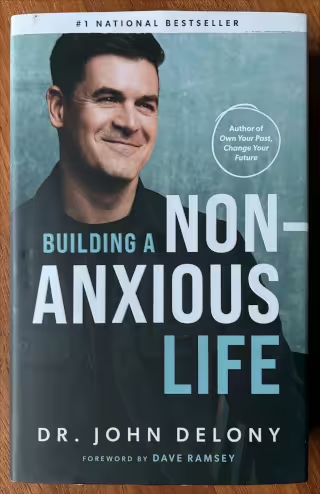 Building a Non-Anxious Life by John Delony, 2023
283 pages. Ramsey Press; 4th printing.
ISBN 979-8-887820-01-9
Being a habitual saver, I've always liked Dave Ramsey's take on debt, saving and investing. My wife listens to his podcasts all the time, and turned me on to another Ramsey contributor, Dr. John Delony, whose training and background is in psychology. He has a call-in show where people ask mostly for relationship, family, and mental health advice. He gives, in my opinion, pretty good answers and has a lot of real-world experience with what works. While tuning in, I kept hearing about this new book he'd written about anxiety and how to get on top of it, so to speak. I went ahead and ordered it from Amazon, and it arrived, like, the next day.
Like many self-help books, it's an easy read. Even being a slow reader (I hear the words in my head), I knocked it out in a couple of days. It has a lot of good advice on how to get your finances, relationships, fitness, and faith on track. But I couldn't help but feel that it was a bit of a bait-and-switch. Here's what I mean: I was expecting insights into the nature of anxiety and how to combat it directly, but the book essentially zeroed in on reasons for anxiety, and how to correct those. It tacitly stipulates that anxiety is appropriate in a given situation, and can most effectively be addressed by fixing the anxiety-producing circumstance. It is essentially silent on what to do with anxiety about things that aren't particularly worthy of it. These can be anything from neurotic worries to ruminating over potential threats to panicking over minor incidents. I've seen (and experienced) some of these myself, and was hoping for practical advice on handling them.
I can recommend the book for someone who is anxious about real problems, who wants to fix their circumstances in order to give themselves space to relax and have resources available for the inevitable troubles in life. But for someone with free-standing anxiety, it may not be of much help. Recommended with this caveat.
8-Feb-2026
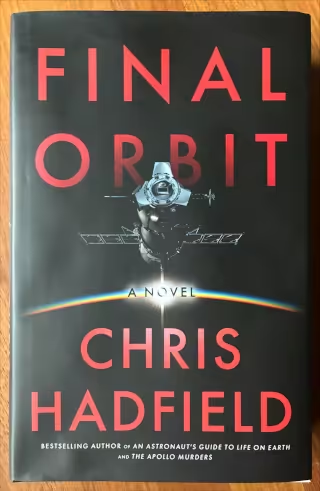 Final Orbit by Chris Hadfield, 2025
407 pages. Little, Brown and Company; first hardback edition.
ISBN 978-0-316-58168-4
Written by someone who was there, and knew a lot of the players in the reality of the Apollo, Soyuz, and Skylab era of the early 1970s, this alternate history is plausible enough to accept, and taut enough to engage. It reads a bit like a faster-paced Tom Clancy — a generic thriller that balances several interacting storylines in Houston, China, and low earth orbit. I recognized a lot of the history, having been interested in space travel as a child at the time, and also some places where it had departed. The female lead, a Soviet cosmonaut, had clearly been involved in other fictional events in a prior book, and walked on the moon with Apollo astronauts. But once I figured that out, I settled back in to enjoy the (now firmly alternative) storyline. While technically solid, the story does get a little loose in places, with certain events not explained well enough to be clearly comprehensible. It's unclear why the Chinese try to detain (but not interrogate or kill) the primary capsule commander for the Apollo-Soyuz mission, or how a spoofed Soviet launch of an anti-satellite missile is meant to facilitate the theft of American particle beam technology from orbit. I'd have to re-read it with hindsight, I think, to follow some of these threads, but I find I don't really care to. Walking the balance between making the plot pleasantly surprising and sandbagging the reader with seemingly random events is tough, and Hadfield unfortunately doesn't do the best job, seeming to err on the side of surprise over clarity. The best instances I've seen of managing this seem to involve distraction and misdirection, rather than obscurity: in the end you see what makes perfect sense, but you never considered because you were so intent on a different train of thought. While I can't say I can do any better than Hadfield, I found myself wanting more from a multiple best-selling author. Not recommended except for immersion in the 1970s space program vibe.
5-Feb-2026
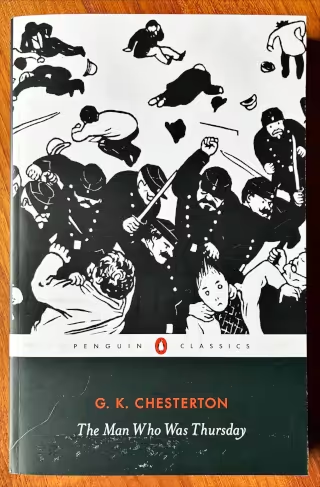 The Man Who Was Thursday: A Nightmare by
G. K.
Chesterton, 1908
The Man Who Was Thursday: A Nightmare by
G. K.
Chesterton, 1908181 pages. Penguin Classics; 2011 trade printing.
ISBN 978-0-141-19146-1
Finished The Man Who Was Thursday: A Nightmare tonight, including the (postponed) publisher's preface which contained spoilers. I'm glad Penguin put the warning at the top and I got to come at it "clean". I anticipated some of the revelations, but the final form they took was, as is fitting a nightmare, completely unexpected — a bolt from the blue, so to speak. I confess I kept trying to figure out whether and what the allegory was, and trying on different alternatives went from enjoyable to somewhat tiresome. I suggest the reader just take it as it is, again like a dream, and wait to the end to attempt interpretations. It's a short, quite enjoyable read. The prose is colorful and witty, the dialog often a bit silly, and the tension very real. You get the sense that anything can happen, and share the protagonist's anxiety at this realization. Definitely a book worthy of multiple readings. Recommended.
3-Feb-2026
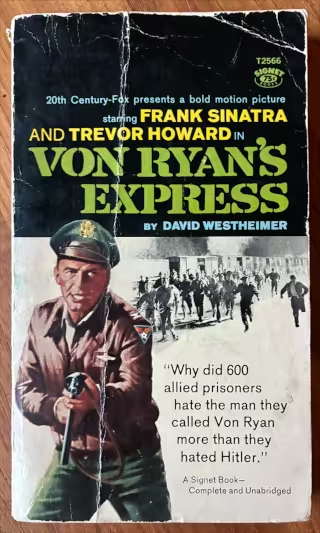 Von Ryan's Express by David Westheimer, 1964
255 pages. Signet; fifth paperback printing.
No ISBN
A fun, compelling tale of Joseph Ryan, a USAAF colonel, sent to an Italian POW camp. As the ranking officer, he takes charge of a slovenly, disorganized, undisciplined combined unit of American and British officers (and a few Other Rank enlisted men), becoming instantly unpopular for his insistence on discipline and order. In direct contradiction of the British lieutenant colonel formerly in charge, he mandates the men show respect to officers on both sides of the fence, and parlays this into concessions from the camp commandant, also a colonel. These include full Red Cross rations, uniforms, and reciprocal respect for Allied officers by camp staff. But his nearly 1000 men are used to slacking off and haranguing their captors, and resent having to shave, clean, and form up in ranks for inspection. Just about this time, the Italians surrender, and things get messy. No one has any orders regarding what this means for the camp. They can't release Allied combatants into what is still a war zone — German troops still operate in the Italian theater. The Allies, and most of the Italians, don't want to let Germany know there are a thousand Allied POWs in a lightly-guarded camp, so they lay low. But eventually, the Germans capture the camp and load the prisoners in boxcars for transport to Germany. Ryan comes up with a daring plan to take the train and escape.
The characterizations are strong and you get a good feel for the social dynamics in the POW camp. Ryan is an unimpeachably dedicated hard-ass, with immense personal dignity, who gives his best and expects the same from everyone else. This is apparent from the opening pages, when he, a captured enemy airman, berates the guard of his soon-to-be prison for his slovenly dress and general lack of discipline. He takes charge of the camp immediately, without regard to how things have settled prior to his arrival. He knows his duty, and the duty of his captors, and pursues these doggedly, despite near-universal dislike. The story is compelling, and only a bit far-fetched. You are really rooting for Ryan to succeed in rescuing his charges, even when they are resisting him. It was made into a movie with Frank Sinatra in the title role — great casting, if you ask me. I have not seen the film, but it's on my watch list if it ever comes up on Amazon Prime. Recommended.
UPDATE: (6-Aug-2026) The motion picture did eventually come up for free on Amazon Prime. I was disappointed. I found it in almost every way inferior to the book, so I'm glad I didn't pay to see it. I expected there would be missing scenes in a two-hour movie, but the plot was altered significantly, almost from the very start. Ryan is not the cocksure officer unwilling to let discipline slide, but is at first deferential and hesitant to take charge. Villains, obstacles, and adversities are changed out for new ones, and the ending is significantly different. The film may be decent in its own right, but it's nowhere near as good as the book.
27-Jan-2026
 Letters to Malcolm: Chiefly on Prayer by
C. S. Lewis, 1963
Letters to Malcolm: Chiefly on Prayer by
C. S. Lewis, 1963124 pages. Harcourt, Brace & World; First American edition.
No ISBN
This was the February selection for the Beaverton C. S. Lewis Society. I had never read it before, and didn't know until someone told me at the meeting that there is no Malcolm. Lewis once again has made verisimilitude an art, and rendered one side of a months-long conversation with a completely fictional correspondent. I assumed he might have added a bit of context here and there to make sure the reader could grasp the gist of what Malcolm had said, but instead it was all invention. Anyway, regardless of its structural qualities, the book is also an excellent investigation into the nature and practice of prayer, from liturgical corporate prayer to closed-door adoration and petition. Lewis is his usual unguarded self, raising and attempting to answer the most troubling and perplexing questions regarding how we address God and whether, when and how He responds. And indeed, how much of our prayer life is just God talking to God with us as the instrument, as the Spirit intercedes for us. But none of it is high-minded theologizing — it is instead a real man talking to his (admittedly imaginary) friend about his real experiences, impressions, and feelings. At just 124 pages, I thought I'd breeze through it, especially when I saw that a lot of them contained only "orphaned" paragraphs at the beginning or end of chapters. But there's so much depth here, I had to read it over twice before attempting to engage with the questions presented for group discussion. Highly recommended if you're up to it.
26-Jan-2026
 The Adventures of Tom Sawyer by Mark Twain, 1876
222 pages. Airmont Books; 1962 paperback edition.
No ISBN
I had never read this as a child, so when it came up in the library-on-a-stick, I grabbed it. It's an easy read (intended, as it is, for youth), but neither as clever nor as offensive as I had been lead to believe. Tom is at times winsomely shrewd, but is more often just lazy and inconsiderate. Societal flaws are on display, but Tom stands firmly within society, rather than judging it from above, so the reader is left to make his own judgements. There are a few instances of "the n-word", but the book does not appear to be the racist holdover I had been lead to expect. It seems instead only to obliquely reference the accepted hierarchies of the time, including those based on race — and these are ancillary to the story. Tom doesn't hate black slaves, but he acknowledges their low estate, just as he recognizes the status of people society favors, like judges and senators. And in a certain sense, he does so innocently — Tom didn't build the institutions and hierarchies, and his complicity is largely (though not entirely) unexamined. If anything, Twain's matter-of-fact presentation encourages the reader to consider how future generations might view unsavory aspects of our own society which we to some degree tolerate. In Tom, we may get a glimpse of Twain's own boyhood, with his nascent tendency to kick against the goads, but also his naïve acceptance of the world he was born into, which he only later came to question. All in all, it is a well-written and engaging book that conveys the outlook and attitudes of boyhood well, only in exaggerated relief for humorous effect. Recommended.
25-Jan-2026
 Dwellers in the Mirage by A. Merritt,
1932
Dwellers in the Mirage by A. Merritt,
1932158 pages. Avon Books; 1944 paperback edition.
No ISBN
Unsurprisingly, this is not a great book. But, while pulpy and lurid, it is at least adventuresome; a lesser example of the kind of books Haggard or Stevenson produced. Leif Langdon, an atavistic Swede, born to small, dark-haired parents but possessed of a massive frame, fair hair and blue eyes, is captured by Mongolian Uighurs who believe he is their long-awaited savior. He discovers they preside over the ruins of a lost civilization, which they hope he will renew by mysterious rites involving a black, tentacled monster he recognizes as the Kraken, but they call Khalk'ru. Leif escapes, but unsure whether his experiences in the Gobi are real or hallucinations, he returns to the West, eventually winding up in a remote region of Alaska with his Cherokee friend Jim. They discover a hidden land underneath a mirage of rocky plain — a tropical paradise beneath the frozen landscape. Both Leif's and Jim's folklore inform their discoveries therein. They contend with miniature natives, fearsome Amazons, and mysterious priests of Khalk'ru. Leif must battle his own genetic memories that threaten to drown his identity in that of Dwayanu, the ancient high priest of Khalk'ru. While the book has interesting elements, its narrative thrust wanders, and it lacks moral clarity. It ends up being little more than a fantastical B-movie plot. Not recommended.
14-Jan-2026
 Mistress of Mistresses by
E. R. Eddison; 1935
Mistress of Mistresses by
E. R. Eddison; 1935401 pages. Del Rey Books; 1978 paperback 4th printing.
ISBN: 0-345-27220-X
The Zimiamvian Trilogy: #1
Like The Worm Ouroboros, this book is written in Jacobean English, with frequent ancillary clauses, long and descriptive, interspersed within the narrative. I found it difficult to read under good conditions, and nigh impossible when distracted, even by my own internal dialogue. It also demands a good deal of attention to follow the story, which can shift between reality and realms of dream or magic. Also, the characters are many and variously referenced: by title, name, or relation. There are many references to Greek and other poetry (Sappho being the most frequent), but most of the foreign-language content comes with a translation (except French for some reason). But even with all these caveats, the book holds one's attention: why is Lessingham in league with such a rogue as the Vicar? What is his connection with Duke Barganax and Fiorinda, or Queen Antiope? What is the nature of Doctor Vandermast's seemingly extra-planar cottage, and why are nymphs and fey creatures his frequent companions? Alas, the answers to these questions are only hinted at in this first volume, though the author states explicitly (on the back cover) that this is a world created by Aphrodite for her Lover. It may well be that she inhabits both Fiorinda and Antiope, and her Lover both Barganax and Lessingham. Perhaps the rest of the trilogy will tell. Recommended, but with serious caveats.
9-Jan-2026
 The Silver Chair by C. S. Lewis,
1953
The Silver Chair by C. S. Lewis,
1953217 pages. Collier Books; 1970 paperback edition, 40th printing.
ISBN: 0-02-044250-5
Book 4 of the Chronicles of Narnia
I re-read this classic for the C. S. Lewis Society of Beaverton January 2026 meeting. I was struck by how plainspoken and accessible it is (being a children's book) while simultaneously conveying such profound concepts. For example, when the children hear they are to be welcomed to a feast by the Gentle Giants, they not only forget their duty, but become even more discontented with their surroundings and each other. Anticipating comfort distracts from both duty and present enjoyment. When the witch tries to enchant them all into disbelieving in Narnia, or anyplace other than the Underworld, their own concept of something better is what convinces them she's wrong. This is a potent illustration of the notion that our own material experience is merely a shadow or copy of the Reality we all long for, and indeed were made for. Throughout the book, death is portrayed as a journey from these shadow-lands into Aslan's Country, where everything (including us) is perfected. The children "muff" most of the signs given to them by Aslan, typically by being lazy or distracted, yet they still succeed in their quest (though perhaps with additional troubles) once they resolve to follow them. It's also notable that to follow the final sign and keep their word to Aslan, they must break their word to one another and release the Knight: there are levels of loyalty, which can come into conflict. Definitely recommended for both children and adults.